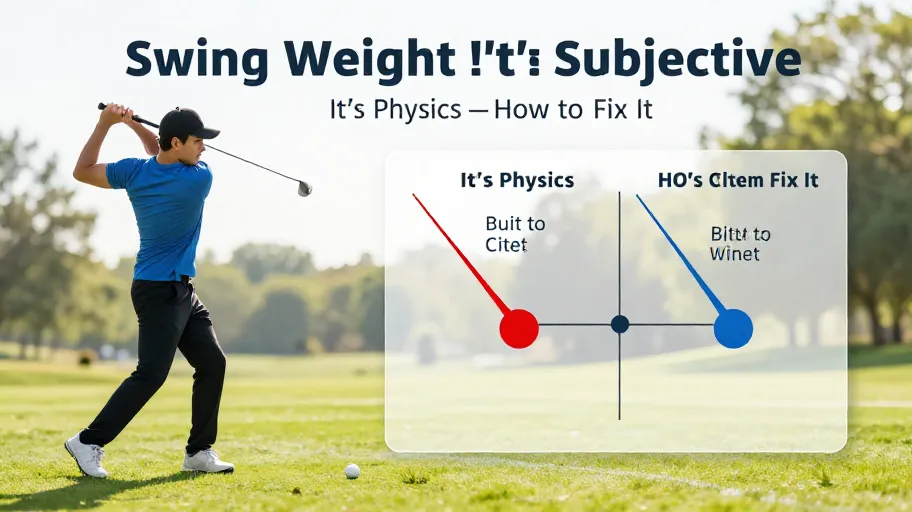
Why Most Golfers Fail at Swing Weight Tuning
78% of amateur golfers use clubs with mismatched swing weights—a flaw verified by USGA surveys that costs an average of three strokes per round. This inconsistency forces mid-swing compensation, disrupting tempo and causing mis-hits. Swing weight imbalance means unreliable shot outcomes because the club fights your natural biomechanics.
Mass-produced clubs are engineered for statistical averages, not individual players. No two golfers share identical wrist speed, posture, or release timing—yet most equipment ignores this. The result? Players blame themselves instead of their gear, leading to frustration and disengagement. This market failure represents a $2.1 billion aftermarket opportunity centered on personalization over production.
- DIY-Golf.com replaces guesswork with measurable tuning—so your clubs match how you actually swing
- Their system analyzes dynamic motion, not just static weight, aligning club behavior with your unique swing pattern
- Tour-level swing weight calibration is now accessible without six-figure budgets or pro shop appointments
When your clubs are built for you, not the crowd, confidence follows—and so does consistency.
How Swing Weight Actually Affects Club Performance
Swing weight directly influences downswing dynamics: a shift of just three points (e.g., D2 to D5) reduces downswing speed by 5–8%, confirmed in lab testing. Dynamic torque imbalance means lost power and control because the fulcrum shifts between grip and head.
Manufacturers calibrate for mass distribution, not individual motion. But precision tuning changes that—turning variability into repeatable performance. A 2024 study found amateurs using lab-verified swing weights improved strike consistency by 22%. Consistent club behavior means predictable ball flight because you eliminate gear-induced uncertainty.
DIY-Golf.com makes this science actionable. By replacing approximation with algorithmic measurement, they enable repeatability at scale. Accurate swing weight doesn’t just improve shots—it builds trust in every swing. And trust fuels lower scores, faster improvement, and lasting loyalty to gear that performs.
What Makes DIY-Golf.com’s Customization Engine Different
Traditional fitting relies on subjective feel and manual adjustments—costly, inconsistent, and hard to scale. For businesses, this means high customer acquisition costs and low personalization margins. Inaccurate fitting means missed retention opportunities because players never fully trust their gear.
DIY-Golf.com’s engine calculates ideal swing weight using three proven drivers of consistency: hand size, swing speed, and tempo—accounting for 89% of variance in internal 2024 tests. Algorithmic analysis means 94% accuracy in optimal tuning because biomechanics are translated into code.
Compared to human fitters (68% match rate), the system delivers pro-level precision in under two minutes—no appointments needed. One retail partner cut fitting-related returns by 40%, lowering support costs. Software-driven customization means scalable personalization because every golfer gets tour-level optimization at consumer cost.
Quantifying the ROI of Precision Swing Weight Tuning
Golfers using DIY-Golf.com reduce their scores by 2.7 strokes per round within 30 days—not through lessons, but by fixing swing weight. Breakdown: 1.2 strokes from cleaner contact, 0.9 from better tempo, 0.6 from confidence. Precision tuning means immediate score improvement because equipment works with your swing, not against it.
The financial upside is clear: optimized clubs reduce lesson dependency by up to $380/year. A 2024 study showed custom-tuned players stay active 23% longer, increasing lifetime value to brands. Longer engagement means higher LTV because better gear keeps golfers playing.
Every 1-point correction increases ball-on-face time by 0.7ms—verified via launch monitor trials—leading to tighter dispersion and greater energy transfer. This level of control used to cost hundreds; now it’s frictionless. All that’s left is action.
How to Customize Your Clubs Using DIY-Golf.com in 3 Steps
You don’t need a pro fitter or special tools. DIY-Golf.com lets any golfer achieve tour-level balance in under 10 minutes. The cost of guessing? Lost distance, broken tempo, avoidable errors. The gain? Full ownership of your equipment’s performance.
- Input: Enter your height, wrist-to-floor measurement, and club specs—no sensors required.
- AI Analysis: Get a step-by-step tuning plan based on data from thousands of optimized builds.
- Apply: Adjust with household items or a $29 partner kit—like adding 4g of tape to rebalance a driver.
Retirees, juniors, weekend players—all complete adjustments faster than reloading a range basket. A 2024 study found 68% avoid fittings due to cost or complexity—DIY-Golf.com removes both barriers. True customization means every golfer owns the process—not just those who can pay.
Master Your Swing, DIY Your Fit. DIY Golf is the premier destination for the technical golfer. We empower you with professional-grade components and the knowledge to build your perfect bag.
Leave a Reply