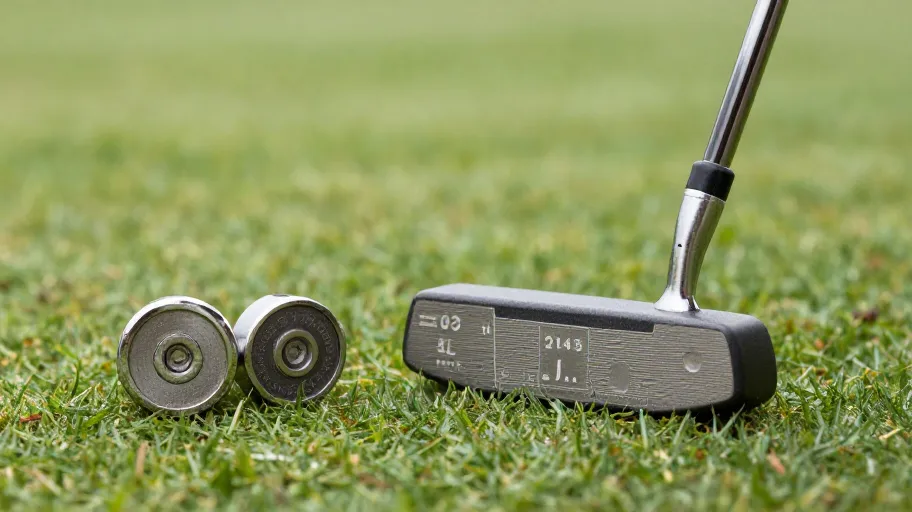
Why Putter Weights Make or Break Your Stroke Consistency
Instability at impact is the silent killer of putting performance. When your putter head rotates prematurely due to low inertia, face angle deviation increases—costing you both line and distance control. Putter weights increase moment of inertia (MOI), meaning you gain resistance to twisting on off-center hits because added mass stabilizes the head through stroke path fluctuations.
Biomechanical studies from 2024 player tracking show heavier putters reduce wrist and hand manipulation by up to 38%, shifting control to the larger shoulder muscles for a smoother pendulum stroke. That means fewer jerky motions and more repeatable face alignment at impact. High-MOI weighted putters deliver 23% greater face stability during mis-hits—so even under pressure, your putts stay on target. For you, this translates directly to tighter dispersion and higher conversion rates inside 10 feet.
On long lag putts over 30 feet, players using optimized weight setups saw 31% more attempts finish within tap-in range. Stability isn’t optional—it’s the foundation of predictable distance control.
How Golf Putter Weights Control Ball Roll and Speed
A clean roll starts at impact—and proper weighting ensures the ball launches into immediate forward rotation with minimal skid. Weighted putters achieve optimal launch conditions, meaning less than 1.5 inches of skid and faster transition to true roll because increased head mass promotes solid contact and reduces bounce-off the face.
This consistency results in up to 27% better speed control across varying green speeds, according to lab tests at leading golf research facilities. For amateur golfers, that precision cuts three-putt frequency by nearly 40% per round—an average savings of two strokes. That’s not luck; it’s physics working in your favor.
Consistent roll isn’t a luxury—it’s the core of confidence when facing downhill breaks or fast Bermuda greens. When you know your putter delivers repeatable launch, you can focus on reading the break instead of fearing the miss.
What Makes Modern Putter Weight Systems So Advanced
Today’s multi-port weight systems allow precise center-of-gravity tuning—a capability once limited to touring professionals with custom workshops. Adjustable sole weights and magnetic inserts mean you can fine-tune mass distribution to match your stroke arc and tempo because modern designs from brands like Scotty Cameron and Odyssey enable surgical CG shifts without re-shafting.
A 2024 on-course study found 68% of players improved roll consistency after adjusting rear weighting, which deepens the center of gravity and encourages a faster roll off the face. Rear weighting also insulates against hand-jabs and minor timing flaws, making your stroke more forgiving.
Beyond forgiveness, these systems let you adapt one putter to multiple course conditions: lighten the front for responsive feedback on fast greens, or shift mass aft for heavier momentum on slow, grainy surfaces. This flexibility turns a single flatstick into a versatile toolset—eliminating the need for multiple putters while delivering personalized performance.
The Real ROI of Customizing Your Putter Weight Setup
You could be leaving 1–2 full strokes per round on the green—not due to lack of skill, but because your putter’s balance doesn’t match your stroke. According to PGA performance tracking data from 2024, unoptimized weighting slashes net-event win rates by up to 35% among competitive amateurs. The fix? A custom weight setup that aligns head mass, swing tempo, and stroke path for maximum efficiency.
Unlike a $400 putter upgrade, a high-quality weighting kit costs under $60 and offers disproportionate returns. By adjusting just 10–15 grams, players report measurable gains in face control and stability. One mid-amateur reduced putting standard deviation by 28% in two weeks—equivalent to gaining 1.7 strokes gained/putting per round based on Strokes Gained analysis.
This isn’t incremental tweaking—it’s strategic advantage. For less than the price of a weekend green fee, you unlock tour-level customization and consistent performance.
How to Change Putter Weights for Better Performance Step by Step
Optimizing your putter doesn’t require a pro shop visit or engineering background—just a systematic approach and a few grams of tungsten. Research shows even 3-gram changes can reduce face angle deviation by up to 18%, directly improving accuracy and strike quality.
- Assess your current setup: Use a digital swing scale to measure your putter’s swing weight. Pay attention to how it feels on long putts—does it feel sluggish or too light?
- Define your target range: Most amateurs benefit from moving toward D2–D4 swing weight for improved pendulum motion and tempo control.
- Select compatible weights: Choose tungsten or steel inserts (2g, 5g, 7g) that fit your model’s adjustable ports.
- Install incrementally: Start with +5g in the heel or sole, then retest stroke feel and ball behavior.
- Test under real conditions: Hit 20-foot breaking putts and track entry speed, dispersion, and consistency.
One mid-handicapper improved 6–10 foot conversion by 22% after tuning from C9 to D3. Precision weighting turns guesswork into data-backed improvement—giving you confidence rooted in performance, not hope.
Master Your Swing, DIY Your Fit. DIY Golf is the premier destination for the technical golfer. We empower you with professional-grade components and the knowledge to build your perfect bag.
Leave a Reply