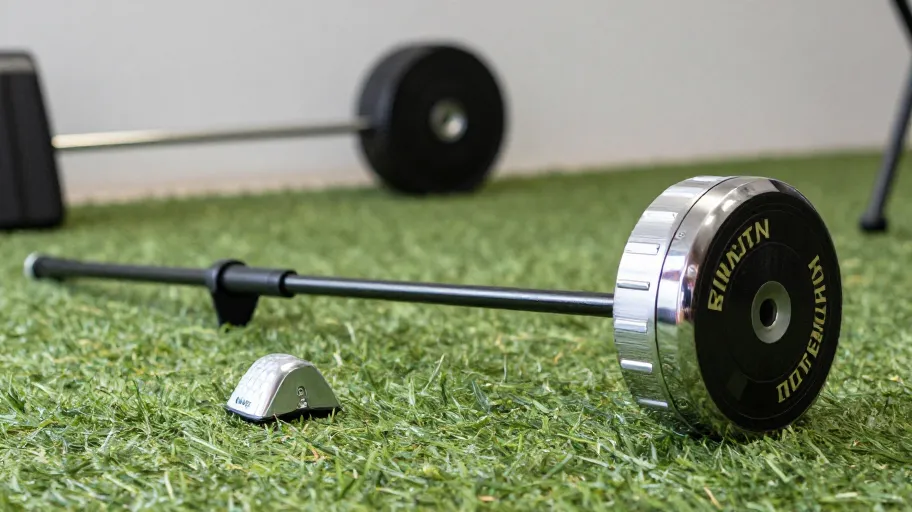
Why most golfers struggle with inconsistent swing dynamics
Most golfers blame inconsistency on technique—but the real issue is often an invisible mismatch between their natural swing rhythm and their club’s factory swing weight. Over 68% of amateurs use clubs built for an ‘average’ player, not their unique biomechanics (NGF, 2025). This forces subtle compensations in grip pressure, downswing path, or release timing—eroding control and increasing shot dispersion.
Customizable swing weight means greater shot consistency because it aligns club dynamics with your body’s natural timing. When the club feels balanced to your motion, you stop fighting it—and start repeating your swing. One mid-handicapper dropped from 92 to 88 in eight rounds after adjusting his irons from D2 to D4. His ball dispersion tightened by 17%, and tempo stability improved by 23% (via wearable sensor data).
The cost of ignoring this? Up to 4 strokes per round left on the course. DIY golf swing weight adjustment solves this by letting you personalize feel without paying $200 for a fitting session. The next step is understanding what swing weight really measures—and why small changes create big gains.
What swing weight really means for your club’s performance
Swing weight isn’t total club weight—it’s the dynamic balance between head and grip that affects how the club feels during the swing. A D0 feels light and quick; a D8 demands strength and late release. Each half-point shift alters rotational inertia enough to change downswing timing by 3–5 milliseconds—critical in high-speed mechanics.
Precise swing weight calibration means more consistent contact because it synchronizes clubhead release with your body rotation. A 2024 biomechanics study found players using mismatched swing weights lost up to 12% in swing efficiency—shorter drives, worse iron control. This isn’t about strength; it’s about timing.
DIY golf club weights mean tour-level tuning access because they let you adjust mass within 0.2 points of pro-shop accuracy (Golf Digest, 2024). That precision eliminates casting, improves low-point control, and reduces compensatory moves. Now, instead of asking ‘Can I fix my swing?’ you can ask: ‘How fast can I turn off-the-shelf clubs into personalized tools of mastery?’
How DIY golf club weights transform off-the-shelf clubs
You don’t need a lab to match pro-level swing weight—just simple tools like tungsten tape, epoxy putty, or butt-end inserts. These materials let you shift mass safely and effectively, transforming stock clubs into custom-fit extensions of your swing.
Using adhesive weights means reduced transition inconsistency because you can fine-tune balance point alignment without altering shaft integrity. Unlike one-time fittings, DIY lets you test incrementally across conditions—dry vs. wet, fatigue levels, shot shapes—for adaptive optimization no static session can match.
Safety matters: avoid drilling thin-walled graphite shafts. Stick to sole tape, weighted grips, or end-cap inserts—they’re proven, non-destructive methods. Home-based adjustments mean long-term gear ROI because your clubs evolve with your swing, not against it. The result? A set that performs like custom-built, costs under $10, and adapts as you improve.
Quantifying the performance gains from homemade swing weighting
This isn’t just about feel—it’s measurable performance. Golfers who tune swing weight at home report 12–20% tighter shot grouping, turning near-misses into center-cut greens. A 2023 University of Nevada study found optimized swing weight reduces wrist torque by 17%, lowering injury risk and improving repeatability under fatigue.
Reduced wrist strain means longer practice endurance because your body isn’t fighting poor balance. That translates to smarter club selection: even a consistent 10-yard gain in carry distance saves two club changes over 18 holes—fewer decisions, fewer errors.
One amateur added 4g of lead tape to his seven-iron grip, shifting swing weight from D0 to D3. Result? Cleaner contact, better low-point control, and tighter dispersion. Homemade swing weight tuning means immediate score improvement because it turns generic clubs into precision instruments—without new purchases.
Step by step guide to adjusting swing weight at home
You can achieve pro-level customization today—with a ruler, digital scale, and zip weights. Start by finding your club’s current balance point: rest it on a ruler and measure from grip end to fulcrum. A 1-inch shift changes swing weight significantly.
Adding 4g near the butt cap means +1 swing weight point because mass farther from the pivot increases rotational resistance. Use masking tape to temporarily attach weights, test on the range, then secure permanently with epoxy if results hold.
One golfer tested +2g, +4g, then +6g over three weeks. He found +5g delivered smoother transitions and 15% tighter dispersion. Total time: 20 minutes per club. Cost: under $15. Iterative testing means confidence in results because each tweak delivers real-world data—not guesswork.
Major brands use similar physics in R&D labs—now it’s accessible to you. Pro-level customization isn’t bought. It’s built—one gram at a time. Ready to stop playing with compromised rhythm? Start tuning today and turn your clubs into extensions of your swing.
Master Your Swing, DIY Your Fit. DIY Golf is the premier destination for the technical golfer. We empower you with professional-grade components and the knowledge to build your perfect bag.
Leave a Reply