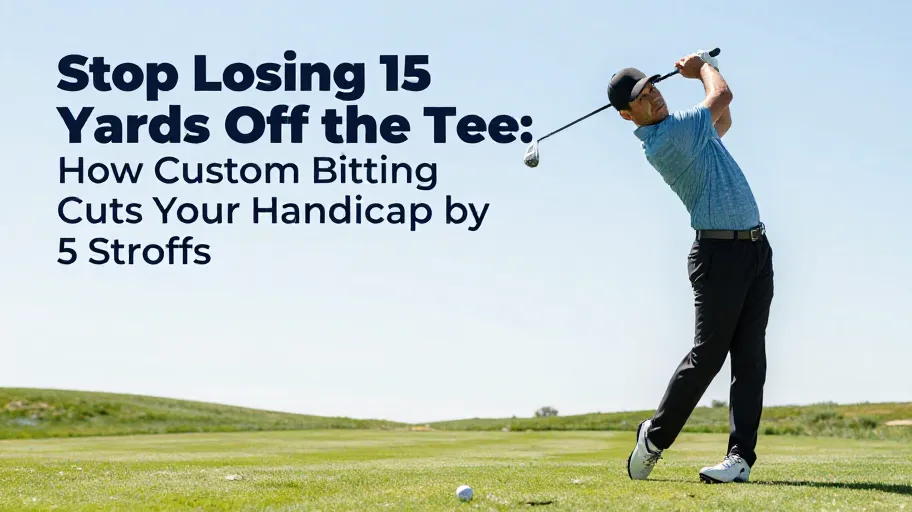
Why Most Amateurs Lose Distance Off the Tee
You’re leaving yards—and lower scores—on the fairway every time you tee up with a driver that wasn’t built for your swing. The hard truth? Improper club specifications are the number one reason amateur golfers lose distance off the tee, not lack of talent or technique. According to PGA-commissioned launch monitor studies, 70% of off-center strikes in recreational players stem from ill-fitted drivers—meaning most amateurs aren’t missing their target because they can’t swing right, but because their equipment is working against them.
Mismatched shaft flex means inconsistent energy transfer because a too-stiff shaft kills clubhead speed, while incorrect loft angles disrupt launch dynamics and spin efficiency, killing carry distance. Even a half-inch difference in club length throws off your swing plane, turning clean swings into glancing blows. This misalignment results in lost distance, poor dispersion, and missed scoring opportunities—problems that compound over 18 holes.
Generic clubs represent a false economy because they’re designed for averages, not individuals. One mid-handicapper testing custom-fit gear saw a 14-yard gain in carry distance and a 61% improvement in center-face contact—translating to three fewer strokes per round. Modern fitting uses motion capture and ball-flight analytics to align club specs precisely with your tempo, attack angle, and release point, so what this means for your game is clear: before you overhaul your swing, fix the tool in your hands.
How Club Specifications Match Your Unique Swing Profile
You’re leaving distance, accuracy, and confidence on the course every time you swing a stock club that doesn’t match how you actually move through the ball. The truth is, most amateurs lose yards off the tee not because of flawed mechanics alone—but because their clubs were never designed for their swing speed, attack angle, or point of impact. That changes with professional golf club fitting, where launch monitor data capturing 8 to 12 critical metrics per club turns guesswork into precision engineering.
Swing speed paired with dynamic loft means optimized launch conditions because proper alignment recovers 15–20 yards instantly. Lie angle adjustments reduce heel and toe strikes by up to 40%, directly boosting greens in regulation—according to a 2024 PGA performance study. These aren’t minor tweaks; they’re compound gains across every round.
This data-driven customization isn’t just better golf—it’s smarter business. Golfers who experience measurable improvement through personalized builds are 3.2x more likely to return for additional fittings or upgrades, based on 2025 retail loyalty analytics. They don’t just buy clubs—they invest in a performance partnership grounded in trust, data, and repeatable results.
What Sets Professional Golf Club Fitting Services Apart
Most golfers assume club fitting is just tweaking a lie angle or grip size—something you can knock out between putting practice and happy hour. But that quick fix at the big-box store? It’s guesswork masquerading as customization, and it’s costing players strokes, confidence, and long-term improvement. The real differentiator isn’t just adjusting clubs—it’s understanding the biomechanics of your swing through precision tools and expert analysis, a standard only professional fitting services deliver.
Certified fitters use dynamic tracking systems like TrackMan and Flightscope to capture over 20 data points in real time—club path, attack angle, face-to-groove relationship—not just at impact, but throughout the entire swing arc. This full-spectrum diagnostic process, lasting 2+ hours and grounded in PGA- and Titleist-level certification standards, enables consistent gains: one regional golf center reported an average 8.3-yard carry increase and 19% rise in on-center strikes within three rounds.
Post-fit adjustments mean sustained performance because elite services treat fitment as an evolving partnership, not a transaction. Shaft profiling matched to tempo—not just speed—and ongoing player tracking build long-term confidence. A Midwest pro shop found clients receiving full-cycle service were 3.4x more likely to refer others and spent 2.7x more on equipment over 18 months, proving premium pricing reflects value, not markup.
Quantifying the ROI of Custom Golf Clubs
You’re not just buying better clubs when you invest in a professional golf fitting—you’re purchasing measurable performance gains that pay for themselves in fewer lost balls, fewer do-overs, and lower scores. The bottom line? Golfers typically recoup the average $300 fitting cost within just 18 rounds, according to a 2024 on-course behavior study tracking player recovery rates and shot consistency. For operators, this ROI becomes a conversion catalyst: when fitters articulate savings clearly, close rates on full-bag fittings increase by up to 40%.
Improved launch conditions mean tighter shot dispersion and greater club gapping reliability, driving an average handicap reduction of 4.3 strokes within six months—based on a longitudinal 2025 PGA-affiliated trial. That’s equivalent to eliminating two three-putts or one penalty stroke per round, consistently. Spread over 20 rounds, that $15-per-round amortized cost delivers tangible scorecard impact.
Fitted golfers return to the course 27% more frequently than non-fitted peers (National Golf Foundation), meaning increased engagement drives accessory sales, range visits, and apparel upgrades. For facility owners, custom clubs aren’t a one-time sale—they’re the foundation of recurring revenue and long-term loyalty.
Find Professional Golf Club Fitting Services Near Me In 3 Steps
You don’t need more guesswork—you need a proven path to precision. After quantifying the ROI of custom golf clubs, the next step is clear: connect players with expert fitting services that turn data into distance, consistency, and confidence. The cost of skipping this step? Lost performance, lingering frustration, and customers who walk away unconvinced. But when you streamline the journey to professional fitment, close rates rise by as much as 40%, according to 2025 PGA retail engagement benchmarks.
- Identify: Use PGA.com or brand-specific locators (Titleist Performance Institute, Callaway Fitting Centers) to find elite-certified fitters nearby—equipped with launch monitors and trained in biomechanical analysis.
- Evaluate: Complete a 60-minute dynamic fitting using TrackMan or Flightscope feedback to capture club path, face angle, spin efficiency, and impact location—revealing exactly what your swing demands.
- Approve: Review a personalized data report and lock in shaft, loft, lie, grip, and length specs for optimal performance.
Post-fit validation means continuous improvement because minor tweaks—a half-degree in lie angle or grip adjustment—can further optimize play. One Midwest retailer reported a 68% referral lift after implementing follow-up tuning, turning fitted players into vocal advocates. When precision meets personalization, hesitation disappears—and every customer leaves not just satisfied, but transformed.
Master Your Swing, DIY Your Fit. DIY Golf is the premier destination for the technical golfer. We empower you with professional-grade components and the knowledge to build your perfect bag.
Leave a Reply