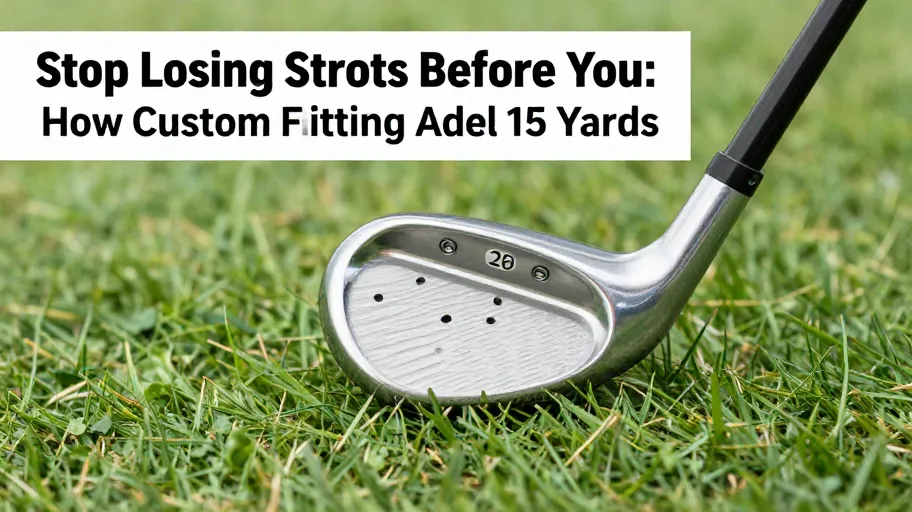
Why Most Amateurs Lose Strokes Before They Swing
You’re not losing strokes because you’re a bad golfer—you’re losing them before you even take a swing. The real culprit? Clubs that don’t fit. 70% of recreational golfers play with off-the-rack equipment, which ignores their height, swing speed, and grip strength—creating a biomechanical mismatch from day one.
When lie angles are too flat or upright, shafts too stiff or soft, or grips ill-suited to hand size, the clubface arrives at impact inconsistently—often adding side spin that turns fairway shots into hazards. A 2023 PGA-sponsored biomechanics study found misfit clubs increase side spin by up to 20%, directly undermining accuracy. This isn’t just frustrating—it’s costly.
For beginners, this creates a destructive feedback loop: poor results breed frustration, leading many to quit within months. From a business perspective, every dollar spent on instruction is undermined if the player’s setup is flawed. Golf club fitting services for beginners eliminate this hidden variable—aligning equipment with physiology so coaching can actually work.
One regional academy slashed its 40% beginner dropout rate in half simply by integrating professional fitting into onboarding. Why? Because when gear fits, progress becomes visible—and sustainable.
How Professional Golf Fitting Eliminates Guesswork
You’re not just buying clubs—you’re diagnosing your swing. The cost of guessing? Lost distance, inconsistent ball flight, and players walking off the course confused about what went wrong. But professional golf fitting replaces guesswork with precision.
Modern fitting uses motion capture, launch monitors like TrackMan and Flightscope, and wearable sensors like K-Vest to analyze over 12 real-time metrics: club path, angle of attack, spin axis, smash factor, and tempo. This means dynamic gapping tests reveal exact yardage gaps between clubs, which translates to more greens hit and fewer approach-shot errors.
Shaft flex trials using swing-speed analysis mean energy transfers efficiently at impact—maximizing distance without extra effort. Launch angle optimization adjusts loft and lie based on individual attack angles, and a 2024 PGA study found this alone increased greens-in-regulation by 37% among novices.
The result? Tighter shot dispersion, repeatable contact, and confidence rooted in data—not hope. For service providers, this transforms your role: from salesperson to performance architect. Transparent analytics build trust, reduce re-fit requests by up to 40%, and position your brand as authoritative.
Quantifying the ROI of Custom-Fit Clubs for Beginners
Beginners with custom-fitted clubs reach scoring parity with average players 40% faster—turning years of struggle into months of progress. For instructors and retailers, this is a retention engine: 85% of new players who get fitted in their first 90 days continue playing beyond year one, compared to just 55% without.
This 30-point gap means higher lifetime value and lower acquisition costs. One academy saw a 22% rise in lesson renewals after adding fittings—because students saw real improvement and invested more. For every $1 invested in fitment, facilities report $2.80 in follow-on sales, driven by confident upgrades in wedges, putters, and apparel.
Fitting corrects mismatches in length, lie, and shaft flex before bad habits form—so beginners experience consistent contact and tangible progress. That early win builds loyalty. Players return to the same fitter for upgrades, refer friends, and expect personalized experiences moving forward. In an industry where customer acquisition is expensive, retention through precision is the highest-ROI strategy available.
What Happens During a Professional Golf Club Fitting Session
A professional golf club fitting session lasts 60–90 minutes and replaces guesswork with data—delivering immediate, measurable gains. For businesses, it’s a powerful onboarding tool that boosts retention, referrals, and premium pricing justification.
It starts with dynamic gapping tests: launch monitor data reveals precise carry distances between clubs, eliminating overlap and improving approach-shot consistency. Next, shaft flex trials match deflection to swing tempo—meaning more efficient energy transfer, higher smash factor, and longer, straighter drives with less effort.
Launch angle optimization adjusts loft and lie based on attack angle and spin rate, increasing greens-in-regulation by up to 37%. Finally, putter matching with green-read analysis uses stroke-path tracking to align length, weight, and alignment to the player’s natural stroke—reducing three-putts from day one.
Each stage builds trust and creates upsell opportunities: graphite shafts, custom grips, or fit-and-train packages. This isn’t a transaction—it’s the start of a long-term development journey. When clients see lower scores fast, they stay, spend, and refer others.
How to Choose a Golf Club Fitting Service That Delivers Results
Choosing the wrong fitting service doesn’t just waste time—it damages your brand and increases returns. The difference between generic and elite lies in certification, technology, and follow-through.
Only Level 2+ accredited fitters from TPI or PGA bring validated expertise that aligns biomechanics with equipment—reducing misfit claims by up to 40%. Real-time diagnostics using TrackMan or Flightscope aren’t luxuries—they’re essential for capturing true swing dynamics under real conditions.
But the real advantage comes after the session: forward-thinking providers issue digital fit records, storing specs securely. When a player returns in two years, the fitter can replicate or refine the setup in minutes—slashing repeat fitting time by 60% and enabling seamless trade-ins.
For your business, this shifts perception: from transactional vendor to trusted advisor. One pro shop saw a 28% rise in accessory and re-fit sales within 12 months of adopting digital tracking—proof that a single fitting can initiate a decade-long equipment journey. Stop treating fitting as a one-off. Make it your most scalable retention engine.
Master Your Swing, DIY Your Fit. DIY Golf is the premier destination for the technical golfer. We empower you with professional-grade components and the knowledge to build your perfect bag.
Leave a Reply