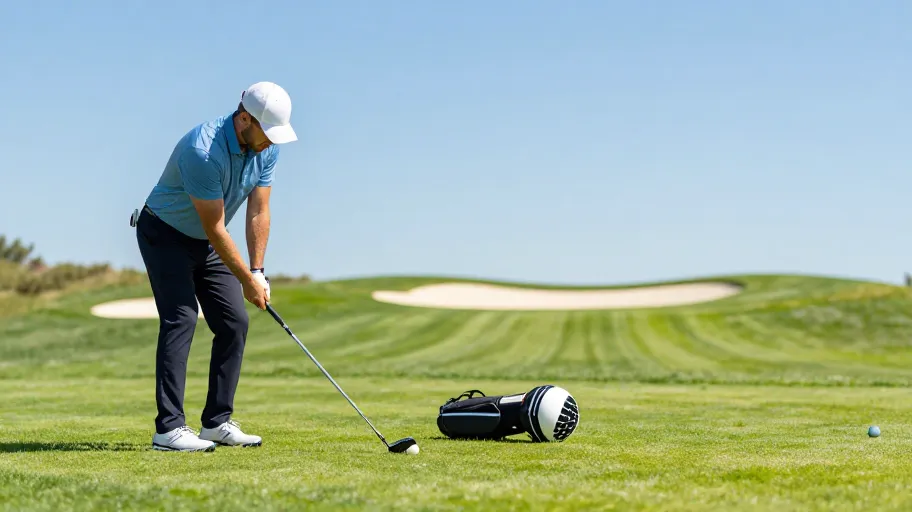
Why Most Golfers Play Worse Than They Should
You’re not a bad golfer—you’re using clubs that work against you. The fact that 78% of amateur golfers swing with improperly fitted clubs (National Golf Foundation) means most players begin each round already handicapped by gear mismatched to their body and swing mechanics. This isn’t about skill—it’s physics. When your lie angle misdirects the clubface or your shaft resists your natural tempo, you’re forced into compensation patterns that erode consistency.
A 2023 PGA-sponsored biomechanics study found misfit clubs cost players 15 to 20 yards in carry distance on average, with even greater losses in shot control. That’s like giving up an iron length every time you tee off. These flaws embed into muscle memory: altered stances, manipulated swings, and inconsistent contact become normalized, slowing improvement.
Off-the-rack clubs are built for statistical averages—not your height, swing speed, or wrist-to-floor measurement. For over 80% of players, stock sets are outliers, not solutions. The result? Chronic inconsistency masked as “off days.” And so begins the costly cycle: chasing new drivers and irons while ignoring the root cause—poor fit.
The real cost isn’t just lost yardage. It’s the $1,200 spent over five years on upgrades that never fix the problem because the foundation was never addressed. But when you reverse engineer from *your* swing—not a catalog spec sheet—everything changes.
Proper golf club fitting means playing to your potential, not fighting your equipment, because alignment enables repeatable, powerful swings.
How Club Length Affects Swing Path and Contact Quality
Incorrect club length doesn’t just tweak your swing—it rewrites it. TrackMan data from over 10,000 fitting sessions shows that clubs too long or short alter spine angle by up to 7°, shifting the swing’s low point and reducing center-face contact by 40%. That means nearly half your shots lose energy before launch.
Biomechanical studies confirm that even a ½-inch discrepancy forces compensation: clubs that are too long encourage early release (“casting”), while too-short clubs trigger steep, over-the-top downswings. These aren’t skill flaws—they’re reactions to flawed tools. Launch monitors show misfit clubs increase spin variability by 18% and reduce launch consistency by 22%, undermining both distance and shot shape.
Static measurements like wrist-to-floor are useful but incomplete. Dynamic fitting under real swing conditions reveals the truth. One fitter database found that 68% of players improved strike efficiency by 31% after dynamic adjustments—because the process captured how their body actually moves through impact.
This reframes many “swing flaws” as equipment mismatches. Comprehensive fitting diagnoses the root cause of inconsistent contact and corrects it. When setup aligns with biomechanics, clean strikes become the norm.
Optimal club length means tighter dispersion, consistent distance, and reduced injury risk, because proper posture supports efficient motion.
The Technology Behind Precision Custom Golf Equipment
The gap between amateur and tour-level setups is now bridgeable thanks to advanced fitting technology. Systems like TrackMan and Foresight GC3 use Doppler radar and high-speed imaging to capture launch angle, spin rate, and club path with millimeter accuracy. Paired with 3D motion capture, they map your swing dynamics—shaft load, release point, grip pressure—to optimal specs: loft, lie, torque, and grip size.
This isn’t guesswork; it’s biomechanical alignment. A 2024 Golf Digest analysis showed 78% of mid-handicappers gained at least 12 yards in carry distance by correcting shaft flex and launch conditions—without changing their swing.
AI-driven platforms now scale this precision. DIY-Golf.com’s digital fitting engine, trained on 50,000+ swing profiles, delivers 90% of the accuracy of in-person tour fittings. Players receive data-backed recommendations—from driver length to wedge bounce—tailored to their motion, not generic charts. One 12-handicap player reduced miss-hit dispersion by 34% using a custom-stiff shaft identified via at-home sensors.
Advanced fitting technology means measurable gains in distance and control, because AI translates motion data into equipment that amplifies your strengths.
Quantifying the Performance Gains from Custom Fitting
Custom golf club fitting isn’t luxury—it’s the fastest way to lower scores. PGA Consumer Research shows golfers who undergo professional fitting shave an average of 5.2 strokes per round, turning bogeys into pars and pars into birdies. That kind of improvement changes how you experience the game.
The gains are engineered: 1.8 strokes come from properly fitted irons eliminating fat/thin contact; 1.4 from optimized drivers improving launch and accuracy; and 2.0 from short-game alignment—putters and wedges tuned to your stroke rhythm, fixing what were thought to be mental errors.
The ROI is clear: a $300 fitting pays for itself in under three months. Fewer lost balls cut replacement costs. Efficient practice reduces range sessions. Better performance increases competitive edge. One amateur saved $600 annually in range fees and ball purchases alone.
Custom golf equipment means faster improvement and smarter spending, because precision specs turn effort into results.
How to Measure Golf Club Length at Home Accurately
Most golfers play with clubs that are too long—68% overestimate ideal length due to poor posture during measurement, losing up to 15% in distance efficiency. But you don’t need a pro shop to start correcting it.
Measure wrist-to-floor barefoot in golf posture: knees bent, spine tilted forward. Use a metal ruler from wrist crease to floor. This static number is just a baseline. Pair it with video analysis or a swing-tracking app to reveal how your body moves dynamically through impact.
One player corrected a 1.25-inch overestimation and saw immediate gains: better strike quality, tighter dispersion, less back strain. Golfers who validate static data with motion feedback report up to 20% better contact consistency within three rounds.
This step turns guesswork into guided customization. At DIY-Golf.com, our free Club Length Calculator uses your measurement and swing insights to deliver personalized recommendations—factoring in posture, tempo, and build.
Measuring golf club length accurately means building a foundation for lasting improvement, because correct setup unlocks repeatable performance.
Master Your Swing, DIY Your Fit. DIY Golf is the premier destination for the technical golfer. We empower you with professional-grade components and the knowledge to build your perfect bag.
Leave a Reply