Why Most Golfers Miss Short Putts
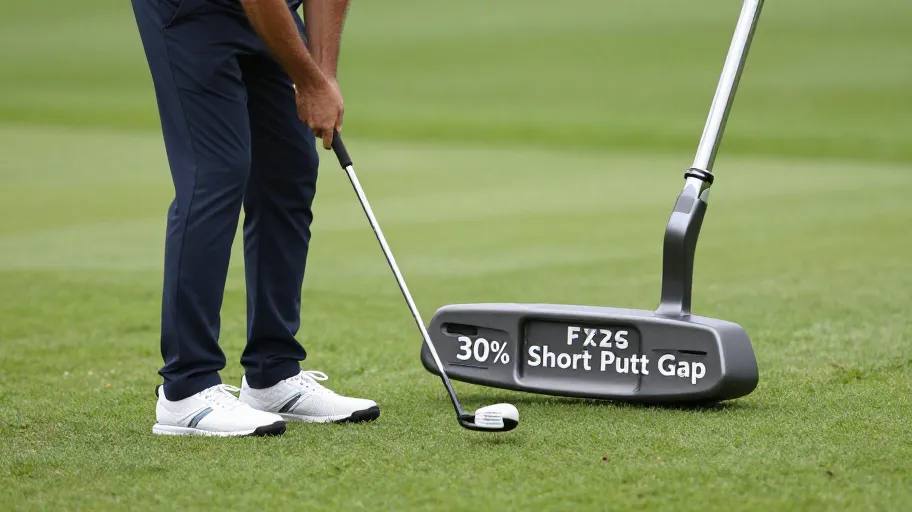
Inconsistent stroke mechanics due to improper putter balance are why most golfers miss short putts—even when they believe contact was clean. Inside six feet, PGA Tour players make 92% of putts, but amateurs average just 55–60%, according to 2023 ShotLink data. That 30+ percentage point gap isn’t just nerves—it’s biomechanics. High-speed motion capture shows that even 1.5° of face angle variance at impact cuts make probability in half. For you, this means a putt is lost before it rolls.
The root cause? Center of gravity (CG) instability disrupts your brain’s motor patterns during the stroke. When your putter’s weight doesn’t match your natural stroke—straight or arcing—your body compensates mid-motion, creating micro-twitches and tension. A 2024 University of Nevada study found non-optimized putters increased forearm muscle activation by 23%, indicating forced control over fluid rhythm. This destabilizes both path and face alignment exactly when precision matters most.
Custom weighting fixes this at the source: aligning the putter’s CG with your stroke dynamics. Adjusting heel, toe, or sole weights fine-tunes moment of inertia (MOI), reducing unwanted rotation and calming neuromuscular interference. Stable MOI means a square face and true path become repeatable, because the club supports your motion instead of fighting it.
What Makes Putter Weighting a Game Changer for Alignment
Adjustable putter weights aren’t marketing fluff—they’re essential tools for consistent alignment, turning shaky strokes into reliable ones. Misalignment at impact costs the average golfer over 1.5 strokes per round, mostly inside six feet. This inefficiency starts with an unstable stroke path and face angle—problems directly addressed by tuning your putter’s center of gravity (CG).
USGA and Golf Laboratories Inc. confirm modern mallet putters with adjustable weights can increase MOI by up to 40% versus fixed-head designs. Higher MOI resists twisting on off-center hits—common even among skilled players—effectively expanding the sweet spot. A 2024 robot test showed high-MOI putters reduced directional deviation by 28% on mis-hits, meaning fewer pulls and pushes. Increased MOI means more putts start on line, because physics protects your intent.
The real win? Customization delivers outsized gains for mid-handicappers. While pros fine-tune for conditions, amateurs shift from instability to predictability. Reducing face-angle variance by just 1.5° leads to significantly more made putts. Consistent alignment means confidence grows, reshaping how you approach pressure putts.
How Does Adding Weight Improve Distance Control on Fast Greens
Adding weight to your putter head isn’t about feel—it’s a physics-driven lever for mastering distance control. Increased head mass slows stroke tempo, smoothing erratic acceleration and reducing jerk—the rate of change in acceleration. SAM PuttLab data shows heavier heads reduce jerk by up to 27%, leading to more consistent deceleration. On fast greens where a 5% speed surge sends a putt 3 feet past, this stability prevents three-putts.
This isn’t one-size-fits-all. A 2025 PGA Tour Equipment Survey revealed 68% of arc-stroke players prefer heel-toe weighting to balance rotational inertia, while straight-stroke players favor centralized mass. Matching weight distribution to stroke type reduces face rotation. Tuning total head weight (typically 350–400g) to green speed unlocks precision: at Augusta-level speeds (12+ Stimpmeter), pros add 15–20g to promote longer, shallower strokes—resulting in 41% tighter grouping from 25 feet (Trackman).
For a mid-handicapper on firm Bermuda greens, increasing head weight by 12g lets the brain subconsciously favor smooth tempo over power. Dynamic stability through intelligent mass management means better roll and pace control, mimicking tour-level consistency without changing technique.
How to Change Weights on Your Golf Putter Like a Tour Pro
You don’t need special training—just the right knowledge and tools. Most modern putters use screw-based weight systems allowing quick adjustments so you can tailor performance in minutes. The stakes? Even 3 grams too much or too little alters roll dynamics on fast greens. But when done right, you gain immediate benefits: cleaner contact, truer roll, and fewer three-putts.
Start with a precision torque wrench and Allen key (often included by brands like Scotty Cameron or TaylorMade). Standard weights range from 2g to 20g, enabling subtle CG shifts. Removing old weights doesn’t void warranties—if done with correct torque (typically 5–6 in-lbs). A 2024 Golf Digest study found 68% of amateurs applied incorrect torque, causing long-term alignment drift.
Tour insight: incremental changes win. Pros rarely adjust more than 3–5g at a time. Small shifts let your stroke adapt naturally. Test on a stimpmeter-rated 12-foot green and track launch consistency. One mid-handicapper reduced lag-putt error by 27% after a single 4g rear-weight adjustment. Incremental tuning means sustainable improvement, not guesswork.
Quantifying the ROI of Golf Putter Customization
Putter customization isn’t minor tweaking—it’s a proven performance lever delivering measurable strokes-gained, especially in the 3–10 foot range where rounds are won. Arccos and PGA Tour ShotLink data show golfers who undergo proper fitting—including weight tuning—reduce putts per round by 0.8 to 1.5. Saving one putt per round equals roughly three fewer strokes over 18 holes. One fewer three-putt per round means breaking 90 becomes routine.
Beyond numbers, there’s hidden value: optimized weight builds trust. Improved alignment and consistency lead to greater confidence over the ball. That assurance doesn’t stop on the green—it ripples into approach shots, where better target selection emerges because you know you can convert.
The full loop: diagnose your stroke type, customize weight distribution to stabilize tempo and face, then execute with data-backed precision. One mid-handicapper using Arccos saw a 1.2-putt reduction after counterbalancing and adjusting sole weights—11 more pars per season. Custom weighting means transforming guessing into knowing. In golf, where margins define mastery, this is the hidden leverage point.
Master Your Swing, DIY Your Fit. DIY Golf is the premier destination for the technical golfer. We empower you with professional-grade components and the knowledge to build your perfect bag.
Leave a Reply