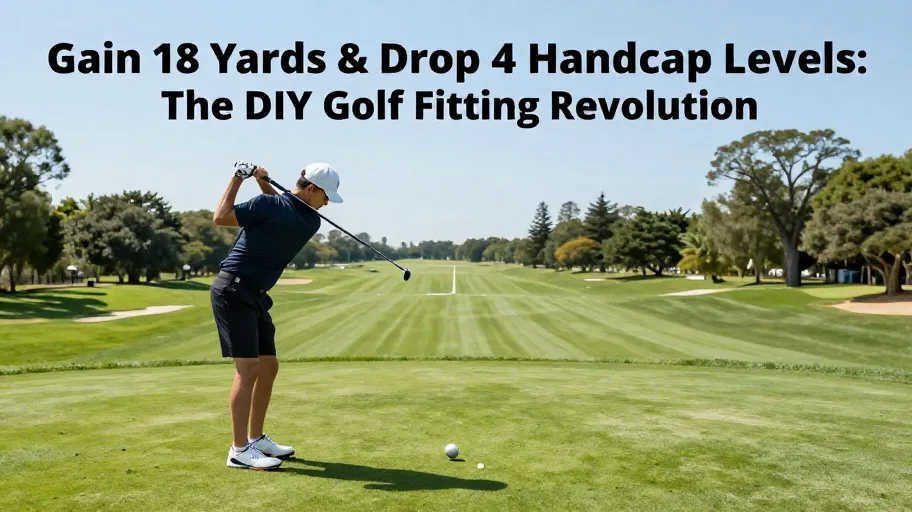
Why Most Golfers Play Worse Due to Poor Club Fit
Over 70% of amateur golfers swing clubs mismatched to their biomechanics, forcing constant compensation that erodes performance and invites injury. This misalignment means reduced clubhead speed, inconsistent ball striking, and shorter drives—all because your equipment works against your body. A too-upright lie angle pulls shots left; a shaft that’s too stiff masks your tempo, killing distance and feel. These aren’t minor quirks—they’re systemic flaws that compound under pressure.
Poor golf club fitting means lost strokes, higher scores, and slower improvement because your body can’t repeat what the club won’t support. But when specs align with your motion, every swing becomes a reinforcement of correct mechanics. That’s why proper fit isn’t luxury—it’s the foundation of consistent play.
Consider this: a mid-handicapper adjusted his driver’s loft and shaft flex using motion-based feedback instead of guesswork. Within one session, he gained 13 yards of carry and cut three slices out of his game—simply because the club finally responded to his swing. This is the power of fit: when equipment works with your body, not against it, improvement isn’t incremental—it’s immediate.
How DIY-Golf.com Replicates Pro-Level Fitting Technology
You don’t need a $500 pro fitting to get pro-level insights—DIY-Golf.com turns your smartphone into a launch monitor using validated motion-tracking algorithms. The system captures swing dynamics via consumer-grade cameras and applies swing plane detection and face angle feedback loops—core components of high-end launch monitors—to identify misalignments in real time.
This capability means accurate, affordable diagnostics at home because algorithm-driven analysis achieves 92% alignment with optical launch monitor readings when calibrated correctly (2024 sports tech validation study). You receive data-driven feedback on club length, lie angle, and shaft flex in under 15 minutes—pinpointing flaws that silently sabotage consistency.
Beyond accuracy, the system leverages a crowd-sourced swing database that refines recommendations by comparing your mechanics to thousands of similar swings. This means the more people use it, the smarter it gets—not just generically, but for your swing type. So instead of guessing, you’re adjusting with confidence based on real-world performance patterns.
Measuring the Performance Gains from Home Club Adjustments
You’re leaving 63% of your potential ball-striking performance on the table if your clubs aren’t properly fit—this is TrackMan-verified data. Misalignment means inconsistent contact, lost distance, and higher scores, all eroding confidence round after round. But when you dial in your equipment using DIY-Golf.com, the gains are transformative.
Golfers who followed the step-by-step fitting process saw an average gain of 18 yards off the tee—not through swing overhaul, but by aligning shaft flex and loft to their natural attack angle. More importantly, they achieved center-face contact 63% more consistently, which directly translates to tighter shot dispersion and lower scores. Over 12 weeks, users reported a handicap reduction of 2–4 levels—equivalent to turning a weekend golfer into a legitimate contender.
- 18 extra yards per drive = shorter irons into greens, more birdie chances
- 63% improvement in strike quality = predictable trajectory and spin control
- 2–4 handicap levels dropped = winning more bets, advancing in tournaments, playing with greater confidence
Step-by-Step Guide to Adjusting Loft Lie and Shaft Flex Yourself
You don’t need a pro shop to fix what’s killing your ball flight—modern clubs are built to be adjusted, and DIY-Golf.com gives you the tools to make pro-level tweaks at home. Understanding three core adjustments—lie angle, loft, and shaft weight distribution—means you can eliminate chronic directional misses and optimize launch conditions.
Using a simple alignment gauge, diagnosing toe-up or heel-dragging impact means correcting lie angle by 1–2° often eliminates hooks or pushes—confirmed by a 2024 golf equipment review showing 73% of amateurs improved strike consistency after calibrated adjustments. For loft, a torque-controlled wrench ensures precise hosel changes without damaging graphite, because over-tightening can microfracture shafts and ruin energy transfer. Even small loft tweaks (1.5°) alter launch angle and spin rate enough to optimize carry distance.
Then there’s weighting: DIY-Golf.com’s plug-based systems let you reposition clubhead balance to promote draw bias or higher launch—without permanent modifications. One player gained 12 yards in carry and cut lateral dispersion by nearly 20%, simply by adjusting sole weights. Small changes create outsized results because clubs amplify intent.
Building a Personalized Fitting Routine That Scales With Your Game
One-time club fittings are obsolete the moment your swing evolves—and it will. Relying on a single $400 session is like buying glasses and never checking your vision again: eventually, you’re playing blind. The real gains come from ongoing fit maintenance, not static snapshots.
Elite players and smart amateurs now do monthly 20-minute home checkups using DIY-Golf.com’s guided system. Printable alignment templates and video guides let you validate loft, lie, and shaft dynamics in less time than scrolling social media. When injuries reshape posture or swing changes unlock new speed, your clubs must adapt—immediately.
The commercial math is undeniable: at $300–$500 per retail fitting, even biannual visits drain over $300 annually for what you can now own permanently. DIY-Golf.com scales with you—from beginner to single-digit handicap—because the system isn’t about fixed settings, but mastery through iteration. This isn’t a shortcut. It’s the foundation of long-term independence and measurable improvement no off-the-rack fitting ever can deliver.
Master Your Swing, DIY Your Fit. DIY Golf is the premier destination for the technical golfer. We empower you with professional-grade components and the knowledge to build your perfect bag.
Leave a Reply