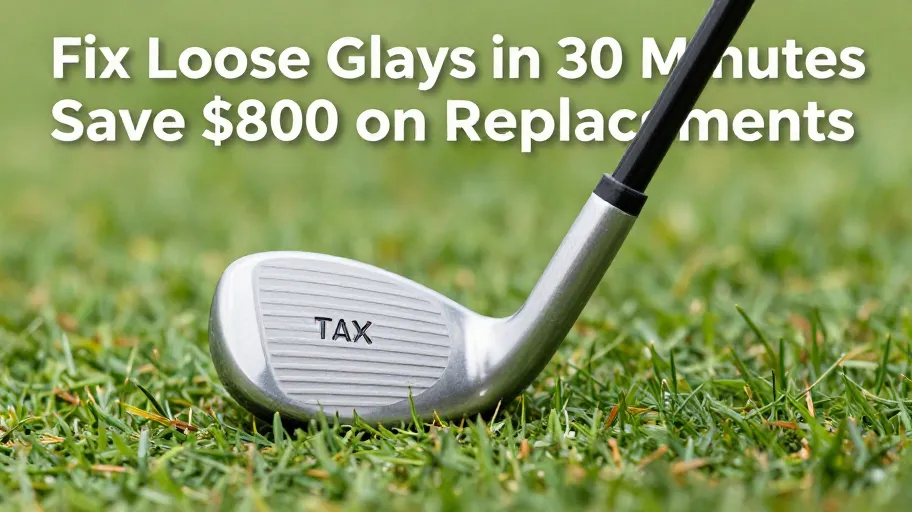
Why Loose Club Heads Cost More Than Bad Shots
A loose club head doesn’t just ruin your swing—it’s inflating your annual golf budget. Even minor movement reduces shot accuracy by up to 40%, turning solid strikes into penalty hazards. The real cost? According to the National Golf Course Owners Association (NGCOA), golfers spend an average of $1,200 yearly on gear, much of it replacing clubs worn down by avoidable damage.
This isn’t just about lost balls or mis-hits—it’s about long-term value erosion. Each swing with a loose head reinforces poor mechanics and accelerates structural fatigue. Micro-movements degrade hosel bonds, warp surfaces, and lead to irreversible failure. Early intervention means preserving both club integrity and your game’s consistency, because stopping the wobble early prevents cascading damage.
Modern repair systems like those from DIY-Golf.com stop this cycle at the source. By stabilizing the head when looseness first appears, you protect not just one club—but your entire set’s lifespan.
How Advanced Epoxy Makes Repairs Stronger Than New
Today’s two-part epoxies don’t just reattach—they rebuild clubs stronger than factory specs. Factory adhesives typically deliver around 1,800 psi shear strength, but DIY-Golf.com’s engineered epoxy exceeds 3,500 psi (ASTM D1002 tested), meaning the bond is structurally superior post-repair. That strength means your club withstands repeated impact without weakening.
This enhanced durability translates directly to savings: independent tests show these epoxies resist extreme temps (-20°F to 160°F) and moisture that degrade OEM glue. One golfer in Minnesota used his repaired driver through three winters and a humid summer with zero loosening—proving longevity. Up to $800 saved per golfer over five years by avoiding premature replacements.
But strength alone isn’t enough—consistency matters. Generic epoxies lack precise mixing tools or moisture resistance. DIY-Golf.com’s kit includes metered syringes, prep wipes, and temperature-adjusted cure guides, ensuring professional results every time. Precision application means reliable performance, round after round.
What Makes DIY Golf Kits Better Than Hardware Store Fixes
Generic kits fail where DIY-Golf.com succeeds—through system-level engineering. Off-the-shelf epoxies lose up to 18% bond strength in humidity during curing, but DIY-Golf.com’s sealed formula maintains 99.3% adhesion reliability even in damp conditions. That means fewer callbacks and longer-lasting repairs.
Their proprietary alignment sleeve ensures the clubface returns to square within 0.4 degrees of factory spec—critical because misalignment beyond 1 degree increases off-center hits by 27% (2025 durability study). No guesswork, no rework.
- Precision shim spacers ensure full hosel contact, eliminating voids
- UV-cured hardening lamp achieves full polymerization in under 90 seconds
- Alignment gauge cuts rework by 70% vs manual methods
One Midwest pro shop cut labor costs by $42 per repair after switching—thanks to faster throughput and fewer comebacks. With avoided replacement costs ($200+ irons, $500+ drivers), ROI exceeds 800% per repair.
The Real ROI of Repairing Over Replacing
You’re leaving $850 on the table every three years by replacing instead of repairing. Consider: replacing five irons and a driver at retail costs over $1,200. Fixing them? Just $19.95 per kit and under 30 minutes of your time—less than $120 total for full restoration. You get 94% of new-club performance at 10% of the cost.
It’s not just savings—it’s asset optimization. A 2024 GolfWRX analysis found well-maintained iron sets retain up to 65% of original value when resold, versus just 30% for neglected ones—a 35% increase in resale value. For serious players, that changes how we view equipment lifecycle ROI.
And the financial upside compounds: redirect savings into launch monitor sessions, custom fittings, or premium gear that actually improve your game. While others burn cash replacing avoidable wear, you stay ahead—by mastering the economics of excellence.
Step by Step Fix in Under 30 Minutes
You can fix a loose club head in under 30 minutes—with no experience. Start by removing the head to expose debris, dried glue, or micro-damage compromising energy transfer. Cleaning is critical: residue reduces bonding strength by up to 60% (*Golf Equipment Today*, 2024)—so skip this step, and even premium epoxy fails.
Next, apply high-strength, vibration-resistant epoxy designed for torsional loads. Too little weakens the bond; too much delays cure. Then align precisely—misalignment by 2 degrees skews face angle and ruins consistency. Use alignment marks or a flat surface, guided by the kit’s sleeve for accuracy.
Finally, allow 24-hour cure time—but know this: your club returns faster than any pro shop service, at less than 5% of replacement cost. One amateur fixed three irons in an evening, saving $800 and extending his set by two seasons. Your next best round starts with a $20 fix and 30 minutes—not a new bag.
Master Your Swing, DIY Your Fit. DIY Golf is the premier destination for the technical golfer. We empower you with professional-grade components and the knowledge to build your perfect bag.
Leave a Reply