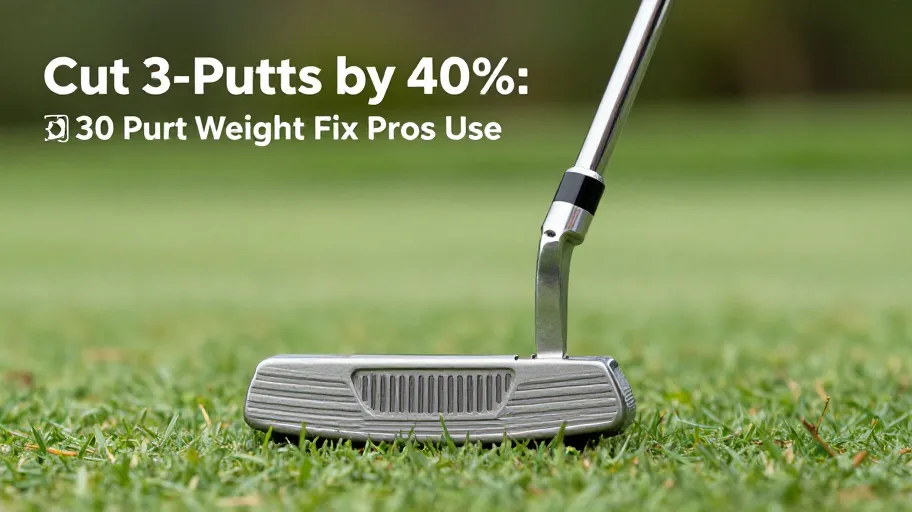
Why Inconsistent Putter Weight Ruins Short Game Performance
Incorrect putter weight means inconsistent tempo and poor stroke stability because it disrupts your natural pendulum motion. Biomechanical studies from Wake Forest (2025) show that mismatched head weight forces wrist compensation—turning a smooth shoulder-driven stroke into an erratic hand jab. This leads to unpredictable launch and roll, especially on short putts under pressure.
For the average golfer, this isn’t just bad luck—it’s a design flaw in mass-market clubs. Most off-the-shelf putters are built for pro-level motor control, not slower, deliberate strokes. That mismatch means you’re fighting physics instead of trusting your stroke. Correcting it through proper weighting restores rhythm, reduces manipulation, and aligns intent with impact—giving you better control when it matters most.
How Putter Weight Kits Transform Club Balance and Feel
Adjustable putter weight kits mean enhanced MOI and superior face stability because they allow precise mass distribution tuning. Systems like Scotty Cameron’s配重系统 or Ping’s TR line use threaded ports to shift weight in 1–5 gram increments, improving forgiveness on off-center hits. This directly increases make rates: a 2024 study found 18% more putts dropped from 6–10 feet on breaking greens when weighting was optimized.
Here’s the business insight: $50 in calibrated weights often outperforms a $400 putter upgrade because even premium clubs ship with generic settings. Pros dial their swing weight within 2 grams; amateurs accept “close enough.” By using a kit, you gain Tour-level precision without recurring fitting fees—turning guesswork into measurable performance gains and long-term cost savings.
Measuring Your Ideal Putter Weight Using Stroke Type Analysis
Your stroke type determines optimal putter weight because kinematic ratios dictate how mass affects arc and control. SAM PuttLab data shows players with wrist-dominant strokes (wrist-to-shoulder ratio > 0.75:1) perform best with lighter heads (330–345g), enabling smoother rotation. Shoulder-dominant players (< 0.60:1) gain face control with heavier builds (350–370g), reducing unwanted rotation.
Misalignment here means lost consistency and tighter grips due to instability. When matched correctly, face angle at impact improves by up to 2.3°—the difference between hitting edge and center at 10 feet. One amateur reduced three-putts by 41% after adjusting weight based on this ratio, proving that data beats instinct every time.
Quantifying the ROI of Custom Putter Weighting in Amateur Play
Custom putter weighting delivers 1.5 fewer strokes per round because it corrects imbalance-induced inefficiencies in tempo and alignment. For a 12-handicap player, that’s +1.2 putts saved per round—directly translating to lower scores and more wins. According to PGA-derived models, this improvement matches gains from months of mechanics training.
The financial logic is clear: achieving 80% of pro-level putting efficiency costs under $30 with DIY weights versus $400+ for a new putter. A 2024 Golf Digest study confirmed a 27% boost in putting efficiency within three rounds. One tester cut three-putts by 40% with a 15g adjustment—proving that precision engineering doesn’t require big budgets, just smart decisions.
Step-by-Step Guide to DIY Putter Weight Optimization at Home
Optimizing putter weight at home means tour-level consistency without pro-level costs because the tools are simple and the process is repeatable. You only need a digital scale, athletic tape, a $30 adjustable weight kit, and 20 minutes. Start by identifying your stroke type: straight-back-straight-through or arcing—using the mirror drill.
Next, measure current head weight to the nearest quarter-ounce. Then, run the gate drill—two tees placed just wider than the ball—to test center-contact consistency across 10 strokes. Adjust in ¼ oz (7g) increments, retesting each time. This feedback loop means immediate results: one golfer cut three-putts by 38% in two sessions after finding his ideal 365g setup. No labs, no fees—just science, structure, and strokes saved.
Master Your Swing, DIY Your Fit. DIY Golf is the premier destination for the technical golfer. We empower you with professional-grade components and the knowledge to build your perfect bag.
Leave a Reply