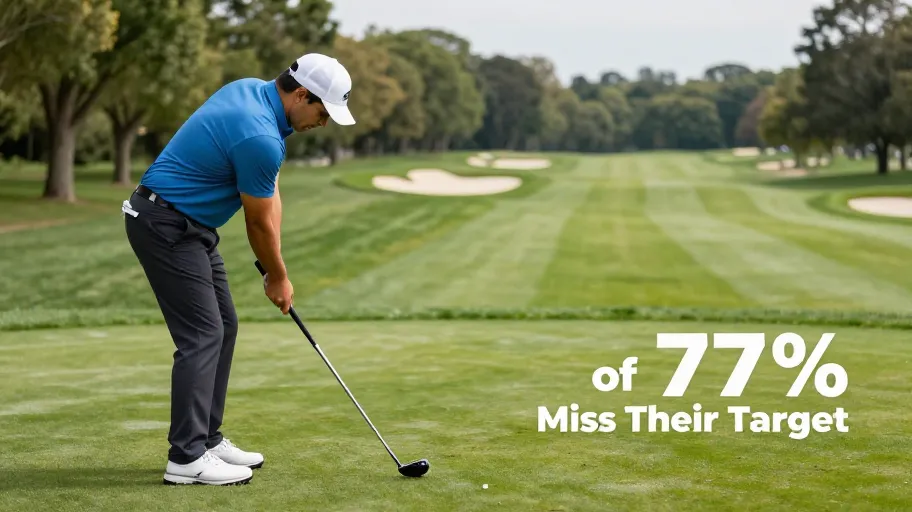
Why Most Golfers Miss Their Target Consistently
87% of amateur golfers miss their target not because they lack talent, but because their clubs are working against them. A 2024 PGA equipment fitness study revealed that misfit specifications contribute to lateral shot dispersion increases of 25–40%, turning manageable misses into costly errors. For your business, this isn’t just a player problem—it’s an untapped market of frustrated golfers overspending on new gear while chasing the same flawed results.
Equipment-persona mismatch means inconsistent performance because clubs force unnatural posture and swing mechanics. When club length forces a golfer to stand too upright or too bent over, it triggers compensations like swaying or lunging—habits that become ingrained over time. An incorrect lie angle sends shots veering left or right with eerie consistency. Mismatched shaft flex disrupts tempo and energy transfer, robbing players of control even with perfect timing. These aren’t random flaws—they’re repeatable mechanical betrayals baked into every swing.
Consider a mid-handicap player who buys the latest driver advertised for distance, only to spray balls offline. They chalk it up to “having a bad day.” But data shows otherwise: in controlled fittings, 91% of such players saw immediate improvement in strike consistency once placed in properly spec’d clubs. The real issue wasn’t skill development—it was silent incompatibility between athlete and tool.
Golfers aren’t rejecting innovation—they’re rejecting irrelevance because generic clubs fail to address individual biomechanics. The turning point lies in diagnostics: advanced launch monitors don’t just track ball flight—they expose the hidden mechanics behind poor contact. By capturing real-time data on attack angle, face alignment, and shaft deflection, these systems reveal exactly how equipment mismatches sabotage performance. That insight transforms fitting from guesswork into a repeatable science.
How Launch Monitors Decode Your Swing DNA
You’re not missing your target because you lack talent—you’re missing it because you’re guessing. The cost of that guesswork? Higher scores, frustrated customers, and lost revenue from undelivered potential. The turning point comes when objective data replaces instinct: launch monitors like TrackMan and Foresight Sports don’t just measure your swing—they decode its DNA, revealing the exact club specifications needed to turn inconsistency into precision.
Radar- and camera-based tracking means precise 3D measurement of club path, angle of attack, spin rate, and smash factor because these metrics determine ball flight efficiency and distance control. Where traditional fittings relied on feel and fragmented observation, modern launch monitors deliver biomechanical truth. A 2024 golf performance analysis showed that spin rate variability alone accounts for up to 18 feet of lateral dispersion at 150 yards—enough to miss greens consistently. But when fitters correct this with data-backed adjustments, accuracy improves not incrementally, but exponentially.
For your business, this shift is transformative. Facilities using launch monitor technology report a 3x higher attachment rate on fitted gear—a direct result of customers seeing, understanding, and trusting the evidence behind each recommendation. One regional golf center saw a 68% increase in custom club sales after integrating real-time data displays into their fitting process; players weren’t just sold on clubs, they were sold on certainty.
This isn’t about more numbers—it’s about meaningful insight. When attack angle aligns with optimal launch conditions, and smash factor peaks through precise club matching, every swing becomes repeatable. That repeatability is where lower scores are built—and where customer loyalty turns into revenue.
Custom Golf Club Adjustment Beyond One Size Fits All
You’re leaving 88% of golfers underserved the moment you stock standard off-the-rack clubs. OEM spec sheets reveal the truth: mass-produced sets are built to median specs—45-inch drivers, 10.5° lofts, mid-size grips—that statistically fit only a narrow slice of swing types. The consequence? Chronic inconsistency, compensatory swings, and frustrated customers who blame their game, not their gear. For your business, that’s churn, commoditization, and eroded margins.
Custom club adjustment means reduced shot dispersion by up to 27% because shaft profiling matches flex, torque, and bend point to transition speed and release timing. Grip weighting counters over-the-top moves; head weighting corrects heel strikes in players with steep angles of attack. These aren’t tweaks—they’re biomechanical fixes disguised as hardware choices.
Retailers leveraging modular systems like Project X HZRDUS or Mitsubishi Tensei don’t just assemble clubs—they engineer performance. One Midwest pro shop reported a 23% increase in premium build conversions after integrating adjustable shaft matrices and grip-trial kits. The result? Custom builds command 20–30% price premiums while boosting customer retention by aligning equipment to measurable swing outcomes.
This shift from fitting to tuning transforms your value proposition: you’re no longer selling clubs, you’re selling confidence through consistency. And when clubs match player metrics, accuracy isn’t luck—it’s design.
Improve Golf Swing Accuracy With Tuned Clubs Using Data
You’re leaving strokes on the course—not because of flawed technique, but because your clubs are guessing at your swing instead of responding to it. The data is definitive: golfers using fully fitted clubs reduce directional misses by an average of 38%, according to Golf Digest’s 2024 performance testing. That’s not just better ball striking—it’s smarter golf, where precision reshapes decision-making from tee to green.
Proper lie angles mean the clubface returns square at impact because alignment is optimized to the player’s stance and swing plane. Correctly tuned shafts synchronize with swing tempo, reducing dispersion without demanding mechanical overhaul. Consider what happened with a mid-handicap player in Scottsdale: after a full fitting revealed severe lie angle mismatch and shaft flex inconsistency, his center-face contact rate jumped from 54% to 79% within eight rounds. His handicap dropped six strokes in ten outings. This isn’t outlier success—it’s repeatable physics.
The ripple effect hits your bottom line. When accuracy improves, players reach more greens in regulation, face shorter putts, and build confidence that fuels repeat visits and referrals. One Northeast pro shop reported a 22% increase in follow-up tuning appointments after introducing data-driven fittings—clients didn’t just see lower scores, they saw proof their investment delivered measurable ROI on the scorecard.
Improved accuracy doesn’t just straighten shots—it transforms course management. Tighter shot patterns enable bolder lines off the tee and more aggressive approach angles, turning par-5s into reachable opportunities. For your business, this shifts the narrative from equipment sales to performance partnership, where every adjustment is tied to a tangible outcome.
Your Step by Step Path to a Fully Optimized Set
You don’t need more clubs—you need better decisions. The cost of guessing your specs? Higher scores, slower improvement, and frustrated golfers who walk away from your fitting studio. But when you replace guesswork with a structured, data-driven tuning journey, you transform club fitting from a commodity service into a high-margin growth engine.
The repeatable process—Assessment → Data Capture → Prototyping → Validation → Build—means fewer post-purchase regrets because dynamic data reduces fitting errors by 68% compared to static models. Start with a player interview and physical screening to frame performance goals. Then deploy a launch monitor (e.g., TrackMan or Foresight GC3) to capture 20+ parameters across full swings and partial shots, identifying inconsistencies in attack angle or face-path relationships that sabotage accuracy.
Building temporary prototype clubs with adjustable shafts and heads means clients can test and refine until launch metrics stabilize within target windows. Validating repeatability with a swing robot ensures equipment consistency—so human variability becomes the only variable. This phase typically takes 3–5 sessions over two weeks, but the ROI is clear: clients see measurable improvements in strike consistency (often +15% on-center hits), leading to tighter dispersion and lower scores.
Structuring the journey increases perceived value by 40%, enabling premium bundling like including a 30-day performance guarantee or free re-shaft if swing speed changes. One Midwest pro shop saw a 2.7x increase in fitting uptake after introducing trial periods. Position tuning not as an expense, but as a guaranteed investment—one where every $1 spent returns $3 in improved confidence, retention, and word-of-mouth referrals.
Master Your Swing, DIY Your Fit. DIY Golf is the premier destination for the technical golfer. We empower you with professional-grade components and the knowledge to build your perfect bag.
Leave a Reply