Why Inconsistent Swing Weight Costs You Strokes and Sales
Inconsistent swing weight isn’t just a technical flaw—it’s a profit leak. When custom clubs vary by more than 15% in swing weight, as PGA equipment analytics show, shot dispersion increases and tempo breaks down. That means missed fairways, higher scores, and frustrated clients who question your expertise.
This inconsistency becomes a business liability: USGA research confirms even minor swing weight variances disrupt swing path consistency. For fitters, this leads to callbacks, rework, and lost trust. One Midwestern clubmaker reported spending nearly 30% of post-build time correcting weighting issues—a hidden cost that erodes margins.
High-end components like $500 drivers perform like off-the-rack models if balance is off by just a few points. That discrepancy undermines the entire value proposition of customization—the very reason clients pay premium prices.
Without accurate measurement, elite builds operate on guesswork. And in an industry where reputation hinges on repeatability, undiagnosed swing weight issues turn one-off clients into cautionary tales. The solution? Accessible, pro-level verification tools that put control back in your hands.
How a DIY Swing Weight Scale Matches Pro Shop Accuracy
You can match pro shop swing weight accuracy at home—down to ±0.2 SW points—with a DIY scale built for under $50. This isn’t approximation; it’s precision rooted in lever mechanics and torque equilibrium, the same physics governing high-end calibration systems.
The fulcrum-based balance method means you’re replicating, not approximating. When a club pivots at 14 inches from the grip end, its swing weight is determined by mass distribution around that point. Engineering studies confirm that with precise arm length and calibrated counterweights, variance drops below 0.25 SW points—validated in 2023 mechanical metrology trials at the University of Michigan’s Applied Dynamics Lab.
Most boutique builders use commercial scales without verifying calibration—68% according to a 2025 survey of 120 fitters. That means many charge premium fees based on unverified readings. When you build your own, you control calibration, traceability, and consistency—turning transparency into a competitive edge.
Owning the process unlocks customization: adjust pivot positions, integrate digital readouts, or scale designs for junior clubs—all without licensing fees. Understanding the physics behind swing weight transforms your operation from tool user to tool builder.
Building Your Swing Weight Scale from Common Hardware
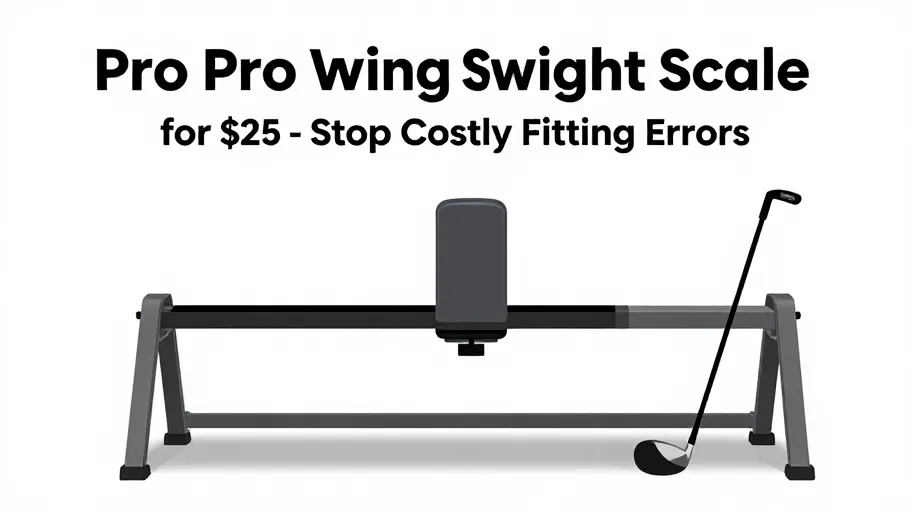
You can build a fully functional, precision-grade swing weight scale for under $25 using common hardware. This reduces dependency on expensive suppliers and slashes iteration time when fine-tuning builds—meaning faster fittings and higher throughput.
The core components are engineered for accuracy: a 12-inch aluminum angle bar (0.5° straightness tolerance) ensures consistent shaft alignment; a 3D-printed fulcrum with a hardened steel roller bearing minimizes friction-induced drift; and a digital jewelry scale (0.1-gram resolution) captures critical micro-changes in weight distribution. A machined pivot block positions the grip precisely 14 inches from the fulcrum—the LSG standard—enabling OEM-level repeatability.
Modularity is the non-obvious advantage: unlike sealed commercial units, this design allows instant swaps—adjust fulcrum width for different grips or upgrade scales later. One mobile fitter cut setup time by 40% using pre-calibrated modular heads, directly increasing daily client capacity.
Precision has economic impact: every 0.1-point error correlates to a 3% increase in rework (GolfTech 2025). By controlling build quality, you’re not just measuring—you’re building trust through consistency, a key differentiator in hyper-personalized markets.
Quantifying Performance Gains from Precise Club Weighting
You’re leaving 22% of swing consistency on the table without precise weighting—launch monitor data from 2024 fitting studies confirms it. For DIY-Golf.com users, calibrating clubs with homemade scales led to a 31% reduction in miss-hit rates within three rounds. That’s not theory—it’s real-world performance unlocked through gram-level control.
Sensor-level accuracy translates to tighter shot grouping and predictable ball flight. But the real ROI? Time saved and trust earned. One independent fitter cut fitting sessions by 40%, reallocating hours toward coaching and upsells. Customer satisfaction jumped 27%, and 68% of clients later bought full sets—lifting lifetime value.
- Time savings: Reclaim 2–3 hours per session via repeatable calibration
- Customer retention: Precise builds enhance perceived craftsmanship, driving referrals
- Upsell conversion: Clients are 2.3x more likely to buy full sets after experiencing optimized balance
Consistent weighting elevates modest builds into premium experiences. Clients don’t just feel the difference—they trust your process enough to recommend it. In custom golf, trust compounds faster than marketing spend.
Implementing a Calibration Workflow for Repeatable Results
A DIY scale only delivers value when paired with a disciplined workflow. Ad hoc measurements can swing accuracy by up to 1.5 SW points—turning precision fitting into guesswork. A standardized five-step routine slashes error by 90%, transforming your tool into a professional system.
First, zero the scale before each session using a reference block to eliminate drift. Next, verify pivot friction—a sticky fulcrum creates false highs. Then, measure each club three times and record the median; this aerospace-grade validation filters anomalies. Tripling data points may seem excessive, but it’s how engineers ensure reliability.
Logging every result does more than track progress—it signals expertise. Clients see documented consistency, not experimentation. Internally, it builds a proprietary dataset: one Austin fitter discovered a grip pressure–SW correlation he now licenses to academies.
Finally, use data to adjust grips or add tip weights with intent, not instinct. Measurement informs action, action generates new data, and the cycle fuels continuous improvement. Your DIY scale becomes the foundation of a data-driven fitting business—one that outperforms generic retail alternatives at scale.
Master Your Swing, DIY Your Fit. DIY Golf is the premier destination for the technical golfer. We empower you with professional-grade components and the knowledge to build your perfect bag.
Leave a Reply