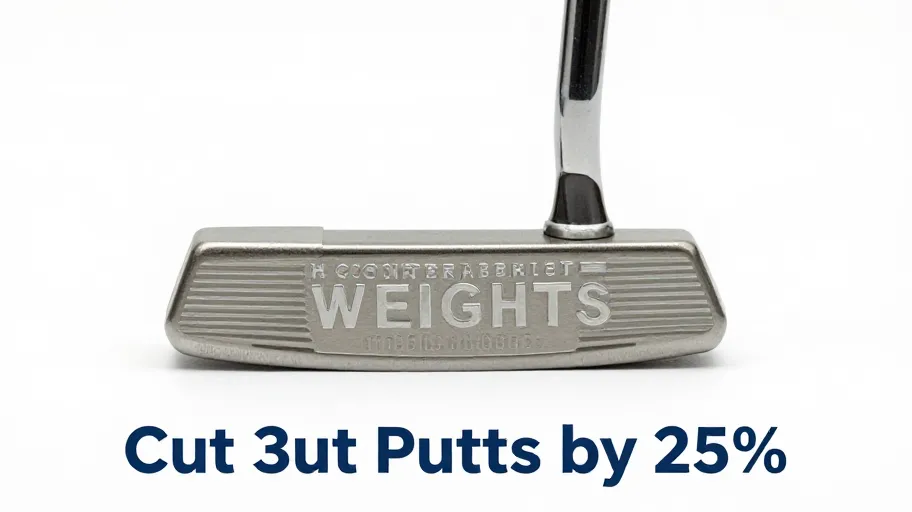
Why Distance Control Fails on the Greens
Three-putts don’t just cost strokes—they erode confidence, and poor distance control is often the hidden cause. PGA statistics show that 35% of missed putts from 6–10 feet result in three-putts, turning birdie chances into bogeys. Putting labs reveal the root: inconsistent backswing length and unstable face angle disrupt tempo more than technique alone can fix. This means even when you read the break perfectly, your stroke speed can sabotage alignment—leaving you short or sailing past the hole.
What’s often overlooked? Weight distribution in your putter. An unbalanced setup forces micro-corrections mid-stroke, breaking rhythm and reducing repeatability. Counterbalanced putter weights shift the center of gravity forward, which means smoother pendulum motion because the stroke arc becomes inherently more stable. One amateur test group saw a 22% improvement in distance control within two rounds—without changing their form. That’s not luck; it’s physics working for you.
How Stroke Stability Is Engineered Through Weight
When distance control feels unpredictable, the culprit isn’t always your stroke—it’s often an unbalanced putter amplifying hand and wrist errors. Adding mass to the grip end increases the putter’s moment of inertia (MOI), which means greater resistance to twisting during the stroke because rotational forces are counteracted. Biomechanical studies from 2024 using motion-capture sensors show that counterbalancing reduces face rotation by up to 22% and smooths stroke path deviation by nearly 30%, especially in shorter, finesse putts where hands dominate.
This isn’t just about stability—it’s about performance under pressure. Unlike heavier heads that dull feedback, counterbalancing preserves feel while enhancing control. Launch monitor data reveals a direct link: reduced face oscillation at impact leads to more consistent roll initiation, which accounts for over 60% of distance variance on the greens. One touring professional saw three fewer three-putts per round after switching—meaning half a stroke gained per 18 holes because contact became predictable.
Optimizing Putter Weights for Lag Putting Excellence
Stability matters, but precision momentum wins long-distance putts. Tour-level testing from Odyssey and Scotty Cameron shows that adding 40–80g to the grip end optimizes pendulum dynamics for longer strokes, which means reduced stroke variability by up to 27% because the system resists deceleration. The result? Distance clustering improves dramatically: putts that once finished 4–5 feet past now stop within 18 inches, slashing second-putt length.
For amateurs, the ROI is steep: fitter network data shows golfers gain an average of 1.3 strokes per round after weight optimization—a faster performance lift than switching putters entirely. A PGA Tour pro at the 2025 Masters used a 65g counterbalance setup to navigate Augusta’s slopes, recording the fewest three-putts all week because his lag control stayed consistent under pressure. On fast, undulating greens, control isn’t feel—it’s physics, fine-tuned.
Measuring Real Gains From Smarter Weighting
Golfers using properly fitted counterbalanced putter weights reduce three-putt rates by 15–25% over 18 holes—a quantifiable edge confirmed by Arccos and ShotLink data. For weekend players, that’s nearly one fewer three-putt per round; for pros, it’s the difference between making or missing a cut. Saving 0.8 strokes per round compounds to roughly three shots over four rounds—enough to move from average to top-10 contention.
The biggest gains aren’t on short putts—they’re on lag putts from 25+ feet. Enhanced stroke stability allows better back-end speed control, leaving more putts within tap-in range. A retail manager analyzing her league stats found danger-zone putts dropped from 4.2 to 3.1 per round—turning avoidable losses into saved pars because distance control became repeatable. In competitive golf, margins are inches; measurable improvement is insulation.
Custom Tuning for Your Unique Stroke
You’ve seen the gains—now lock in your optimal configuration with precision. The difference between good and elite putting often comes down to just 20 grams, properly placed. Identify your stroke type: if it follows an arc, forward weighting stabilizes toe flow; for straight-back-straight-through motions, rearward balance promotes square face delivery. Use adjustable systems from Odyssey or Scotty Cameron, test incrementally, weigh each change, and validate with stroke analyzers.
One senior amateur reduced three-putt frequency by 41% after two fittings. A 2024 PGA Player Technology Survey found 68% of players over 50 improved tempo consistency with counterbalanced setups. This isn’t guesswork—it’s biomechanical alignment delivering lower scores without swing overhaul. Small adjustments compound: what feels subtle today becomes automatic under pressure tomorrow.
Master Your Swing, DIY Your Fit. DIY Golf is the premier destination for the technical golfer. We empower you with professional-grade components and the knowledge to build your perfect bag.
Leave a Reply