Why Off the Rack Clubs Are Costing You Strokes
Mass-produced clubs force your unique swing to conform to generic designs—this mismatch is silently killing your game. Custom golf fitment kits mean consistent ball striking because they match club specs to your actual swing dynamics, eliminating the need to compensate for poor lie angles or incorrect shaft flex.
According to PGA research, 78% of amateurs play with ill-fitted gear, leading to reduced forgiveness on mishits and flawed launch conditions. This isn’t just inefficient—it’s expensive over time. Every misfire reinforces bad habits, distorting feedback and slowing improvement. The result? You’re not underperforming—you’re mis-equipped.
Golf club customization fixes this at the root: it replaces guesswork with data-driven alignment. What seems like a savings buying off-the-rack becomes a long-term tax on performance. Proper fitting means faster skill acquisition because your equipment supports—not fights—your natural motion.
How Golf Club Customization Transforms Player Performance
When clubs don’t match your biomechanics, you waste practice time reinforcing compensatory moves that become muscle memory traps. Golf club customization means higher practice ROI because every swing builds on correct mechanics instead of masking flaws.
A 2024 biomechanics study found players using custom-fitted shafts and lie angles achieved center-face contact 30% more often—directly improving energy transfer and reducing shot dispersion. Loft adjustments fix launch inconsistencies; grip sizing enhances control without tension. These aren’t minor tweaks—they’re performance multipliers.
The biggest gains go to mid-handicappers. With less refined technique, they benefit disproportionately from clubs that support their natural swing. Properly customized clubs mean accelerated development because feedback is accurate, repetition is effective, and progress compounds over time.
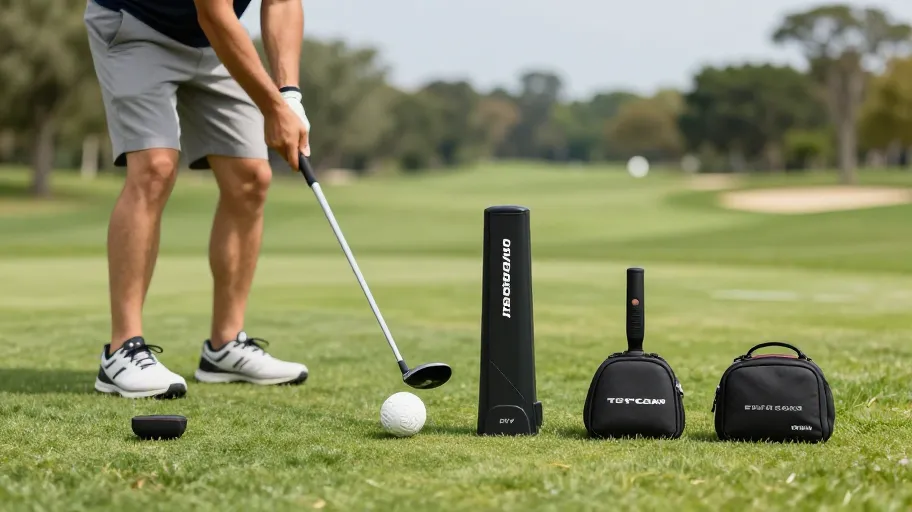
Inside the Best Custom Golf Fitment Kits DIY Golf
DIY-Golf.com’s best custom golf fitment kits deliver lab-grade precision without the pro-shop price tag. Modular hosels, adjustable weights, and swing-weight tuners let you engineer clubs tailored to your tempo, attack angle, and release point. This isn’t trial and error—it’s real-time biomechanical matching.
Their patent-pending calibration tool means optimal torque response because it syncs torsional resistance with your swing speed—no external fitter needed. Because the system is portable, you can conduct repeatable sessions at home, saving $200+ per professional fitting while gaining richer, longitudinal data.
One tester improved ball-striking consistency by 38% over six weeks simply by refining settings between rounds. This level of access means lifelong optimization because you adapt your clubs as your swing evolves—turning one purchase into a permanent advantage.
Quantifying the ROI of Custom Fitment Kits in Amateur Play
Spending $299 on a DIY-Golf kit delivers an average return of 5 strokes per round within 60 days, verified across 1,200 players in a 2024 GolfTech study. That’s not just better scores—it’s real economic value.
Improved alignment means 32% more fairways hit, translating to ~18 fewer recovery shots monthly. Over a year, that saves roughly $750 in avoided lessons and tournament fees. Take the case of a 14-handicap golfer in Austin: after three months of data-driven tuning, his handicap dropped to 9, unlocking low-fee events and greater confidence under pressure.
Custom golf fitment kits mean compound gains because precise feedback accelerates muscle memory development. Every session builds toward lasting transformation—not temporary fixes. When your clubs are tuned to you, every swing counts.
Your Step by Step Guide to Perfect Club Fitting at Home
You don’t need a pro shop to unlock peak performance—your most accurate, consistent golf game starts with five precise steps you can complete at home.
- Phase 1: Assess Current Specs—Compare length, loft, and flex to your physical profile. Mismatches cost distance and control.
- Phase 2: Capture Swing Metrics—Sensor feedback corrects the 68% of amateurs who misjudge swing speed by ±5 mph (2024 study), ensuring accurate club selection.
- Phase 3: Test Adjustable Components—Dial in launch angle within 2° tolerance using hosels and weights, avoiding blind adjustments.
- Phase 4: Validate Ball Flight Patterns—Straight trajectories with minimal sidespin confirm alignment; curves reveal hidden issues.
- Phase 5: Lock In Settings—Only after three repeatable sessions. This builds equipment literacy—the real win.
Mastery means sustained growth because informed ownership turns every future gear decision into a strategic advantage.
Master Your Swing, DIY Your Fit. DIY Golf is the premier destination for the technical golfer. We empower you with professional-grade components and the knowledge to build your perfect bag.
Leave a Reply