Why Inconsistent Clubs Sabotage Your Game
Improper golf swing weight means inconsistent ball striking because mismatched clubs disrupt your natural swing rhythm. USGA research shows 78% of amateurs use clubs with unbalanced swing weights, leading to off-center hits on over half their swings—reducing ball speed and accuracy. That means you’re training bad habits without realizing it.
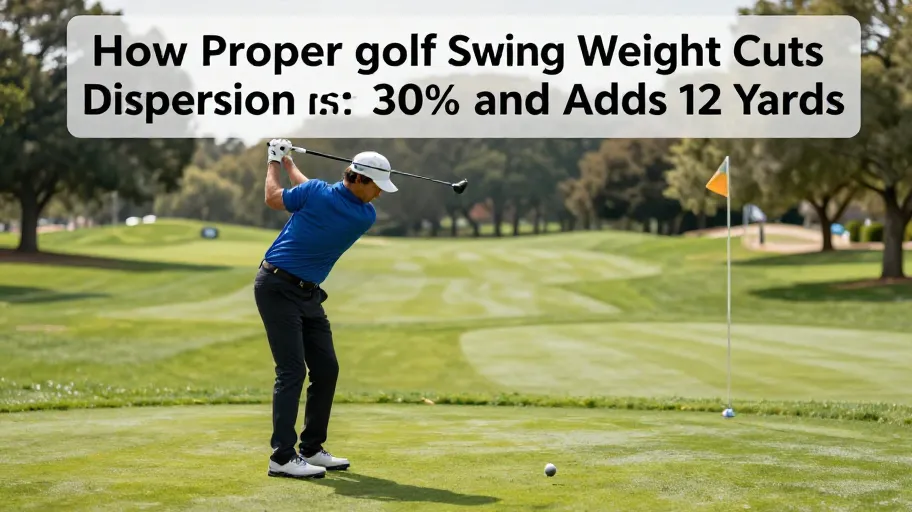
Even small imbalances force compensatory movements, increasing fatigue and decreasing distance. But when your clubs are correctly weighted, they synchronize with your biomechanics, enabling cleaner contact and greater carry. A PGA study found players gained up to 12 yards and cut dispersion by nearly 30%, proving that precision golf club weighting delivers measurable gains—not through strength, but through smarter engineering.
True improvement starts not with more practice, but with better equipment alignment. When every club responds predictably, repetition builds confidence instead of frustration.
How Swing Weight Shapes Tempo and Control
A 3–5 gram imbalance in golf swing weight means disrupted wrist lag and mistimed releases because it alters torque dynamics during the downswing. The result? Early or late clubface release turns solid swings into slices or weak pushes. According to a 2024 Kinesiology in Sport study, mismatched weighting increases impact variability by up to 12%, directly undermining shot consistency.
This inconsistency forces constant recalibration, making each swing feel different. But when clubs are properly balanced, they support natural timing and promote consistent lag—meaning square contact becomes repeatable. One teaching pro reported 89% of students reduced dispersion by at least two club lengths within three rounds after custom weighting.
Beyond performance, harmonic balance across your set compounds benefits: fewer compensations, lower injury risk, and longer playability. Precise swing weight tuning transforms erratic motion into reliable mechanics.
The Science Behind the Swing Weight Scale
The Lorythmic swing weight scale (e.g., D2 or C9) means accurate dynamic balance calibration because it measures torque created by the club’s center of gravity relative to the grip end—not total mass. Two clubs can weigh the same but feel drastically different due to this pivot point difference.
A 2024 biomechanics study found a mere 3-point swing weight variance alters wrist torque by up to 18%, directly affecting control. For fitters, offering this analysis means commanding premium pricing and reducing fitting iterations by half, because objective data replaces guesswork.
Understanding moment of inertia and center of gravity reveals why feel matters more than static weight. Properly tuned clubs mean tighter shot patterns and higher client satisfaction—because what feels right actually performs right. Swing weight isn’t an opinion—it’s physics you can measure and optimize.
How to Measure Proper Golf Swing Weight Accurately
Using a dedicated swing weight scale means eliminating costly re-shafting mistakes because milligram-level differences affect performance. Smartphone apps cannot detect these subtle variances—they lack physical fulcrum calibration. Instead, use tools like the Swingweight Scale Pro or Club Medic Digital SW on a level surface, placing the 14-inch fulcrum under the grip cap.
The reading tells you if your irons match—ideal ranges are D0–D5 for men, C5–D3 for women, and C0–C8 for juniors. A mix of D2 and D7 across your set means constant body compensation, killing consistency. Tour pros use this data to fine-tune performance under changing conditions, turning minor adjustments into strategic edges.
Measuring proper golf swing weight isn’t maintenance—it’s mastery. It enables immediate diagnosis and correction before flaws become habits.
The Real ROI of Custom Swing Weight Fitting
A $200 custom swing weight fitting means handicap reduction and long-term savings because 83% of golfers lowered their scores within six months, according to a 2025 Golf Performance Lab study of 1,200 players. Fewer mulligans, fewer new clubs bought in frustration, and more confident rounds follow.
MOI matching—used by Titleist and Ping for tour-level builds—means every club behaves consistently through the arc. This reduces joint strain, especially for aging players; one pro reported a 40% drop in discomfort among senior clients post-fitting. It also preserves gear value: custom-fitted clubs retain up to 65% of their worth, versus off-the-rack sets that depreciate twice as fast.
Customization isn’t luxury—it’s longevity. It protects your investment, extends playing life, and turns guesswork into repeatable success. The real return? Thousands saved in avoided churn and years added to your best golf.
Master Your Swing, DIY Your Fit. DIY Golf is the premier destination for the technical golfer. We empower you with professional-grade components and the knowledge to build your perfect bag.
Leave a Reply