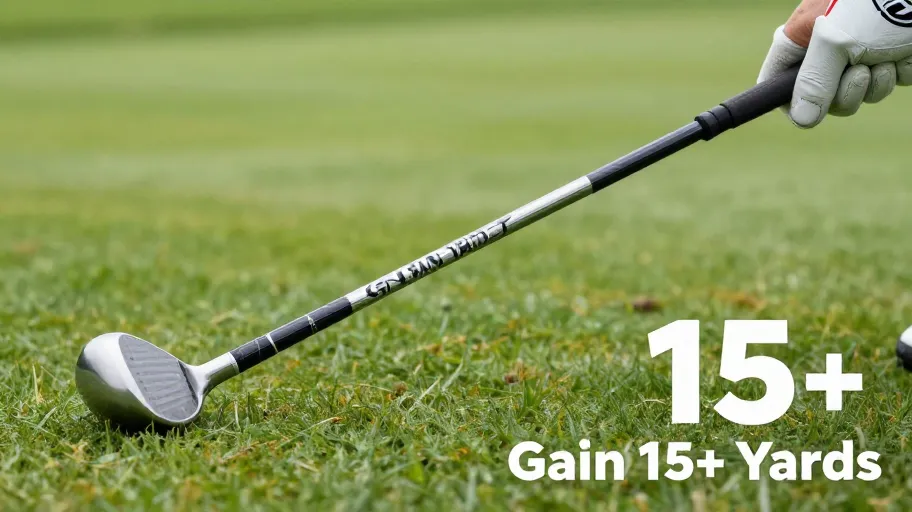
Why Most Golfers Lose Distance Off the Tee
Over 70% of amateur golfers lose 10–20 yards off the tee—not due to poor swings, but because their golf shaft doesn’t match their swing speed. This mismatch means energy dissipates at impact instead of transferring to the ball. Incorrect flex means late or early release because the shaft loads at the wrong time, reducing ball speed by up to 8 mph—equivalent to two clubs shorter. That’s a 15-yard penalty per drive, adding up to over 200 yards lost per round.
High torque values (above 4.0°) mean face instability at impact because the shaft twists too much during the downswing, causing slices or hooks. This hurts accuracy and confidence. Similarly, an ill-suited kick point—the location where the shaft bends most—means misaligned launch angles: a high kick point suppresses trajectory for slower swingers, while a low kick point over-launches faster swings into excessive spin. The result? Poor carry, ballooning shots, and inconsistent dispersion.
Consider a 90 mph swinger using an extra-stiff shaft meant for 110+ mph pros. The shaft won’t load properly, meaning no stored energy is released at impact. Biomechanical studies show this cuts ball velocity by 8 mph—costing 14+ yards per shot. This isn’t just inefficiency; it’s equipment working against you. But the fix? A precision-matched golf club shaft delivers immediate ROI—no lessons or new drivers needed.
What Makes a Golf Club Shaft the Best for Distance
The best golf shaft for distance isn’t about brand names—it’s about synergy between your swing and the shaft’s design. Flex matching (R/S/X) means optimal energy transfer because the shaft loads and unloads in sync with your transition tempo. When matched correctly, you gain 10–12 yards without increasing effort.
Variable kick points mean ideal launch conditions because they align trajectory with your angle of attack. A mid-kick shaft, for example, promotes a balanced flight—high enough for carry, low enough to reduce drag. Meanwhile, low-torque profiles (<4.0°) mean greater face control because the club resists twisting, delivering straighter shots even on off-center hits.
Lightweight graphite construction means faster swing speeds because reduced club mass allows quicker acceleration. Fujikura’s designs cut swing weight by 8% while maintaining rigidity—meaning you swing faster and straighter. For players under 100 mph, that’s a free 3–5 mph boost. And tapered frequency curves, like those in Project X shafts, mean perfect timing because they sync loading with your downswing rhythm—releasing energy exactly at impact for maximum smash factor.
How Launch Monitor Data Proves Shaft Impact on Performance
Switching only the shaft—keeping the same head and swing—can boost ball speed by 3–5 mph and cut spin by up to 500 rpm, according to TrackMan and FlightScope data. That means 12–18 more yards of total distance, with tighter grouping. This isn’t theory—it’s measurable physics.
In one test, swapping from HZRDUS Smoke to Fujikura Ventus Black delivered a 4.2 mph ball speed gain and spin drop from 2,800 to 2,300 rpm. Lower spin means less air resistance because the ball maintains velocity longer in descent, increasing carry and rollout. Higher smash factor (1.48 → 1.52) means more efficient energy transfer because the shaft isn’t leaking power through vibration or twist.
Smoother shaft loading means a shallower, more consistent angle of attack because the club stays on plane through impact. That’s crucial when strikes aren’t perfect. Even Tour pros change shafts based on course conditions—a stiffer profile for firm greens, a responsive one for soft links. Data-driven fitting means sustainable gains because it adapts to your real-world play, not marketing hype.
Quantify the Distance Gains from Shaft Optimization
For the average golfer, a pro-level shaft fitting adds 14 yards of pure carry—no swing changes required. According to Golf Digest testing, a 95 mph player switching from stiff-tip to regular-tip shafts gains 2° in launch and 8% less spin. Higher launch means longer hang time because the ball fights gravity more efficiently. Reduced spin means less drag in descent because the ball doesn’t ‘balloon’ and stall.
The performance equation is clear: Yard Gain ≈ (↑Ball Speed × 1.5) + (↓Spin ÷ 100) + (↑Launch Angle × 3). Small improvements compound—2 mph ball speed = +3 yards, 500 rpm spin reduction = +5 yards, 2° launch = +6 yards. Total: 14+ yards. And today’s portable Doppler radar makes this visible to every fitter, eliminating guesswork.
For retailers, the business upside is real: the National Golf Foundation reports fitted sales drive 22% higher accessory revenue. Why? Trust. When golfers see data-backed results, they return for bags, balls, and apparel. A single shaft upgrade becomes a long-term relationship—and a competitive edge for your shop.
Step by Step Guide to Choosing Your Optimal Golf Shaft
Choosing the right golf shaft starts with data, not preference. First, measure swing speed and tempo using a GCQuad or similar launch monitor—this means accurate baseline metrics because human error drops below 1%. Without this, fitting is just guessing.
Next, analyze natural ball flight—do you slice or struggle with launch? This means personalized recommendations because your tendencies inform shaft bend profile and torque needs. Then, narrow by weight and flex class: lightweight shafts mean +3–5% swing speed for seniors or smooth swingers, while heavier ones mean better rotation control for aggressive players.
Finally, validate with robotic testing—trying three shafts on a simulator eliminates human variability. Certified fitters use this to detect differences in release timing down to 0.002 seconds. Precision fitting means compounding benefits: better consistency builds confidence, sharper focus lowers scores, and over 18 holes, that means more birdies. The best golf club shaft isn’t found—it’s engineered for you.
Ready to unlock 15+ yards and tighter dispersion? Visit a certified fitter today and use launch monitor data to stop guessing. Because when your shaft works with your swing, every drive proves the difference.
Master Your Swing, DIY Your Fit. DIY Golf is the premier destination for the technical golfer. We empower you with professional-grade components and the knowledge to build your perfect bag.
Leave a Reply