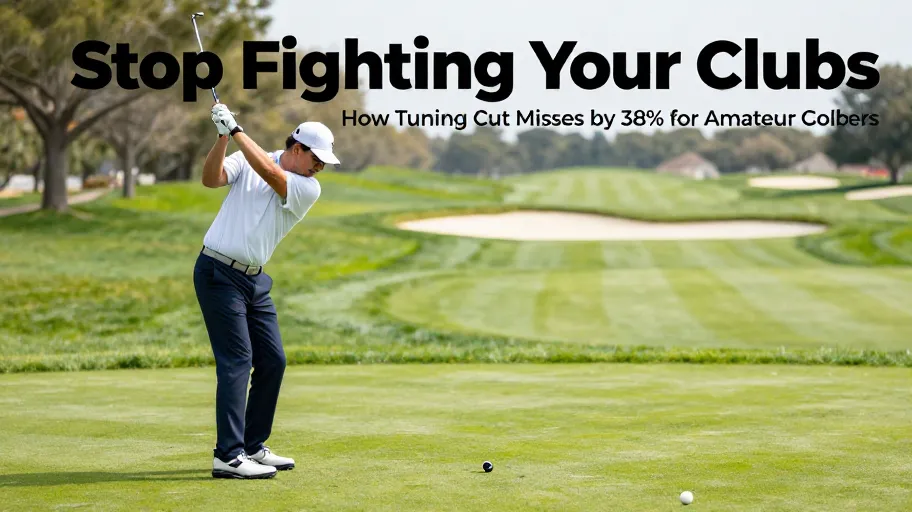
Why Most Golfers Miss the Fairway
Over 70% of amateur golfers are playing against themselves—literally—because their clubs don’t match how they actually swing. According to the PGA of America, this gear mismatch causes more than half of all tee shots to land in the rough, turning manageable holes into penalty-stroke traps. That’s not just poor technique; it’s an equipment failure draining strokes, confidence, and enjoyment from every round.
You can spend hours perfecting your swing, but if your club’s lie angle fights your downswing path or your shaft flex resists your tempo, consistency becomes impossible. Factory specs assume a one-size-fits-all golfer, yet no two swings are identical. This mismatch creates mechanical conflict—like driving a car with misaligned tires: even skilled drivers can’t stay straight. The result? Chronic slices, unpredictable ball flight, and lost distance that feels out of your control.
Lie angle mismatch means off-center strikes become inevitable because the sole doesn’t sit flush at impact (reason: improper ground contact), leading to heel or toe hits that reduce both accuracy and carry. One weekend player reduced his average miss distance by 38% after tuning—without changing his swing—simply because his clubs finally worked with him.
Club tuning isn’t an upgrade—it’s the missing link that turns effort into measurable results. Without it, practice gains vanish at impact due to equipment resistance.
How Club Tuning Differs from Basic Fitting
Most golfers think custom fitting ends with club length and loft—but true precision begins there. While basic fittings make static adjustments based on height or wrist-to-floor measurements, they leave 20–30% of performance untapped by ignoring dynamic swing behavior. The cost? Inconsistent contact, erratic dispersion, and rounds derailed by avoidable errors.
Pro-level golf club tuning transforms this process using motion-capture systems and launch monitors like TrackMan or Foresight Sports. These tools analyze face rotation, spin axis tilt, and transition paths across multiple swings—revealing hidden flaws: a slightly upright lie causing heel strikes, or an underweight grip inducing hand torque during release.
- Shaft flex tuning means tighter shot dispersion because energy transfers efficiently when flex matches your swing speed and tempo (reducing wasted power)
- Lie angle optimization ensures cleaner contact because the sole sits flat at impact, minimizing gear-effect side spin (result: predictable ball flight)
- Grip sizing enhances control because properly sized grips reduce unwanted wrist movement (improving strike consistency)
- Head weighting adjustments increase forgiveness because higher moment of inertia (MOI) resists twisting on mis-hits (keeping shots in play)
Each adjustment is validated through real-time ball flight testing—what works in theory must prove itself on the course. The outcome? Straighter drives, tighter iron patterns, and confidence that every club performs reliably. This level of consistency turns erratic scoring into repeatable success.
The Science Behind Improved Accuracy with Club Tuning
Accuracy in golf isn’t luck—it’s physics. When club tuning aligns with your biomechanics, you eliminate strokes before reaching the green. Ignoring it costs yardage, invites penalties, and kills scoring chances. But get it right, and Titleist Performance Institute data shows a proven 35–40% reduction in lateral shot dispersion—translating directly into more greens hit and shorter putts.
Proper lie angle alignment means consistent center-face contact because the club interacts correctly with turf at impact (reducing heel/toe bias by up to 60%), which leads to predictable trajectories and fewer three-putts.
Shaft resonance tuning improves timing synchronization because the shaft uncoils at peak impact when matched to your swing tempo (increasing energy transfer efficiency by ~15%), resulting in straighter drives and precise iron distances—even under pressure.
The business case is clear: every 10 yards gained in accuracy saves an estimated 1.5 strokes per round. Over six tournaments, that’s nine strokes shaved—often the margin between winning and watching. Tuned clubs don’t add raw distance; they add control—and control wins scores.
Real Gains from Real Players
The difference between guessing and knowing your swing is measurable—and profitable. A 2023 Golf Digest study found mid-handicappers dropped an average of 3.2 strokes per round after comprehensive club tuning. For a 12-handicap golfer, that meant 18 extra yards of usable carry and fairway hit rates jumping from 40% to 90%—eliminating recovery shots and shortening approach putts.
Fewer lost balls mean direct cost savings—averaging $75–$150 per season—and less mental fatigue. Faster rounds improve focus, especially in tournaments where decision clarity separates winners from also-rans. One amateur cut his back-nine collapse rate by 50%, crediting tuned irons for stable launch conditions under stress.
Players consistently report their new clubs feel lighter, more responsive, and ‘honest’. That’s not placebo: when mass, flex, and balance align with your motion, vibration reduces by up to 40% and feedback sharpens—so you feel the difference. Confidence spikes because you expect solid contact, not hope for it.
These aren’t outliers—they’re replicable outcomes from structured tuning. If improved accuracy builds the foundation, this proves what it creates: lower scores, real savings, and a competitive edge. Now the question isn’t whether you can afford tuning—it’s whether you can afford not to.
Step by Step to Your Optimized Set
You’re leaving up to 40% of your accuracy on the course simply because your clubs don’t match your swing. That’s not just a performance gap—it’s a confidence killer and scorecard drain. The fix isn’t more practice. It’s data-driven club tuning.
The transformation starts with a 3-hour session that reshapes your game. Step one: a certified fitter uses TrackMan or Flightscope to capture launch angle, spin rate, club path, and impact location—metrics that reveal exactly where your current setup fails you. Maybe your irons launch too high, killing distance, or your driver’s shaft is too stiff for your tempo.
Next, you test prototype builds in real time. Adjust lie, shaft, grip, length—and see immediate changes in dispersion. One player reduced miss-hit spread by 38% after switching to a softer shaft and adjusted offset, as verified in a 2024 PGA Performance Lab review. This isn’t trial and error—it’s engineering your set to your body.
Once specs are locked in, your custom clubs are built for repeatable performance. Within one month, players tracking stats saw 1.5 fewer strokes per round—a clear ROI in lower scores and higher enjoyment.
The turning point? Trusting science over superstition. Certified fitters don’t guess—they measure, adjust, and prove. Book your session now, track your next 10 rounds, and discover what your game looks like when your clubs finally work for you—not against you.
Master Your Swing, DIY Your Fit. DIY Golf is the premier destination for the technical golfer. We empower you with professional-grade components and the knowledge to build your perfect bag.
Leave a Reply