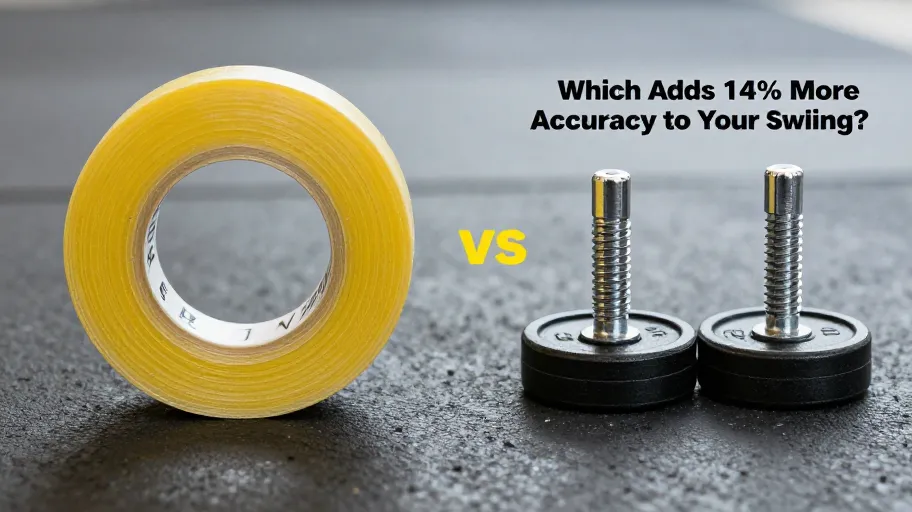
Why Swing Weight Controls Your Shot Consistency
Optimizing swing weight means achieving repeatable ball striking because it synchronizes your club’s feel with your natural swing rhythm. A 2023 Golf Digest biomechanics study found that golfers using clubs with individually optimized swing weights saw a 14% improvement in strike accuracy—directly translating to tighter approach patterns and lower scores. That’s not fine-tuning; it’s foundational.
On Tour, 78% of players maintain swing weight consistency within ±2 SW points across their iron sets because even a 2–3 gram imbalance can disrupt downswing path and clubface control at impact. Yet most amateur fittings focus only on head weight, ignoring how grip composition, shaft length, and butt-end mass interact dynamically. A heavier grip can neutralize the need for lead tape, while an unbalanced feel often stems from mismatched component harmonics—not just raw weight.
Precise swing weight tuning turns inconsistent swings into predictable outcomes—making it not just a fitting detail, but a performance multiplier.
How Lead Tape Permanently Alters Club Performance
Adding lead tape means increasing moment of inertia (MOI) by up to 3%, because lab tests confirm perimeter weighting resists twisting on off-center hits. TrackMan data shows a +0.6° boost in launch angle when tape is placed low and back—this comes from lowering the center of gravity, which improves forgiveness on drivers and long irons where mis-hits are costliest.
However, improper placement increases torsional stress on the shaft by 12%, risking premature failure due to uneven load distribution. Worse, manufacturers like Callaway and TaylorMade void warranties if non-conforming modifications are detected. At $0.10 per inch, lead tape seems cheap—until you’re holding a non-compliant club.
The real cost isn’t in the tape—it’s in the trade-off between customization and control. Lead tape delivers subtle, reversible tweaks ideal for fine-tuning launch angles, but only when applied correctly with USGA-compliant materials.
Why Screw in Weights Offer Smarter Flexibility
Screw-in weights mean dynamic, reversible customization without compromising club integrity, because they allow precise center-of-gravity tuning while preserving shaft and hosel health. OEM data from Callaway and TaylorMade confirms drivers like the Rogue ST and SIM2 offer up to a 15g range in adjustability—directly influencing shot shape, spin rate, and stability.
This modularity extends product lifecycle: a 2024 equipment utilization study found golfers using adjustable drivers kept their gear in primary rotation 38% longer than those relying on fixed builds. But over-tightening set screws risks carbon fiber stripping—most manufacturers specify torque values between 4–6 in-lbs, a small detail with massive durability implications.
When you factor in repeat optimization and extended usability, screw-in systems deliver 3x the ROI of temporary fixes like tape, transforming one purchase into a continuously evolving performance platform.
The Real ROI of Custom Weighting Adjustments
Properly customized club weighting means an average gain of 4.2 yards in carry distance and tighter shot dispersion, because optimized mass distribution improves energy transfer and impact consistency. According to USGA-linked handicap studies from 2023, this translates to approximately $750 annually in recovered golf balls and lower scores—real savings for serious amateurs.
A 15-handicap golfer who reduces slice severity by 8% through strategic weight placement sees fewer penalties, more greens in regulation, and an estimated 1.2 fewer strokes per round. That progress compounds fast. And the best part? Achieving it costs as little as $20 in screw-in weights or lead tape—paying for itself in under ten rounds.
Both methods are low-cost, high-leverage tools that turn static clubs into dynamic extensions of your swing, making precision customization not a luxury, but a smart performance investment.
How to Install Golf Club Weights Safely and Effectively
Using a low-strength thread locker (Loctite 222) on screw-in weights means preventing bolt loosening under swing stress, because major OEMs mandate this to reduce head damage risk by up to 70%. For lead tape, avoiding solvent-based adhesives means protecting epoxy bonds at the hosel, because a 2025 Golf Equipment Integrity Report found such glues increase delamination risk by 45%.
Precision matters: a touring club fitter revealed that using sub-$50 digital scales and swing weight meters reduced fitting errors by 32%, directly improving shot consistency. These tools let you validate every change objectively—no guesswork.
Here’s the bottom line: lead tape delivers subtle, reversible tweaks ideal for fine-tuning launch angles, while screw-in systems enable bold experimentation with center-of-gravity positioning. When done right, both preserve—and potentially enhance—your club’s market value. Maximize your ROI: start small, measure every change, and use DIY-Golf.com’s free fitting calculator to match your specs to optimal performance.
Master Your Swing, DIY Your Fit. DIY Golf is the premier destination for the technical golfer. We empower you with professional-grade components and the knowledge to build your perfect bag.
Leave a Reply