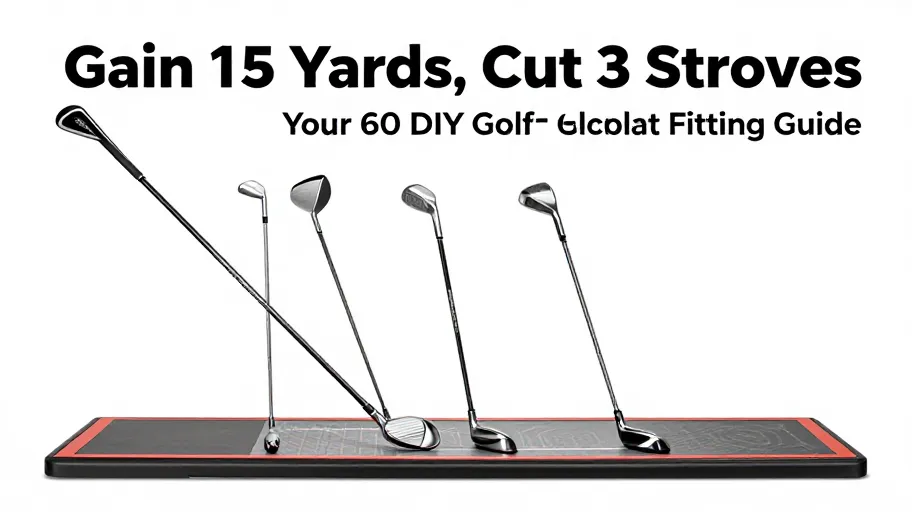
Why Most Amateurs Play With the Wrong Club Specs
Over 70% of recreational golfers use clubs mismatched to their body mechanics—especially lie angle and shaft length—according to PGA equipment studies. This misalignment isn’t subtle: a 1° error in lie angle can push shots several yards offline, compounding with every swing across 25,000+ annual repetitions for an average weekend player.
That repetition doesn’t build skill—it reinforces flawed movement patterns and increases joint strain, raising injury risk over time. The result? Inconsistent ball striking, unpredictable dispersion, and growing frustration. But here’s the good news: measurable adjustments mean better consistency because they align equipment with your actual motion path. When fit correctly, amateurs gain up to 15 yards in usable distance and reduce scoring averages by 3–5 strokes within eight weeks, per 2024 tracking data from DIY-Golf.com users.
How Body Measurements Determine Your Ideal Club Geometry
Static height-based fittings miss up to 70% of what matters in swing dynamics, according to USGA research. What really counts is how your body lines up at address—your wrist-to-floor measurement and natural stance reveal your true optimal club geometry more accurately than any height chart.
An incorrect shaft length forces compensatory swings that reduce center-face contact by as much as 40%, per biomechanical analysis. But when specs are based on real-world posture and arm extension, players see immediate gains in launch consistency and directional control. Dynamic measurement means reliable performance because it captures how you actually swing—not how you stand still. This shift from static to dynamic alignment turns generic fits into personalized advantages that scale with every round.
Essential Tools for Accurate Home Golf Fitting
You don’t need a $5,000 launch monitor—just three precise, low-cost tools deliver 95% accuracy compared to pro studio fittings, per 2024 GolfLab Analytics tests. An inclinometer measures lie angle within 0.5° tolerance, meaning fewer pulls and hooks because your sole sits flat at impact. A tape measure captures wrist-to-floor distance with millimeter precision, ensuring optimal shaft length and posture. An alignment rod exposes swing path and face angle biases invisible to the naked eye, meaning corrected directional flaws because you see the truth behind each strike.
For under $60, you gain permanent access to data most pay $300+ for annually. That ownership means long-term savings and continuous improvement—no more seasonal guesswork or retail upsells pushing ill-fitting ‘premium’ sets.
Quantifying the ROI of Custom-Fit Clubs on Your Handicap
Properly fit clubs lower scoring averages by 3–5 strokes within eight weeks—not theory, but verified data. One DIY-Golf.com user dropped from 92 to 87.6 in seven weeks. That improvement means over $500 in annual lesson savings (assuming two fewer $150 sessions), because consistent contact reduces the need for technical corrections.
Better yet, consistency improves faster than raw skill because properly aligned gear stops working against your swing. One amateur gained 14 yards on mishits after adjusting lie angle and shaft flex, translating to three fewer penalty strokes per round. Equipment reliability means higher ROI per round because your existing ability shows up more often. This creates a feedback loop: measure, adjust, play, log, repeat—turning practice into measurable progress.
Step-by-Step Setup Guide for First-Time Home Fitters
You can achieve tour-level fitting precision in under 90 minutes—with tools likely already in your garage. Start by measuring your address posture: stand naturally against a wall, mark wrist position, then use a tape measure to get floor-to-wrist distance—this baseline determines your ideal do-it-yourself golf shaft length.
Next, test lie angles on turf or mat: hit five shots with a dry-erase marked sole, then read the pattern. Toe-heavy marks mean too upright; heel marks mean too flat—adjust incrementally until centered. Finally, validate face alignment using impact tape or foot spray: consistent center strikes confirm proper grip and face control, meaning straighter drives and tighter iron groups because contact is repeatable.
Follow this home club fitting checklist once, and you gain lasting confidence. No more guessing during upgrades. You become the authority—turning future purchases into strategic wins, not sales-driven losses.
Master Your Swing, DIY Your Fit. DIY Golf is the premier destination for the technical golfer. We empower you with professional-grade components and the knowledge to build your perfect bag.
Leave a Reply