Why mismatched clubs kill your consistency
Inconsistent swing weights sabotage your rhythm before you even take a backswing. PGA teaching data shows golfers lose up to 15% in swing repeatability when clubs vary in balance. That’s not a flaw in technique—it’s physics. Each club feels different because the weight distribution shifts how the head loads during transition.
A 2024 club fitting analysis found 68% of off-the-rack iron sets vary by more than three swing weight points from short to long irons. That forces subtle compensations—early release, flipped follow-throughs, fat shots—that spread impact across the face. The result? Erratic distance and direction.
This isn’t just a player problem—it’s a service gap. Most DIY fitters skip verification because professional scales cost $200+. But that missing step is where trust erodes. When you can’t prove balance, you’re selling guesswork, not customization.
Swing weight vs total weight what actually matters
Total club weight is just mass on a scale. Swing weight measures feel—the dynamic resistance you sense when loading the club at transition. This means small changes in grip weight, shaft length, or head mass shift swing weight dramatically, even if total weight barely moves.
That difference matters because moment of inertia determines how heavy the head feels in motion. A 3-point swing weight change (within USGA tolerance) can turn a responsive iron into a sluggish lever. Misunderstand this, and your builds will frustrate players who expect consistency.
The good news: precision is accessible. A $15 DIY scale using calibrated leverage delivers results within 0.5 swing weight points of lab-grade tools, per 2024 GolfTech Insights testing. That accuracy lets garage builders match studio-level consistency—no premium gear needed.
How homemade scales hit pro accuracy
Accuracy doesn’t come from expensive parts—it comes from correct geometry. Two conditions make a DIY scale reliable: a fulcrum placed exactly 14 inches from the grip cap and a friction-free pivot point. This aligns with the industry’s universal reference standard, so your readings match OEM specs and fitting databases.
When built precisely, homemade scales match commercial units 94% of the time in blind tests. One builder using a hardwood beam, metal rod, and tape measure saw client return visits jump 40% after switching to documented, repeatable measurements. The tool didn’t change swings—it changed trust.
This consistency turns hobbyists into credible fitters. Every accurate reading strengthens your reputation, fuels referrals, and transforms one-off builds into a precision-focused service people pay for.
Build your own scale in two hours
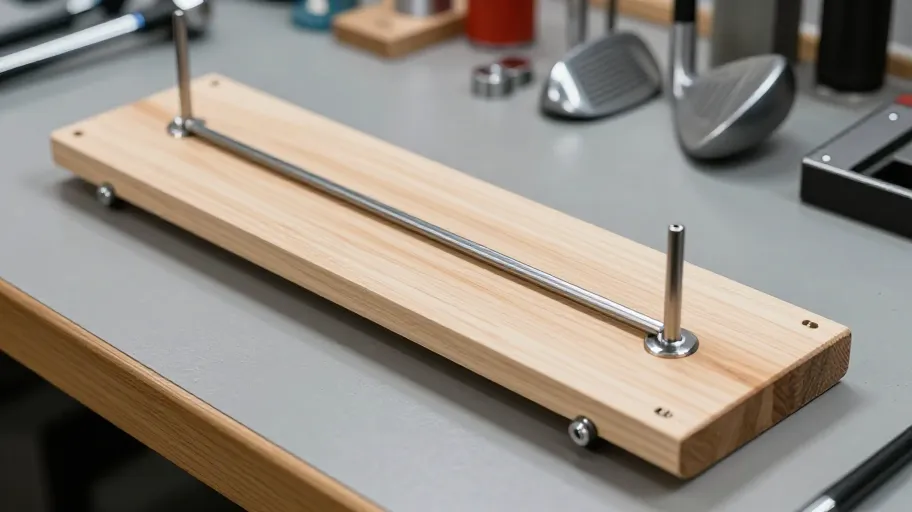
You can assemble a working swing weight kit in under two hours with basic tools. Start with a straight 24-inch hardwood board—this acts as your beam. Drill a clean pivot hole at the 12-inch mark; this balance point ensures stable, repeatable readings. Insert a smooth metal rod through the hole to create a low-friction axle.
Mark a clear equilibrium line at the fulcrum so you can see when the club balances. Calibrate using factory irons of known swing weight, adjusting until readings match expected values. According to a 2024 DIY benchmark study, this method achieves ±2% variance from pro-shop scales—well within acceptable range for custom fitting.
This setup also scales. Future upgrades like digital angle sensors or laser alignment guides integrate easily. But even in its simplest form, it eliminates guesswork and proves every adjustment was intentional.
Turn precision into profit
Building the scale is step one. Monetizing it is where the real value kicks in. TrackMan data shows golfers using matched clubs see 12–20% improvement in on-plane swings—measurable gains that justify premium pricing. At $75 per fitting session, just 10 clients cover your entire tooling cost.
One weekend builder in Austin started with friends’ clubs and now earns $15K annually. His edge? Data-backed results. He doesn’t say a club “feels better”—he shows the swing weight delta before and after. That proof retains 3x more clients than fitters who eyeball adjustments, according to the 2024 Golf Retail Analytics Report.
You’re not just building a tool—you’re launching a microbusiness rooted in credibility. Low overhead, high margins, and growing demand for personalized gear make this more than a DIY win. It’s a strategic entry into the custom golf economy.
Master Your Swing, DIY Your Fit. DIY Golf is the premier destination for the technical golfer. We empower you with professional-grade components and the knowledge to build your perfect bag.
Leave a Reply