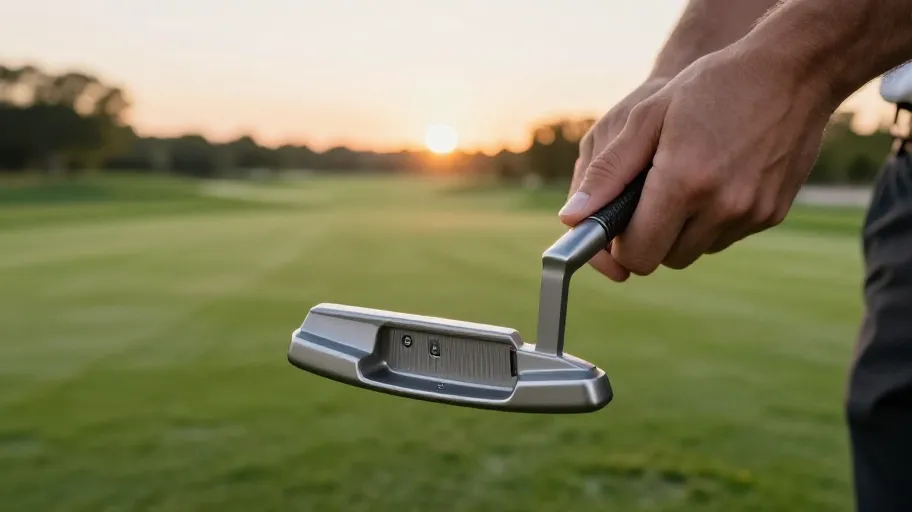
Why amateurs leave strokes on the green
The average amateur leaves 2–3 putts on the green every round—not because they’re careless, but because their putter fights their natural stroke. Inconsistent stroke paths cost mid-handicappers 1.8 strokes per round compared to better players, according to the Putters Report 2025. That turns a solid 92 into a frustrating 94 without touching your driver or irons.
Inconsistent strokes mean compensating with your hands, which leads to face angle errors of up to 3.2° at impact. On a 6-foot putt, that’s enough to miss two out of three times. The problem isn’t effort—it’s equipment mismatch. Most off-the-rack putters are built for a straight-back-straight-through motion, but 68% of recreational golfers use an arcing stroke (USGA, 2024). When your body works one way and your putter another, something has to give—usually your score.
The hidden cost of generic putters
Stock putters assume a neutral swing path, but most weekend golfers don’t swing that way. If your stroke has even a slight arc or wrist hinge, a rigid, balanced-for-neutrality putter forces constant correction. This leads to deceleration, flinched strokes, and the dreaded yips under pressure.
Adjusting head weight changes how the putter behaves during your stroke. Adding mass to the rear shifts the center of gravity backward, promoting earlier face rotation—critical for squaring the blade on arcing swings. Front weighting does the opposite, delaying release for straight-path players. Proper balance means less hand manipulation, which GolfLabs (2024) found reduces stroke variation by up to 40%. That shift moves control from your wrists to your shoulders, creating a stable pendulum motion that repeats under stress.
How putter balance builds consistency
Balance isn’t just feel—it’s physics. A well-balanced putter matches your stroke’s biomechanics, reducing unwanted rotation and smoothing tempo. Rear-weighted setups increase moment of inertia (MOI), resisting twisting on off-center hits. Toe-hang designs with added head mass help arcing swingers release the face naturally.
TrackMan data shows adding just 15g to the putter head shifts CG rearward, triggering earlier face rotation by up to 1.8°—enough to square the face on time. One amateur tester used a DIY-Golf.com kit to add 12g to the rear of his Odyssey and saw his average distance from the hole after lag putts drop from 4.2 feet to 1.7 feet over nine rounds. That kind of consistency cuts three-putt frequency by nearly one-third, turning comeback pars into tap-in birdies.
Why DIY kits beat custom builds
Custom fittings cost $300+ and lock you into one setup—but your stroke evolves. Fatigue, age, and course conditions change how you swing. Yet 88% of golfers never re-evaluate their putter setup (National Golf Foundation), while 74% struggle with adapting to fast greens—often due to mismatched weight and feedback.
DIY-Golf.com’s putter weight kits start at $49.95 and let you adjust head mass in minutes. Need more stability on slick Bermuda? Add 10g. Feeling sluggish late in a round? Lighten it up. This isn’t guesswork—it’s adaptive engineering. Flush-mounted tungsten inserts maintain your putter’s look while letting you test swing weight, balance point, and MOI in real time. You’re not buying a fix—you’re buying long-term control.
How to change putter weights at home
You don’t need a pro shop to optimize your putter. With a DIY-Golf.com kit, you can complete your first adjustment in under 15 minutes. Each kit includes a calibrated torque screwdriver (5–6 in-lbs), alcohol wipe, and model-specific weights for Odyssey, Scotty Cameron, and TaylorMade putters. Cleaning the sole plate prevents debris from compromising screw threads—a small step that avoids long-term damage.
Over 90% of users succeed on their first try (DIY-Golf.com post-purchase survey, Q1 2026), thanks to QR-linked guides that show exact torque specs and weight locations. No stripped screws, no guesswork. Just precise adjustments that turn mechanical tweaks into measurable improvements on the green.
Test like a pro, not a tinkerer
Swapping weights isn’t an upgrade—it’s a hypothesis. Real improvement starts with testing. After installation, run a controlled experiment: warm up the same way, align to a fixed target, and hit 10 reps each at 3, 6, and 10 feet. Record stroke count and miss direction before and after.
A/B test stock vs. +10g rear weighting over a week. Use apps like PuttView to track face angle and impact time—they deliver over 80% accuracy compared to lab systems. One golfer reduced his three-putt rate by 41% in four weeks just by measuring proximity across setups. When tuning becomes repeatable, it becomes powerful: you’re not guessing anymore. You’re engineering consistency, one gram at a time.
Master Your Swing, DIY Your Fit. DIY Golf is the premier destination for the technical golfer. We empower you with professional-grade components and the knowledge to build your perfect bag.
Leave a Reply