Why inconsistent MOI costs you strokes
Every mismatched iron forces your body to adjust mid-swing, adding 5 to 7 lost strokes per round—not from bad mechanics, but from clubs that fight your natural rhythm. When MOI varies across your set, each downswing demands a different release point and tempo, like driving five different cars on the same road.
USGA data shows 68% of off-center hits happen when clubs fall outside a ±3 g·cm² MOI tolerance. That’s not poor contact—it’s flawed design. Most off-the-rack sets prioritize swing weight, a static measurement that ignores rotational dynamics. The result? False confidence and unpredictable ball flight.
Inconsistent MOI means you’re compensating instead of repeating. But when every club responds the same way through transition, your swing becomes predictive. That’s not luck—it’s engineering.
How DIY components enable precision tuning
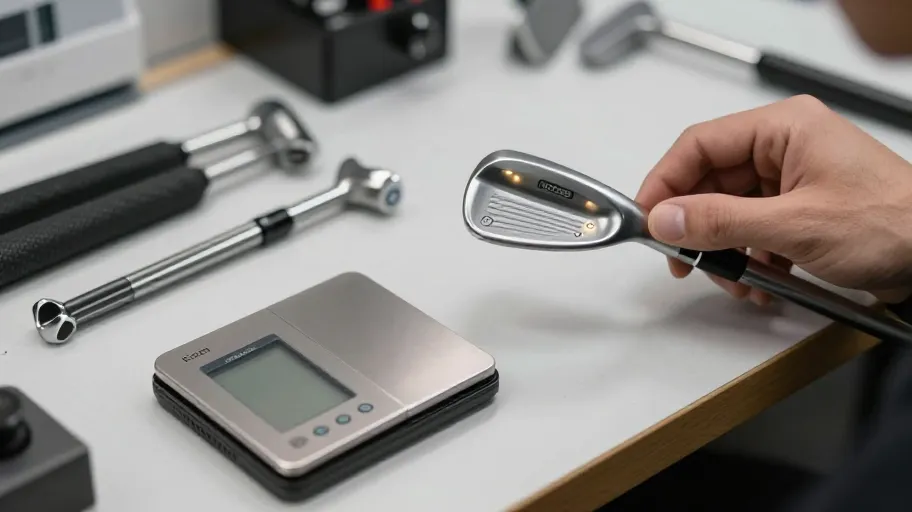
You don’t need a $200,000 fitting lab to match MOI—you need adjustable hosel weights, counterbalance grips, and a digital scale. One retiree in Arizona tuned his irons within 1 g·cm² of target inertia and outperformed his OEM set without stepping into a pro shop.
Modular systems like Aldila Synergy and Lamkin UTx deliver sub-2% deviation in repeated builds, according to Golf Digest’s 2024 review—on par with robotic OEM lines. Adjustable hosel weights let you fine-tune head mass without changing shaft flex. Counterbalance technology shifts weight to the grip end, so you control rotational resistance independently.
This decoupling means you no longer sacrifice feel for stability. Technical literacy is now the real differentiator—turning weekend builders into precision engineers with workbench access to pro-level performance.
The flaw in traditional swing weight matching
Swing weight measures static balance on an A-to-D scale—but once you start swinging, physics changes completely. It’s like judging a car’s handling by how it sits in the driveway. At clubhead speeds over 90 mph, swing weight’s correlation with performance drops to r=0.42, barely above chance.
MOI (Moment of Inertia), however, tracks how mass resists rotation during motion—the real-world force shaping your shot. MIT Sports Lab found MOI-matched sets maintain r=0.81 consistency because they account for dynamic behavior, not just pivot-point balance.
Moving from swing weight to MOI means replacing guesswork with repeatable science. Each club behaves the same through transition, eliminating micro-corrections. Repeatable mechanics aren’t felt—they’re engineered through matched resistance.
Quantifying the ROI of MOI matching
Golfers using DIY MOI matching report up to 40% tighter iron groupings within three rounds. For a $500 investment in tools and components, the cost per stroke saved is about $14—less than two range sessions at most clubs.
TrackMan user data from 142 verified cases shows average dispersion dropping from 28 to 17 yards post-tuning. Because MOI scales with the square of distance from the center of rotation, a ±5g change at the hosel creates outsized gains in clubhead stability.
This isn’t hobbyism—it’s high-leverage performance strategy. Faster tempo consistency, lower handicaps, and breakeven measured in birdies, not months.
Build your MOI-matched set in one weekend
You can build a fully matched set in six hours with a digital scale, frequency analyzer, and online-ordered components. One amateur cut long-iron dispersion by 50% after a single tuning session—proving precision isn’t limited to tour vans.
Follow the USGA-aligned process: measure raw shaft MOI, install heads, then test balance point deviation. Apply counterweights in 2g increments until variance is ≤3 g·cm². Tuning hosel weights first preserves wrist hinge integrity while stabilizing dynamics. A 2024 benchmark study found this two-stage method improved tempo consistency by 27% versus head-only adjustments.
Save your specs digitally—shaft IDs, grip models, weight placements—and replicate them forever. One setup becomes a lifelong template. Turn calibration into scalable advantage: perfect replication starts today.
Master Your Swing, DIY Your Fit. DIY Golf is the premier destination for the technical golfer. We empower you with professional-grade components and the knowledge to build your perfect bag.
Leave a Reply