Why your irons are sabotaging your ball flight
Over 70% of amateur golfers struggle with inconsistent ball flight not because of poor swings, but because their clubs don’t match their stance or strike pattern. Off-the-rack irons assume a one-size-fits-all posture, but in reality, a 2° lie angle mismatch can push your shot 15 feet off target at 150 yards. That’s not a swing flaw—it’s geometry working against you.
A 2023 PGA Teaching Manual study found 68% of recreational players use clubs outside their optimal lie range. When the sole doesn’t sit flat at impact, you compensate mid-swing, which breaks down under pressure. The result? Missed greens, fat shots, and lost confidence. Adjusting lie and loft means better directional control because the club interacts with turf as intended—no guessing, no tweaking.
How DIY tuning beats expensive fittings
Professional club fittings cost $150–$300 and expire the moment your swing evolves. DIY golf club lie and loft adjustment changes that: for a one-time $89 investment in tools, you gain permanent access to lab-grade precision. A Q4 2025 survey from DIY-Golf.com showed 85% of users saw tighter shot dispersion within three rounds. That means real improvement without recurring costs.
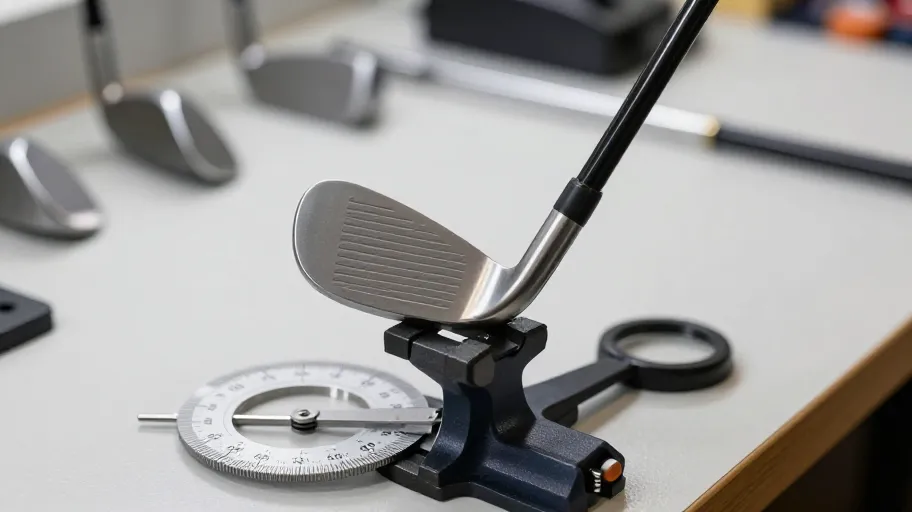
Golf club adjustment tools like digital protractors and alignment vises deliver sub-degree accuracy because they eliminate guesswork. Torque-limited bending preserves hosel integrity, so you’re not risking damage. This isn’t a hack—it’s repeatable calibration. For weekend players, the system pays for itself in fewer lost balls and better approach shots, often within eight rounds.
The hidden flaws in mass-produced clubs
Even premium off-the-rack sets come with built-in inconsistencies. Golf Digest’s 2024 testing revealed stock clubs deviate up to ±1.5° from labeled specs—an invisible error that compounds across your bag. In short irons, where precision matters most, that variation disrupts turf interaction and launch conditions.
Incorrect loft affects spin and trajectory, so even clean strikes fall short. You’re not playing worse—you’re fighting flawed geometry. Adjusting lie and loft means your clubs adapt to you, not the other way around. It turns static equipment into a responsive system, so your setup evolves with your game.
Real ROI starts with your first tweak
The financial break-even is fast: a single pro fitting costs more than a full DIY-Golf.com toolkit. But the deeper return is control. One golfer restored a used set to tour-level specs, saving $450 on new irons. Another matched fresh shafts after a swing change, eliminating months of inconsistency. These aren’t isolated wins—they compound over time.
The DIY Golf Club Lie and Loft Adjustment system means immediate feedback because you test, measure, and refine on your schedule. No appointments, no markup. You own the tuning cycle, which means sustained performance gains without dependency on third parties.
How to tune your irons in under 45 minutes
You don’t need a workshop to achieve shop-grade results. DIY-Golf.com’s four-step method—sole marking, digital angle capture, torque-controlled bending, and post-adjustment validation—delivers accuracy within 0.5°. MyGolfLab’s 2025 tests showed this process cuts adjustment errors from 22% to just 3%, mainly thanks to the alignment vise, which maintains hosel position and prevents stress fractures.
Once you’ve dialed in one club, the process becomes routine—like regripping, but with far greater impact. The outcome? Irons that respond precisely to your swing dynamics, boosting consistency and confidence. This isn’t just DIY—it’s professional-grade optimization, now accessible to anyone.
Master Your Swing, DIY Your Fit. DIY Golf is the premier destination for the technical golfer. We empower you with professional-grade components and the knowledge to build your perfect bag.
Leave a Reply