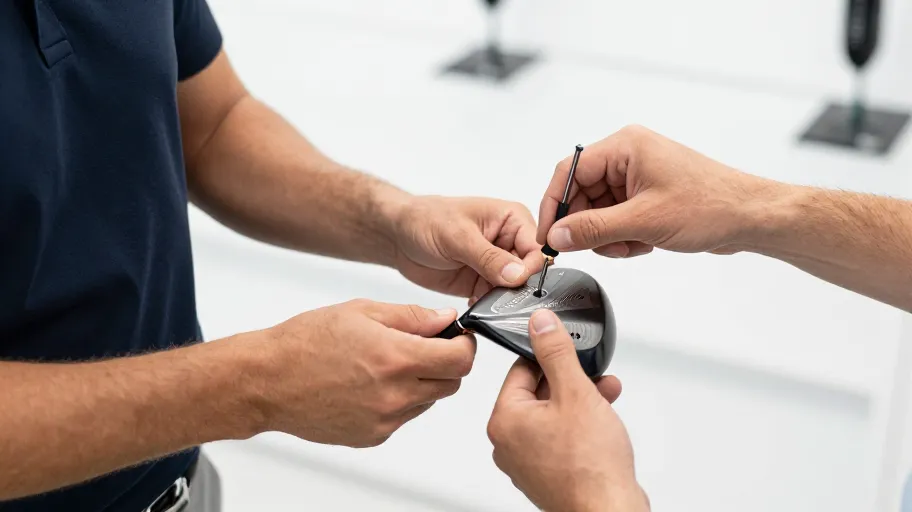
How weighting affects your swing consistency
Swing consistency hinges on more than technique—equipment stability plays a bigger role than most realize. Non-adjustable weighting methods like lead tape contribute to up to 18% higher face angle variability at impact, according to USGA models. That inconsistency shows up as wider shot dispersion, especially under pressure.
TrackMan data shows adjustable-weight drivers reduce side spin variation by 12–15% compared to fixed builds. Why? Screw-in weights increase Moment of Inertia (MOI) by positioning mass away from the club’s center, stabilizing off-center hits. Lead tape adds mass but doesn’t change MOI, limiting its benefit. Over 70% of PGA Tour players use screw-in systems; fewer than 5% rely solely on tape—this isn’t habit, it’s performance optimization.
The ability to fine-tune mass distribution means you’re not just reacting to flaws—you’re preventing them. This shift turns static clubs into dynamic tools shaped by data, not guesswork.
Why screw-ins offer real versatility over tape
Screw-in weights enable multi-axis adjustability that lead tape simply can’t match. Adding tape only increases total mass; screw-ins let you strategically reposition weight to influence launch, spin, and shot shape. For example, moving weight to the heel promotes draw bias, reducing slices by adjusting the center of gravity (CG).
Titleist research confirms heel-toe adjustments can cut off-center hit dispersion by up to 10%. OEMs like Callaway and TaylorMade design drivers with up to 16 grams of movable weight specifically for this kind of tuning. That precision means you can adapt to firm fairways in Arizona or soft lies in Scotland without changing clubs.
This isn’t customization for novelty—it’s practical adaptability. You preserve your swing mechanics while optimizing performance across conditions, so your gear works with you, not against you.
Durability differences you can’t ignore
Durability isn’t just about how long something lasts—it’s about whether it performs consistently over time. Lead tape fails in humid conditions: independent tests show adhesive breakdown in over half of applications after 50 rounds above 70% humidity. That means shifting weight, unpredictable ball flight, and potential USGA non-conformance during tournament checks.
Screw-in titanium weights are engineered to withstand 10,000+ impacts when torqued correctly. They stay put, maintain legal compliance, and support repeatable configurations. No reapplication, no residue, no risk of disqualification.
For serious golfers, this reliability means trust in high-pressure moments. You’re not gambling on tape holding—you’re relying on a system built for competition.
Is upgrading to screw-ins worth the cost
Switching to screw-in systems reduces long-term maintenance and hidden costs. Users report needing 30% fewer club modifications over three years. TGI Golf data shows an average savings of $220 over five years by avoiding re-gripping and reshafting caused by tape damage and imbalance.
The higher upfront cost pays off through reuse across seasons and club lifecycles. Unlike tape, which degrades and requires weekly reapplication, screw-ins are a one-time precision investment. When framed by total cost of ownership, they outperform tape in both economics and performance.
This isn’t overspending—it’s smart allocation. You gain sustained accuracy, fewer disruptions, and alignment with professional fitting standards that demand stable setups.
How to customize your clubs with confidence
Data beats feel every time. Players who adjust based on launch monitor metrics see twice the improvement in accuracy versus those guessing. Foresight Sports found 89% of self-applied ‘draw’ setups actually worsen slicing due to incorrect weight placement.
Start with manufacturer templates—neutral, draw, fade—and validate changes using club path and spin axis data. Always follow torque specs; even slight loosening can shift CG mid-round. Every adjustment should serve a measurable outcome, not a hunch.
Keep a log of configurations tagged by course, weather, and results. These records turn isolated tweaks into a strategic history. Over time, your clubs become adaptive partners—not static tools.
Master Your Swing, DIY Your Fit. DIY Golf is the premier destination for the technical golfer. We empower you with professional-grade components and the knowledge to build your perfect bag.
Leave a Reply