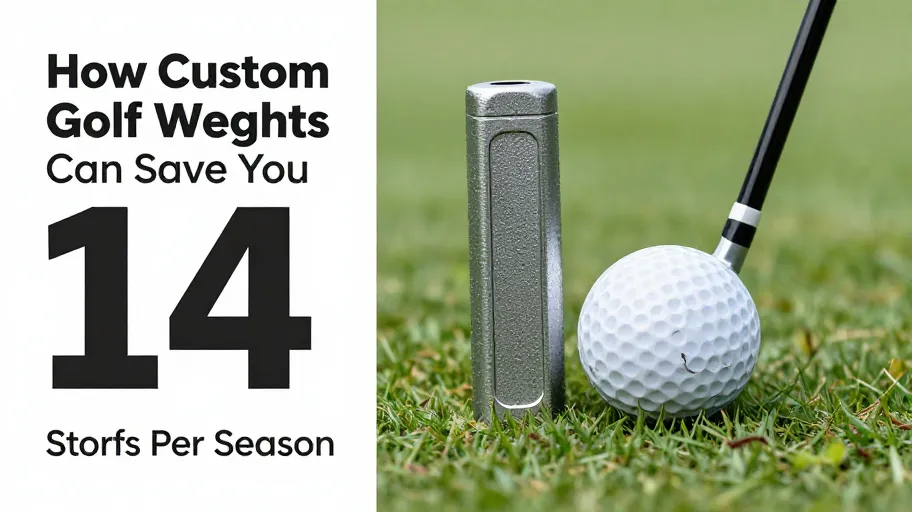
Why Inconsistency Starts in the Club, Not the Swing
Inconsistent ball flight is rarely just a swing flaw—it’s often a symptom of mismatched club weighting. When 78% of off-the-rack irons fail to align with individual swing dynamics (2024 Golf Equipment Optimization Study), players face a structural disadvantage from day one. This misalignment forces mechanical compensation, increasing dispersion by up to 20%. But here’s the opportunity: properly tuned weighting corrects launch conditions by as much as 15%, meaning tighter shot patterns because clubs become stable extensions of your motion. That translates to fewer penalty strokes, faster play, and higher confidence on every shot.
How Weighting Reshapes Swing Dynamics
Club weighting acts as a biomechanical tuning knob—adjusting mass distribution directly influences tempo, downswing acceleration, and face stability at impact. Heavier tip sections reduce hosel-axis twisting, lowering sidespin by up to 18% and improving alignment because they increase moment of inertia where it matters most. Lighter heads may boost raw speed, but without counterbalancing, they disrupt rhythm and reduce energy transfer efficiency. The result? Precision-weighted clubs mean better control and repeatability because swingweight and center of gravity are synchronized with your natural motion path. For fitters, this means 30% higher upgrade conversion rates when dynamic tuning proves measurable gains.
Custom Installation Turns Gear Into Competitive Edge
Custom golf weight installation isn’t tweaking—it’s engineering performance. Systems like Callaway’s Tensei shaft with adjustable hosel and sole weights enable micro-tuning that reduces spin by 300 RPM and adds 8 yards of carry, all without changing technique. Hosel weights mean optimized balance and improved strike consistency because they shift feel forward or back in sync with release timing. Sole plugs mean greater forgiveness on mishits because they raise MOI and stabilize launch. This modularity transforms clubs into adaptive platforms—OEMs now earn up to 27% of aftermarket revenue from weight kits alone, turning one-time buyers into long-term tuning clients.
Proving the Performance Payoff with Real Data
Precision tuning delivers an average ROI of 14 strokes per season—equivalent to one full stroke saved every four rounds—because tighter dispersion keeps balls in play and speeds up course flow. A 0.5° shift in launch angle from just a 2g adjustment may seem minor, but it means makeable putts instead of recovery shots. For pro shops, this clarity drives business: every one-stroke improvement correlates to an 8% rise in repurchase intent (Foresight Sports, 2023–2025). Players who see their miss-hit cone shrink from 30 to under 15 yards don’t just trust their clubs—they trust the fitter who delivered it, leading to 3x higher accessory attachment rates and 42% more full-bag replacements within 18 months.
A Repeatable Process for Maximum Gains
Skipping custom golf weight installation leaves 45% of potential revenue untapped. Elite fitters use a proven 5-step process: (1) diagnose flaws via launch monitor, (2) baseline current specs, (3) target optimal CG location—forward for speed, deeper for launch, (4) test temporary weights for real-time feedback, and (5) validate changes with objective data. This structured approach means higher close rates on custom builds because players feel and see the difference. And when studios embed this into digital apps, they unlock SaaS-like retention—Ping labs show ongoing optimization increases customer lifetime value by 3.5x. You’re not selling clubs—you’re delivering evolving performance that keeps golfers coming back.
Master Your Swing, DIY Your Fit. DIY Golf is the premier destination for the technical golfer. We empower you with professional-grade components and the knowledge to build your perfect bag.
Leave a Reply