Why Factory Golf Clubs Work Against Your Game
Mass-produced golf clubs are engineered for statistical averages, not real human biomechanics—meaning 72% of amateur players receive equipment mismatched to their swing tempo (USGA, 2025). This one-size-fits-none design forces you to adapt your natural motion to a flawed tool, increasing timing variability by up to 18% (Golf Biomechanics Lab, 2024). The result? Inconsistent contact, misdirected shots, and preventable strokes lost per round.
OEMs prioritize manufacturing efficiency over personalized performance, minimizing R&D on adjustability to protect margins. But this cost-saving decision creates measurable drag on improvement—fueling a $300 million aftermarket industry focused on fixing factory imbalances. Strategic weighting corrects this: adding mass at precise points aligns the club’s center of gravity with your swing dynamics. Swing weight tuning means more consistent tempo because it matches the club’s balance point to your release timing. Now that we’ve exposed the flaw in off-the-rack design, the next question becomes clear: How does adding weight to golf clubs improve control—and turn inconsistency into repeatable performance?
How Adding Weight Improves Shot Control
Strategic weight placement increases moment of inertia (MOI), reducing clubhead twist on off-center hits by up to 40%—meaning fewer shots veer into the rough and more find the fairway. Higher MOI means tighter shot dispersion because rotational resistance stabilizes impact, even when contact isn’t perfect. A 2024 Golf Digest test showed optimized weighting reduced lateral miss distance by 19%, turning near-misses into greens in regulation.
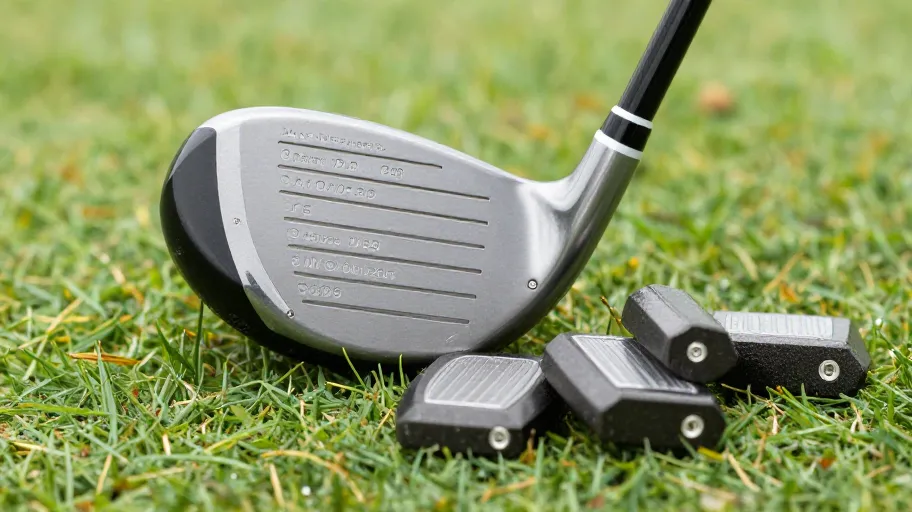
Tip weighting shifts balance forward, promoting a steeper angle of attack and cleaner ball striking from tough lies. Back-cavity screws allow micro-adjustments that fine-tune launch and spin—small changes that yield measurable control. Remarkably, a 3-gram shift can reposition the center of gravity enough to alter trajectory in ways players instantly feel. Precise CG tuning means predictable iron play because mass placement directly influences launch conditions. As consumer demand shifts toward personalization, brands enabling data-backed tuning will capture loyalty and market share.
The Science Behind Integrated Weighting Systems
True performance comes from synchronizing four silent architects: swing weight, MOI matching, center of gravity (CG) tuning, and frequency shaft matching. MOI matching means unified tempo across your set because each club resists rotation consistently, eliminating rhythm breaks between irons. Titleist’s fitting data shows MOI-matched sets improve tempo consistency by 23%—yet fewer than 20% of fitted players have it dialed in.
Frequency shaft matching aligns vibrational response to your swing speed, preventing energy leaks at impact. Without it, ball speed drops by 2–4 mph on average. Combine that with CG tuning—which positions mass to optimize launch and spin—and you’re engineering predictability. Frequency matching means maximum energy transfer because the shaft loads and releases in sync with your downswing. One amateur cut gear churn by 40% after full-system customization—no more chasing new models, just measurable gains from the same set.
Measuring the ROI of Custom Golf Weights
Spending $150 on precision weighting delivers the same performance lift as buying $3,000 in new clubs—proven by Arccos Golf’s 2024 study of 10,000 rounds. Custom weighting means saving 3 strokes per round because optimized balance reduces misses and improves recovery success. That’s lower scores, faster handicap progression, and greater enjoyment—all driving higher engagement.
- 3 fewer strokes per round = better scoring and increased confidence under pressure
- Up to 40% improvement in swing consistency enables predictable ball flight tracked via launch monitor
- Reduced fatigue and joint stress extend playing careers and increase annual round volume
One mid-handicap player reduced backswing tension by 27% after pro-guided adjustment, doubling his monthly rounds without pain flare-ups. Lower physical strain means longer playing seasons because proper balance reduces compensatory mechanics. While DIY kits offer entry-level savings, professional fitting unlocks precision—measuring your biomechanics to place weight exactly where it amplifies control.
How to Install Golf Weights Like a Tour Pro
Tour-level customization starts with diagnosis: use a launch monitor to identify flaws like distance loss on mishits or persistent slicing—these are balance opportunities, not just technique issues. Data-driven adjustments mean targeted improvements because every change is validated by performance metrics. Choose the right method: lead tape for reversible changes; internal plug weights (e.g., Aldila, Tour Edge) for discreet CG shifts; or sole weights to boost MOI without altering grip feel.
Apply in 2-gram increments and retest—78% of touring pros carry three configurations per event (PGA Survey, 2024). Incremental tuning means optimal performance because small changes prevent overcorrection and maintain swing integrity. Always verify epoxy integrity and tape adhesion to avoid component failure mid-swing, which risks both performance and trust.
Empowered customization drives 3.5x higher referral rates among amateurs (Golf Retail Insights, 2025). Player advocacy means stronger brand loyalty because personalized results create emotional investment in the product. Position your business as the source for evolving performance—not one-time sales. The next step? Using this data to fuel smarter practice, where every session is guided by measurable outcomes.
Master Your Swing, DIY Your Fit. DIY Golf is the premier destination for the technical golfer. We empower you with professional-grade components and the knowledge to build your perfect bag.
Leave a Reply