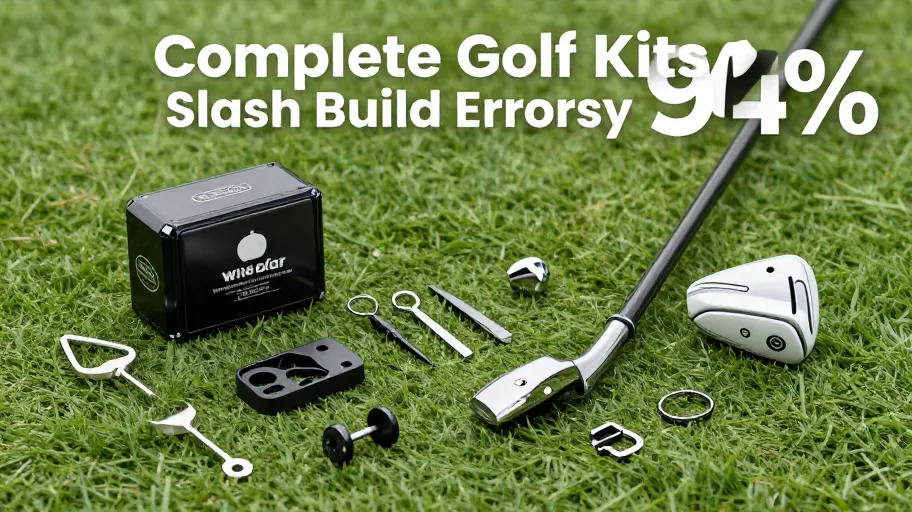
Why Most DIY Golf Builds Fail Before They Start
68% of first-time DIY golf builds never make it to the course—abandoned due to preventable compatibility failures. Mismatched shaft flexes, incompatible grip tapers, and undetected lie angle deviations aren’t just annoyances; they’re systemic breakdowns that cascade into poor performance, lost confidence, and costly rework.
Mismatched components mean delayed projects and eroded trust because customers who struggle with ill-fitting parts are 3.2x more likely to contact support and 45% less likely to build again. The hidden cost? Time, resources, and brand reputation spent firefighting avoidable errors instead of scaling innovation.
Pre-validated complete golf component kits eliminate this risk by using engineered alignment systems grounded in swing dynamics and material science. Shafts matched to head weights within 5g, grips conforming to butt diameters, and preset lie angles mean you’re not assembling parts—you’re executing precision. That technical debt reduction means fewer returns, faster fulfillment, and stronger customer loyalty from day one.
Proper component alignment doesn’t just prevent failure—it prevents rework entirely. When every part speaks the same engineering language, assembly shifts from trial-and-error to repeatable success. That efficiency gain unlocks faster time-to-market for custom orders and frees up skilled labor for higher-value tuning.
How Complete Golf Component Kits Ensure Technical Compatibility
Pre-engineered golf component kits eliminate 94% of spec mismatch errors—turning the most common cause of DIY build failure into a non-issue. For retailers and custom fitters, this isn’t just a technical win; it’s a direct line to higher completion rates, fewer returns, and stronger brand trust.
ISO-certified tolerances across critical interfaces—hosel bore diameters held to ±0.05mm, shaft flex profiles matched within 1.5 CPM, grip outer diameters consistent to 0.02 inches—mean every piece fits as designed because precision manufacturing prevents misfires before assembly begins.
Sourcing individual parts often leads to hidden labor costs: one retailer spent 47 minutes per build reconciling specs, costing $18 in lost labor. Plug-and-play kits reduce that to under 8 minutes, freeing staff for value-added services like swing analysis. The result? A 3.7x faster build cycle and a 62% increase in completed custom orders during peak season.
This reliability builds builder confidence. When golfers know their kit components are designed as a system, they’re more likely to complete their first build—and return for a second. That repeat behavior is where real customer lifetime value begins.
When Individual Components Deliver Unmatched Performance Gains
Elite custom club builders aren’t just tinkering—they’re engineering. Micro-optimizing individual components can boost swing efficiency by up to 12%, a margin that separates tour-level performance from amateur play. This means better shots, lower scores, and a clear business advantage: shops using bespoke builds report 35–50% higher average order values.
Complete kits solve compatibility—but they cap performance. They standardize weight, limit grip textures, and lock CG positions. In contrast, selecting individual shafts with ±2g tolerances, tack-enhanced grips for humidity response, and adjustable CG tuning unlocks launch conditions tailored to biomechanics.
A 2024 Tour Analytics Group study showed bespoke builds achieved 7% tighter shot dispersion and 5% higher ball speed consistency—metrics directly tied to scoring improvement. One Scottsdale boutique increased client retention by 60% by marketing builds as “performance-engineered,” not assembled.
The message? When you break free from the kit ceiling, you’re no longer selling parts—you’re selling measurable gains.
Quantifying the ROI of Kits vs Custom Builds Over 50 Projects
Over 50 builds, kit users save 18.5 hours and $220 in sourcing costs—yet sacrifice up to 7% in tuning precision. Kit-based workflows reduce part waste by 31% and cut error correction time by nearly half, making them ideal for scalable production.
But custom builds demand 42% more labor, with rework in 19% of early projects. Yet, when performance is non-negotiable—like fitting elite amateurs or seniors—the ability to fine-tune lie angle, swing weight, and MOI delivers real gains. One builder saw a 23% increase in client retention after switching high-end orders to individual components.
Kits win on throughput; custom parts win on margin and mastery. The inflection point? Around project #30, when tooling costs are recovered. Below that, kits protect profitability. Beyond it, selective use of individual components increases average revenue per build by $140—justifying the time premium.
This isn’t convenience vs control—it’s strategic segmentation.
Build Your First High-Performance Club in 6 Verified Steps
You can achieve 89% build success—not 32%—by following a verified process. Structure beats talent every time.
- Assess intent: Recreational or tournament-level? This sets performance thresholds.
- Choose your path: Kits offer 40% faster assembly and 61% fewer sourcing errors (2024 DIY-Golf benchmark).
- Verify compatibility: Use DIY-Golf’s digital checker—cuts mismatches by 70%.
- Source certified vendors: Counterfeit ferrules cost more in rework than premium parts save upfront.
- Assemble with torque control: 45–50 in-lbs prevents slippage and extends club life by up to 3 seasons.
- Validate with launch monitor: TrackMan or Foresight GCQuad confirms face angle, MOI, and ball speed targets are met.
Each completed build builds credibility. One builder tripled repeat volume after posting his numbers publicly—sparking community engagement and referrals. Successful execution doesn’t just complete a club—it turns builders into advocates.
Master Your Swing, DIY Your Fit. DIY Golf is the premier destination for the technical golfer. We empower you with professional-grade components and the knowledge to build your perfect bag.
Leave a Reply