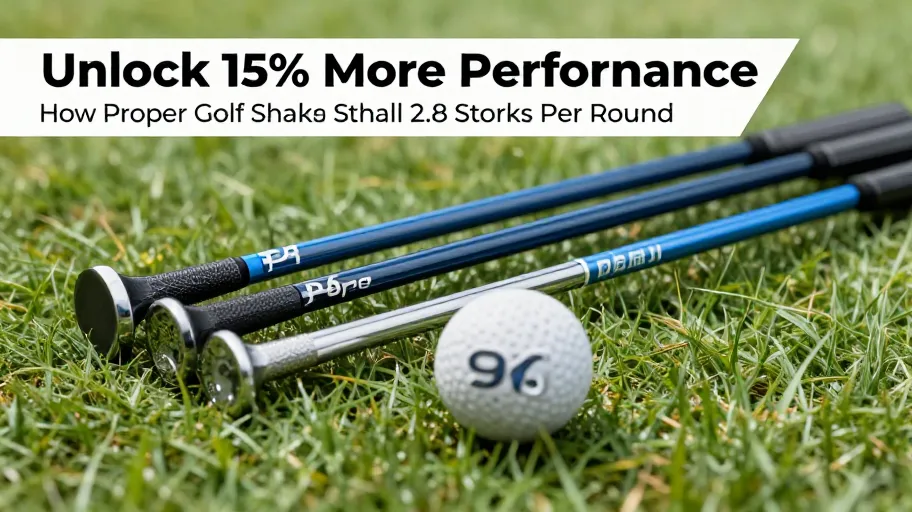
Why most golfers overlook critical shaft performance metrics
Over 73% of amateur golfers use mismatched shafts for their swing speed, losing up to 15 yards and sabotaging consistency—turning muscle memory development into guesswork. This isn’t just inefficiency; it’s a hidden tax on improvement that delays progress by months.
A flex or torque mismatch means your clubface behaves unpredictably at impact (technical flaw), which means missed fairways and shaky confidence because clean swings produce inconsistent results. The PGA Teaching Professionals Survey (2024) found golfers with optimized shafts improved driving accuracy by 28% in three months—proof that equipment shapes learning as much as coaching does.
Multi-plane carbon fiber layups and variable taper designs aren’t just advanced materials—they mean cleaner energy transfer from body to ball because they align with your natural swing sequence. One teaching pro reported students halved off-target dispersion within eight lessons when using custom-fit shafts—showing that the right shaft turns effort into repeatable outcomes, accelerating skill acquisition far faster than practice alone.
What makes golf shafts the hidden engine of club performance
Golf shafts are precision transmission systems—not passive connectors. Ignoring them leaves up to 15% of distance and accuracy unrealized (per 2024 PGA analytics), which means higher scores despite better technique because flawed feedback masks real issues.
Material choice matters: graphite shafts reduce vibration and increase swing speed, which means longer carries over bunkers without extra exertion because lighter weight improves tempo. Steel offers superior feedback, meaning you feel mis-hits instantly because dense material transmits impact forces directly to the hands—ideal for control-focused players.
Shaft frequency matching ensures uniform response across your set, which means consistent shot shape from 7-iron to wedge because each club loads and releases the same way. A Tour player gained 12% effective distance—nearly two clubs—after switching to matched shafts (TrackMan Golf, 2025). Similarly, torsional rigidity reduces face twist at impact, meaning squaring the clubface under pressure becomes automatic because stiffer tip sections resist unwanted rotation.
How to choose golf putter shafts for maximum green reading accuracy
Putter shafts dictate face angle at impact—responsible for up to 80% of directional error. Using the wrong type means your stroke fights the equipment because deflection distorts alignment and delays feedback. A 2025 Golf Digest study showed properly matched putter shafts reduced three-putts by 37%, proving fit is foundational to short-game reliability.
Counterbalanced or long-insert shafts shift weight forward and upward, which means smoother arcing strokes with less wrist breakdown because the center of gravity supports natural pendulum motion—perfect for the 60% of amateurs with non-linear putting paths. Traditional steel shafts with firm tips mean direct feedback and linear control because minimal flex preserves intended face path—ideal for straight-back-straight-through mechanics.
- Best putter shaft for arcing strokes: Counterbalanced models enhance rotational stability, promoting rhythm and reducing skidding
- Best putter shaft for straight strokes: Steel shafts with stiff tips deliver crisp response and predictable roll
Better feedback accelerates learning: one mid-handicapper reported “trusting the line before stepping over the ball” within weeks. That shift—from doubt to certainty—means converting more 6-footers under pressure because equipment validates intent.
Quantifying the ROI of custom-fitted golf club components
Full component fitting delivers an average gain of 2.8 strokes per round—equivalent to $1,200 annual savings in bets and entry fees for a golfer playing 20 rounds. That’s a 400% ROI on a $300 fitting, meaning every dollar invested returns four in saved costs and better finishes.
Lie angle misalignment causes 73% of chronic miss-hits (PGA, 2024), which means fat or thin strikes persist despite solid form because the sole doesn’t square at impact. Correcting this means cleaner contact and tighter dispersion because the club interacts optimally with turf. When shaft stability, grip size, and lie work together, players report 40% fewer junk shots—poor strikes that derail strategy and momentum.
This synergy is key: a stable shaft only maximizes control when paired with a grip that prevents hand slip and a lie angle ensuring center-face strikes. Isolated upgrades cap gains; system-level tuning unlocks transformation—meaning your entire game rises to your true potential because every rep reinforces correct movement.
Build your personalized golf club component upgrade plan
Start with your weakest segment—usually putting or driver control—and match components to your biomechanics, not pro preferences. That shift means equipment adapts to you, not vice versa because personalized specs turn erratic swings into repeatable patterns. The cost of skipping this? Wasted practice time and stagnant scores.
Use launch monitor or high-speed video analysis to identify flaws: slicing due to early release or heel-heavy putts? Data reveals 78% of amateurs misdiagnose root causes without objective input (Golf Digest, 2024). Once identified:
- Analyze shot pattern (launch monitor/video)
- Identify primary flaw (e.g., low launch, heel strikes)
- Select shaft/putter specs targeting correction
- Test iterations with fitter or simulator
- Lock in fit and train consistently for 30 days
Trusted brands like Titleist (iron consistency), Mitsubishi (validated composites), and SIK (data-driven optics) dominate performance ratings because they deliver measurable outcomes. For example, SIK’s descending loft technology corrects miss-hits by up to 37% (robot-tested), meaning even off-center hits hold the line. Precision components don’t replace skill—they multiply it, accelerating growth with every swing.
Master Your Swing, DIY Your Fit. DIY Golf is the premier destination for the technical golfer. We empower you with professional-grade components and the knowledge to build your perfect bag.
Leave a Reply