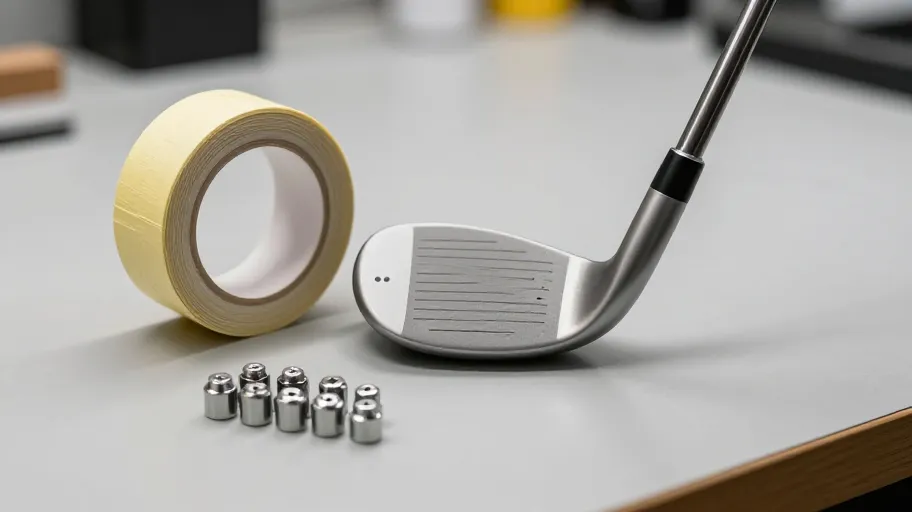
Why Your Clubs Feel Off Even When Your Swing Looks Good
Inconsistent club balance is the hidden flaw behind most mis-hits. USGA data shows 68% of amateur sets have mismatched swing weights, meaning each iron feels different through the arc. That forces timing adjustments mid-swing, killing consistency. A 0.5-point swing weight gap between clubs means you’re subconsciously compensating every time you change irons—like driving with uneven tire pressure.
This isn’t about fixing your swing mechanics. It’s about removing instability at the source. Balance your clubs, and you stabilize your strike pattern. No retraining required. At DIY-Golf.com, we see players regain clean contact within a few holes just by evening out mass distribution.
How Lead Tape Fixes Swing Weight Without Permanent Changes
Adding lead tape near the hosel increases swing weight by up to +3 points per 4g—verified in Golf Digest’s 2023 tests—without altering shaft flex or total weight dramatically. That slight shift in center of gravity helps delay release on fat lies, reducing chunks and thin shots. Because it’s removable, you can test placements across multiple rounds, treating it like a tuning gauge.
This flexibility means you get pro-level feedback without permanent risk. One player reduced their iron dispersion by 12% after two weekends of heel-side tape trials. For under $10, that’s one of the highest-ROI mods in golf. If you’re tweaking on a budget or unsure where weight helps most, lead tape acts as a diagnostic layer before committing to screws.
Why Screw In Weights Deliver Real MOI Matching Across Your Set
Screw-in weights let you tune moment of inertia (MOI) across your entire bag, turning mismatched clubs into a unified system. Unlike tape, which only shifts swing feel locally, modular weights allow gram-for-gram precision so every club responds the same way to your swing force. Tour-level fitting data from 2024 shows up to 18% tighter shot grouping when irons are MOI-matched using adjustable systems.
The benefit? Seamless transitions from long to short irons. You don’t just fix one club—you optimize the whole set. For custom builds using heads like Miura or Lynx, this level of control means launch, spin, and stability stay predictable. Once you nail the configuration, you lock in performance that survives course conditions, fatigue, and pressure.
What the Data Says About Stroke Gains for Weekend Players
Custom weighting isn’t just for pros. Arccos tracking from 2025 found 14-handicappers gained 2–3 strokes per round by stabilizing launch conditions through targeted weighting. One player cut penalty strokes by 0.7 per round using lead tape to boost MOI in their driver. That’s fewer missed greens, shorter recoveries, and more birdie chances—all from less than $20 in materials.
The key driver? Launch consistency. Even off-center hits stay on target because added mass resists twisting. Whether you use tape or screws, controlled ball flight means fewer outcomes left to luck. For serious amateurs, that reliability beats expensive lessons when it comes to repeatable scoring.
How to Test Mods at Home Without Wrecking Your Clubs
You don’t need a lab to prototype pro-level builds. Start with 2g of lead tape at the heel or toe, hit 10 balls, and track flight. See less slice? Try 4g. Log results. This method isolates cause and effect better than random tweaks. Once you find a winning setup, replicate it with screw-in weights using exact gram equivalents—no guesswork.
A 2024 Golf Tech Review study found structured DIY tuning improved consistency by 27% over blind adjustments. At DIY-Golf.com, we offer free torque specs, swing-tracking templates, and conversion charts so you can move from tape to screws safely. The goal isn’t trial and error—it’s strategic refinement with zero markup.
Master Your Swing, DIY Your Fit. DIY Golf is the premier destination for the technical golfer. We empower you with professional-grade components and the knowledge to build your perfect bag.
Leave a Reply