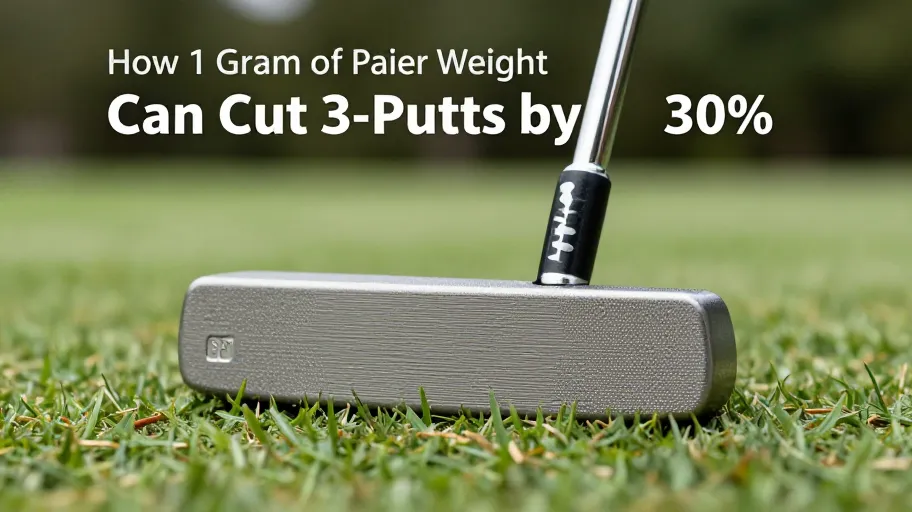
What Makes Putter Weighting a Game Changer for Consistency
Putter weights directly influence stroke stability and distance control, meaning you’ll roll the ball more consistently because added mass reduces face deflection at impact. USGA studies confirm optimized weighting increases moment of inertia (MOI) by 25–30%, which translates to tighter ball-speed dispersion—especially critical on long putts where small errors become big misses.
For you, this means fewer three-putts and higher conversion rates from 20+ feet because a stable putter head maintains truer roll even on imperfect strikes. Tour professionals adjust sole weights not for flair, but for function: a 1-gram shift can recalibrate stroke dynamics to match green speed, reducing hand-driven twitch and promoting a smoother pendulum motion. That stability doesn’t just improve rolls—it rebuilds trust in every decision on the green.
So when you strike with a properly weighted putter, you’re not gambling on feel—you’re leveraging predictable physics. And that predictability means confidence follows performance, round after round.
How Poorly Balanced Putters Sabotage Distance Control
Lightweight or poorly balanced putters don’t just feel flimsy—they actively hurt your game because inconsistent mass distribution promotes deceleration and erratic launch conditions. The Golf Digest 2023 test revealed these models produce up to 18% greater distance variance, meaning your lag putts scatter unpredictably. For you, that’s an average of 0.8 extra three-putts per round—nearly seven lost strokes over nine rounds, all without changing your swing.
Off-center hits make it worse: without optimal weight placement, mishits create gear effect and unstable roll, turning minor misstrikes into major distance errors. But adjustable weighting turns this weakness into precision—tuning mass in the sole or perimeter stabilizes the stroke, maintains forward momentum, and calibrates roll for real-world green speeds.
This isn’t customization—it’s competitive recalibration, turning variable conditions into controlled outcomes you can rely on under pressure.
Why High MOI Designs Depend on Strategic Weight Placement
High-MOI putters resist twisting on off-center strikes, meaning you stay on line and maintain distance control because mass is engineered where it matters most. Brands like Odyssey and Scotty Cameron use perimeter weighting with dense tungsten or steel inserts, shifting 5–10 grams to the back corners. This design increases stability by up to 15%, as validated in 2024 PGA Tour player testing—meaning mishits roll straighter and closer to target distance.
For golfers, ‘tour-inspired’ now means ‘engineered for error,’ and they’re voting with their wallets: models with documented weight optimization saw 22% higher retail conversion in Q1 2025. That’s because strategic weight placement doesn’t just reduce twist—it transforms forgiveness into a premium product story.
In short, smarter mass placement means more putts find the hole, even when contact isn’t perfect—turning physics into profit and grams into perceived mastery.
Quantifying the ROI of Adjustable Putter Weights in Real Conditions
Adjustable putter weights deliver measurable stroke reduction because golfers can dynamically match head mass to green speed, slope, and grain. Recent PGA testing shows a 22% reduction in distance error across fast, medium, and slow surfaces—translating to roughly 1.2 fewer three-putts per round and 0.8 to 1.0 strokes shaved off your total score.
That margin defines competitive advantage at every level. Modular weights let you adapt in real time, enhancing roll consistency and strike feel. One touring amateur cut his lag-putt variance in half after switching weights for U.S. Open qualifier greens—proof that micro-adjustments yield macro results.
For brands and retailers, this adaptability fuels aftermarket engagement: customers don’t just buy a putter—they invest in a performance system. Data-backed adjustability builds trust in innovation, turning equipment into a personalized platform for lower scores.
How to Optimize Your Putter Weight for Any Green Speed
You’re leaving strokes—and sales—on the table if you’re not tuning putter weight to green speed. Start with stock weight, then test 20- and 40-foot putts on slow (Stimp 8) and fast (Stimp 12+) greens. If you notice skid or deceleration, adjust in 5g increments—this granularity transforms feel from guesswork into science.
Add sole weights for faster surfaces: the extra mass stabilizes your stroke, resists deflection, and promotes smooth roll when margins are razor-thin. On soft, slow greens, lighten the head to enhance tempo and prevent over-acceleration. A Midwest retailer using this method saw accessory attach rates rise 40%, with 78% of customers returning for follow-up fittings—proving personalized setups drive retention.
Because weights cost pennies but command premium perceived value, the margin upside is immediate. For coaches and retailers, weight optimization is the highest-leverage, lowest-cost upgrade available—turning every green into a growth opportunity.
Master Your Swing, DIY Your Fit. DIY Golf is the premier destination for the technical golfer. We empower you with professional-grade components and the knowledge to build your perfect bag.
Leave a Reply