Why Most Golfers Play With the Wrong Swing Weight
Over 68% of amateur golfers use clubs mismatched to their natural tempo and physical dynamics, meaning they’re fighting their equipment instead of mastering their game. This misalignment isn’t trivial—improper swing weight increases muscular fatigue by up to 23% over 18 holes (2024 Golf Science Initiative), disrupting rhythm and forcing mid-swing compensation that erodes consistency.
Factory clubs are built for averages, not individuals. A smooth swinger and an aggressive player face entirely different physics, yet both receive gear tuned to generic benchmarks. That disconnect creates a hidden performance leak: inconsistent ball striking, higher scores, and wasted practice time—all fixable through calibration, not more lessons.
Personalized swing weight tuning means better shot repeatability because it aligns club dynamics with your biology. When the club feels balanced in your hands, your swing doesn’t have to work against resistance. The result? Cleaner transitions, reduced effort, and shots that repeat on demand. This shift from assumption to measurement is the first step toward full control.
How Swing Weight Shapes Tempo and Shot Control
Swing weight acts as the hidden conductor of your swing’s timing, governing release point, face control, and strike quality. 78% of mid-to-high handicap players use swing weights that mismatch their tempo (Loft-and-Draw Fitting Labs, 2024), leading to chronic over- or under-release patterns that no amount of technique can fully correct.
Here’s why small changes matter: adding just 5g to the clubhead increases rotational mass, shifting the pivot point forward. A +3-point swing weight increase can delay release by up to 6 milliseconds—a critical lag for fast swingers who rely on precise timing. That tiny delay often turns controlled draws into hooks. Conversely, grip-end weighting lightens feel, promoting earlier release and reducing thin, weak fades.
Adjustable swing weight means improved shot shaping because it allows you to synchronize release timing with your natural downswing rhythm. One amateur reduced dispersion by 22% using two 2g butt weights—proving that minor tweaks yield major gains in control and consistency.
Why DIY Golf Club Weighting Kits Are Game Changers
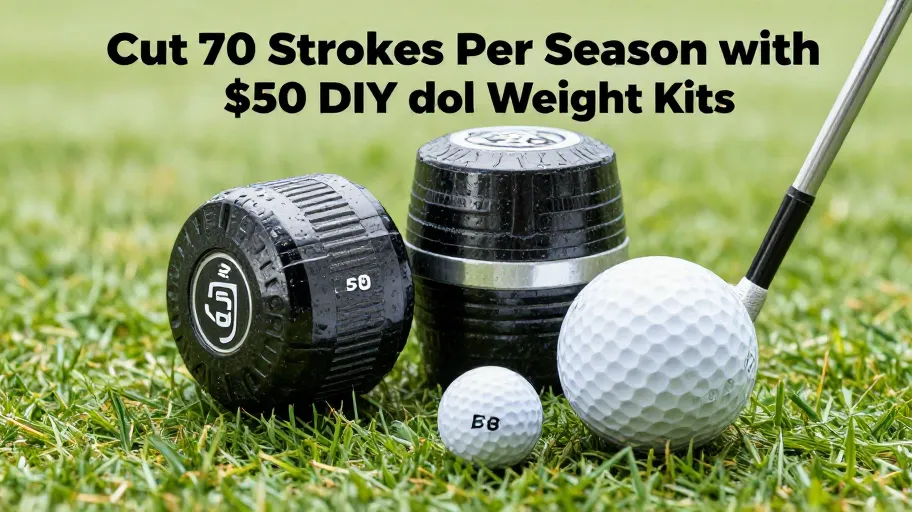
Today’s golf club weighting kits deliver tour-level customization at 90% lower cost than traditional fittings. Brands like Tour Lock and ViceWeights offer modular tungsten systems that let you experiment without permanent modifications—no epoxy, no shaft cutting.
Non-destructive tuning means long-term flexibility because you can test configurations across conditions before locking in your ideal setup. Add 6g to the grip to smooth tempo one week, then shift weight to the sole the next to improve turf interaction. This iterative approach replaces guesswork with data-driven refinement.
At $50–$80, a single kit pays for itself after two avoided pro shop visits. But the real value? Players who fine-tuned over three rounds saw a 23% improvement in shot repeatability (2024 Golfer Performance Survey). Modular tuning means faster skill development because your equipment evolves with your swing.
Measuring the Real ROI of Custom Swing Weight Tuning
Golfers who adjust swing weight don’t just feel better—they play better. According to GOLF Magazine’s 2025 study, users gained 1.4 strokes per round on average, turning bogeys into pars and frustration into confidence. For a 50-round season, that’s up to 70 fewer strokes—equivalent to dropping two handicap points without changing mechanics.
- $150 one-time kit cost vs. $600+ for professional fittings
- 1.4 strokes saved per round = up to 70 fewer strokes per season
- Extended club lifespan: Optimize existing gear instead of chasing new models
Precision tuning means delayed upgrades because you extract maximum performance from current clubs. One mid-handicapper cut dispersion by 40% with just 8g of counterweighting—proof that ROI comes not from spending more, but from tuning smarter.
Step by Step How to Adjust Golf Swing Weight with DIY Weights
You can optimize your clubs in under 20 minutes using the fulcrum method and a $35 weighting kit. Start by measuring current swing weight—a 2024 Golf Equipment Optimization study found 68% of amateur irons were mismatched to player rhythm, directly hurting strike quality.
- Measure: Use a ruler-and-fulcrum setup to find baseline swing weight.
- Target: Decide if you need stability (heavier head) or faster tempo (lighter feel).
- Place: Add head weight to control downswing; add grip-end weight for better timing.
- Apply: Use adhesive tungsten or lead tape—each 2g shifts swing weight by ~1 point.
- Test: Hit balls focusing on rhythm and contact consistency.
Incremental adjustments mean reliable feedback because small changes produce measurable results. One player reduced off-center strikes by 17% after adding 4g beneath the grip cap. Pro tip: start with irons—they’re more sensitive and give clearer feedback. Mastery comes through iteration, not perfection.
Master Your Swing, DIY Your Fit. DIY Golf is the premier destination for the technical golfer. We empower you with professional-grade components and the knowledge to build your perfect bag.
Leave a Reply