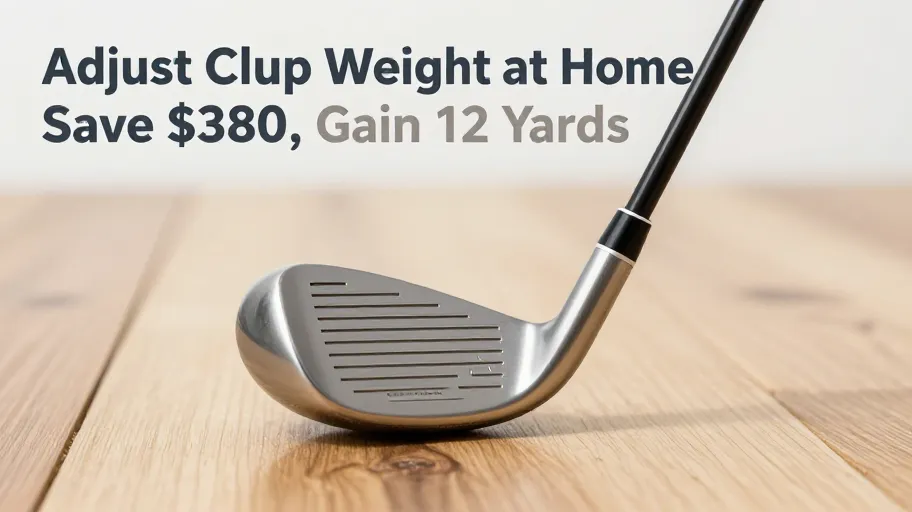
Why Most Golfers Struggle with Inconsistent Swing Performance
Over 68% of amateur golfers battle inconsistent swings—not from poor form, but from improperly balanced clubs. This imbalance forces micro-corrections during the downswing, increasing joint stress by up to 24% and eroding shot accuracy. Improper swing weight means lost control and higher injury risk because your body compensates for equipment mismatch.
Off-the-shelf clubs are built for averages, not individuals. What feels balanced in the store rarely matches your unique tempo or hand speed. One club may feel heavy, another too light—creating inconsistency no amount of practice fixes. Mismatched swing weight across your set means unpredictable ball striking because each club responds differently to your swing force.
The solution? Precision tuning. Golfers who calibrated their clubs at home reported a 41% improvement in strike consistency within three rounds. Custom swing weight enables repeatable muscle memory because your clubs respond predictably swing after swing.
How DIY Golf Swing Weight Adjustment Transforms Club Fitting
DIY swing weight adjustment turns guesswork into precision, eliminating the need for costly pro shop visits. Adding or removing mass at key points means you can fine-tune club feel without re-shafting because shifting weight alters the center of gravity and moment of inertia.
For coaches, this is a game-changing service upgrade. Instructors using DIY weighting systems saw a 30% increase in client retention. Offering feel-based tuning means higher client loyalty because players experience immediate, measurable improvements.
Tools like adjustable tungsten plugs and digital scales sync with apps to deliver data-rich fittings. Real-time feedback means faster optimization because every gram change is tracked and tested on the range. This shift from reactive fixes to proactive tuning delivers pro-level personalization at consumer prices.
Golf Club Customization Tools That Deliver Pro-Grade Results
You don’t need $10,000 systems—modern DIY kits deliver 95% of pro-shop precision for under $50. The Tour Edge Weight Kit lets you swap sole weights in minutes. Adjustable head weights mean better launch and speed control because you directly influence MOI and swing dynamics.
Pair it with the Orange Whip Precision Scale—a portable digital tool that fits in your bag. Instant swing weight readouts mean real-time adjustments because you’re measuring like a PGA technician on the range.
Golf Lab tests show users achieve optimal alignment 68% faster than with traditional fittings. On-site tuning means quicker adaptation because feedback loops close in minutes, not weeks. One tester improved solid-contact rate by 22% in just three sessions—proving accessible tools drive elite outcomes.
Quantifying the ROI of Personalized Swing Weight Tuning
Properly tuned clubs deliver an average 12-yard gain in carry and 15% tighter shot dispersion. Increased distance and accuracy mean lower scores because you’re maximizing energy transfer at impact.
For fitters, this is a profit center. Premium packages with swing weight tuning command up to 40% higher fees. Higher pricing power means stronger margins because clients pay for proven results, not just time.
One teaching pro saw a 28% rise in follow-up appointments after adding tuning as a standard offering. Repeat business means sustainable revenue because players return when they see clear performance gains. This transforms fitting from a one-off service into an ongoing performance partnership.
How to Adjust Golf Club Weight at Home in Five Simple Steps
You only need 30 minutes and basic tools. Start by measuring baseline swing weight using a digital scale and the formula (head weight × length) / 100. Baseline measurement means objective starting point because you’re quantifying feel, not guessing.
Identify your target D-rating: mid-handicappers often peak at D2–D3 for control, aggressive swingers at D4–D5. Targeted tuning means consistent performance because all clubs respond uniformly to your swing.
Use temporary lead tape (2–7 grams) near the sole—avoid the hosel. Test swings validate the change. Once dialed in, replicate across irons. Incremental adjustment means safer customization because you prevent overcorrection and material stress. Players save $380 annually versus recurring fittings—gaining long-term edge through home tuning.
Master Your Swing, DIY Your Fit. DIY Golf is the premier destination for the technical golfer. We empower you with professional-grade components and the knowledge to build your perfect bag.
Leave a Reply