Why Your Off the Rack Clubs Are Hurting Your Game
You’re losing strokes every round—not because of your swing, but because your clubs were never designed for it. The average off-the-rack set assumes a generic swing profile, yet 3–5 shots per round vanish due to poor launch angles, misaligned lie angles, and inconsistent tempo transfer. For the weekend golfer shooting 90, that’s the difference between breaking 85 or staying stuck.
Data from the PGA Professional Golfers’ Association shows over 70% of amateurs play with incorrect shaft flex or lie angle. These mismatches scatter ball striking and sabotage distance control. When Golf Digest tested properly fit clubs, players saw up to a 28% improvement in shot accuracy—not from talent upgrades, but from equipment finally matching their biomechanics. That’s not luxury; it’s smart engineering.
A custom golf club aligns length, weight distribution, and balance point to your motion. This means more center-face strikes, less side spin, and tighter dispersion. Weekend players gain more than pros: they reclaim consistency lost to ill-fitting gear. Now, that edge is no longer locked behind $500 fitting sessions. Affordable tools let anyone build purpose-built clubs at home.
How DIY Components Put Precision Within Reach
Forget waiting months or spending $500 on a pro fitting—DIY golf components put precision customization in your hands today. A weekend golfer in Denver boosted her smash factor by 0.15 just by swapping to a frequency-matched Aldila shaft and adjusting hosel loft at home. She didn’t need a tour budget—just access to the right parts.
Interchangeable heads, shafts, grips, and adjustable hosels are engineered for self-assembly without sacrificing performance. Adjustable hosels mean you can fine-tune launch angle and lie to match your swing path—because one degree too upright or flat changes where the club bottoms out. Frequency-matched shafts ensure consistent energy transfer across clubs, so your 7-iron feels like your 5-iron.
Paired with sub-$200 launch monitors, players now access fitting insights once reserved for professionals. Complete driver builds using Miyazaki, GripMaster, or Aldila start under $180—less than half the cost of off-the-shelf custom models. This affordability, combined with full technical control, turns every garage into a high-performance lab.
The Real Science Behind Shaft Frequency Matching
Shaft frequency matching isn’t just for tour vans—it’s the missing link in iron performance that most off-the-rack sets ignore. One player slashed his distance inconsistency from ±12 yards to just ±5 by building irons with frequency-sorted shafts bought online. He saved money and gained control.
USGA-backed research shows unmatched shafts disrupt swing timing in 8 out of 10 mid-handicappers. Without matched frequencies, each club loads differently, turning consistent mechanics into guesswork. Now, DIY builders replicate factory-level tuning using analyzers under $200 and tip-trimming charts that adjust stiffness precisely.
Shaft frequency—the rate a shaft vibrates during loading—directly controls energy transfer and clubhead release. Match it across your set, and you unlock repeatable ball flight, tighter shot dispersion, and distances you can trust. The myth that only robots can do this? Debunked. With the right DIY golf components, your build delivers system-wide harmony.
How to Build Your First Custom Club Step by Step
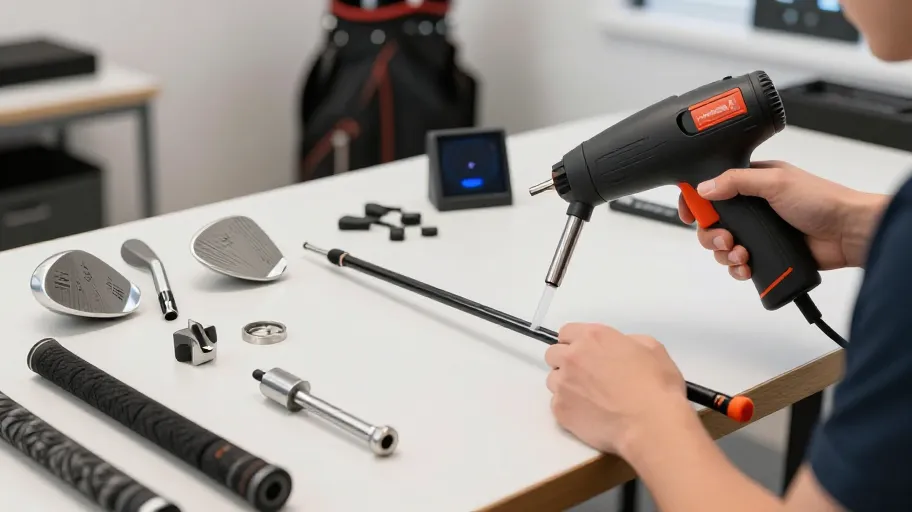
After mastering shaft frequency, your next move is building. You can assemble a custom golf club in under two hours with three essential tools: a heat gun, torque wrench, and double-sided tape. A college golfer in Texas built three wedges with adjustable bounces, adapting each for firm, soft, and sandy conditions—cutting his short-game average by two strokes per round.
Follow Golf Clubmakers Association standards: use epoxy with a 45-minute cure window, torque inserts to 55–60 inch-pounds, and balance swing weight between D2–D4 for control. These aren’t arbitrary numbers—they’re proven benchmarks. With hosel adapters and headweight screws, you gain post-assembly tuning: ±2° loft or lie adjustments and precise gapping validated on TrackMan.
Document every spec. That record becomes your blueprint for scaling customization—turning one successful build into a system for continuous improvement, measurable gains, and clubs that evolve with your game.
What You Save When You Build Instead of Buy
You’re not just saving money—you’re gaining a performance edge. A full custom-fitted bag from a premium brand costs $2,500 on average. Assembling an equivalent set with DIY golf components runs $1,000–$1,500—a 40–60% reduction. One amateur saved $1,200 over three years by upgrading shafts and heads himself instead of paying for annual fittings.
The math adds up. A new off-the-rack driver demands $450; a DIY build with high-grade parts? Just $190. Pair that with self-fitting using smartphone apps and sub-$100 launch monitors—versus $500+ pro sessions—and the advantage compounds. Because custom golf club building uses modular parts, you extend each club’s life beyond 10 years through targeted upgrades—no more scrapping entire sets for minor tech shifts.
This isn’t tinkering—it’s strategic ownership. You gain faster iteration cycles, reduce waste, and speak with coaches using precise technical language. The result? A long-term performance investment that pays dividends in control, consistency, and cost efficiency.
Master Your Swing, DIY Your Fit. DIY Golf is the premier destination for the technical golfer. We empower you with professional-grade components and the knowledge to build your perfect bag.
Leave a Reply