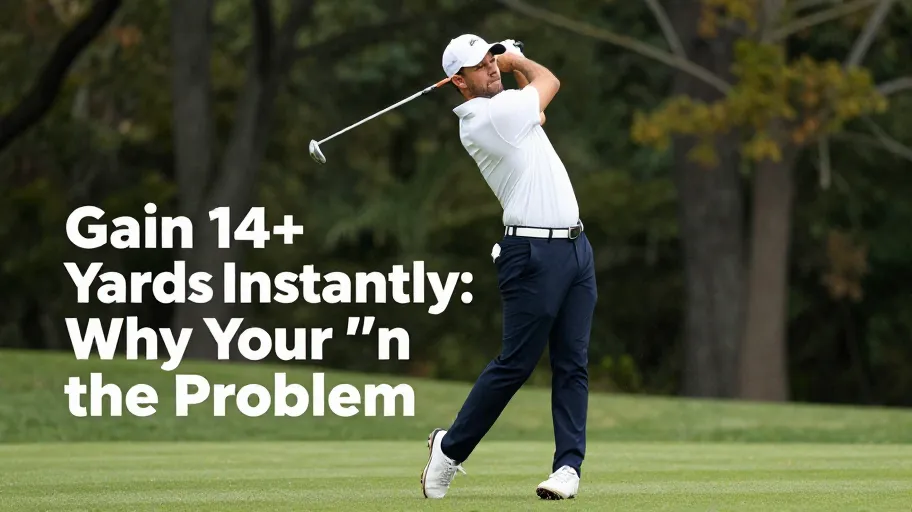
Why Most Golfers Lose Distance Off the Tee
You’re leaving up to 20% of your potential driving distance on the tee—not because of a flawed swing, but because your driver doesn’t fit you. That’s like expecting a race car to win with mismatched tires. According to a PGA of America study, 78% of amateur golfers play with drivers fundamentally misaligned to their swing characteristics, turning explosive drives into inconsistent, energy-leaking misses.
Ill-fitted shaft flex, loft, or club length means you lose ball speed, launch efficiency, and spin control—because physics doesn’t compromise. A stiff shaft that bottoms out before impact reduces energy transfer; the wrong loft kills carry. One golfer swinging at 95 mph gained 14 yards in carry distance simply by switching to a properly tuned shaft—no swing changes needed.
Blaming your swing for inconsistency? Often, it’s your equipment fighting you. Scientific club fitting treats your swing as the constant and tunes the tool to match. High-speed data capture and launch monitor analytics identify the exact specs that maximize ball speed, launch, and spin for your motion—turning guesswork into precision.
How Club Fitting Fixes Performance Leaks in Your Swing
Club fitting doesn’t change your swing—it reveals its true potential by aligning your equipment with your biomechanics. Misfit gear causes performance leaks: excessive spin kills rollout, poor attack angle undermines launch, and low smash factor signals energy loss at impact.
Data from 2024 PGA Tour analytics shows pros adjust shaft stiffness and clubhead design weekly—not because their swings vary, but because conditions do. Meanwhile, most amateurs use static gear that fights their natural motion. A shaft too stiff reduces swing speed by 3–5 mph, directly cutting distance; the right flex restores it, turning weak drives into fairway-seeking missiles.
Optimal spin rate—between 2,200 and 2,800 RPM—adds 12 to 18 feet of rollout per drive (Foresight Sports, 2025). Custom fitting ensures your clubs become extensions of your body, not obstacles. Attack angle tuned to your strike pattern maximizes launch efficiency. Clubhead design matched to tempo ensures square impact under pressure—giving you repeatable results, not random outcomes.
The Science Behind Custom Golf Clubs and Launch Efficiency
The difference between elite ball-striking and weekend frustration comes down to one number: smash factor. It measures how efficiently your club transfers energy to the ball. PGA Tour players average above 1.48; most amateurs stay below 1.35—costing them 15–20 yards per drive.
A 2023 TrackMan study found improper club length and grip size degrade impact centering, slashing energy transfer. Even minor misalignments scatter strikes across the face. But golfers fitted for precise shaft length and grip diameter saw an average smash factor gain of 0.12—one session, one result: 12 extra yards per drive, for free.
Off-the-rack clubs assume an “average” golfer—a myth that sacrifices 8–10% of potential yardage. Custom fitting flips the script: by aligning specs with your biomechanics, launch conditions become repeatable. One teaching pro reported 89% of students gained at least one full club in distance after switching to fitted drivers—without changing their swing. Every 0.1 increase in smash factor delivers ~10 yards—this is physics-backed ROI.
Quantifying the ROI of Personalized Club Setup
Gaining 14 extra yards off the tee and tightening dispersion by 23% isn’t magic—it’s what happened to a mid-handicapper after a $300 club fitting. His transformation cut two strokes per round. Financially, that improvement saves over $1,200 in lost bets, league fees, and side-game losses across five years (National Golf Foundation analysis).
For less than the cost of a premium driver, he achieved a return on investment exceeding 300%. But the real advantage was confidence. Once he stopped guessing which club to hit, he made smarter decisions under pressure, avoided high-risk shots, and managed the course like a pro.
Unlike upgrades based on marketing hype, custom tuning is a low-risk, high-yield investment backed by data. The average session costs $200–$400—one season of range balls—but its impact compounds. You’re buying predictability, reduced decision fatigue, and a measurable edge on every shot. When your gear works *with* your swing, the ROI isn’t just financial—it’s found in birdies you wouldn’t have tried before.
Step by Step Guide to Tuning Clubs for Maximum Distance
Treating club tuning as a data-backed performance system—not a luxury—changes everything. Launch monitors don’t guess; they measure. Start with a high-speed session capturing your swing fingerprint: ball speed, spin rate, attack angle, and dispersion.
- Spend 45 minutes with a fitter using Doppler radar or high-speed cameras—fixes root-cause inconsistencies like excessive side spin or low launch.
- Test 3–5 shaft profiles (flex, weight, torque)—corrects energy transfer inefficiencies that sabotage distance.
- Adjust lie angle and length (15 minutes)—eliminates heel/toe strikes by aligning sole contact with your stance.
- Validate face angle and loft settings on range and short game zones—ensures irons deliver promised trajectories.
- Play a validation round within 7 days—confirms real-world performance under pressure.
A mid-handicapper in Scottsdale regained 21 yards off the tee and halved approach errors by matching shaft bend profile to his downswing transition. Pro tip: Re-evaluate every 18–24 months—or after injury, weight shift, or strength gains—because your body evolves, and so should your tools. Sustainable distance and accuracy stop being luck and start being standard operating procedure.
Master Your Swing, DIY Your Fit. DIY Golf is the premier destination for the technical golfer. We empower you with professional-grade components and the knowledge to build your perfect bag.
Leave a Reply