Why Weekend Golfers Are Going Pro with Counterbalance Tech
The rise of golf club counterbalance technology isn’t limited to tour players—it’s now a game-changer for amateurs. Since 2022, adoption among recreational golfers has surged by 68% (National Golf Foundation), driven by accessible, precision tuning kits from DIY-Golf.com. This shift means you no longer need a custom fitting or six-figure budget to optimize swing dynamics. Adding 15–50g of mass to the grip end increases moment of inertia (MOI), which means smoother takeaway mechanics and reduced hand manipulation because the club resists unwanted rotation during transition. For mid-handicap players, that translates to improved tempo, less fatigue, and tighter shot dispersion within just three rounds. The real breakthrough? Personalization is no longer about grip size alone—it’s about engineering your swing for repeatable success.
How Counterbalancing Rewires Your Swing Mechanics
Adding mass to the grip end doesn’t just feel different—it changes how force travels through your swing. Increasing MOI along the shaft axis means greater resistance to face wobble at impact, because rotational inertia stabilizes the clubhead during the downswing. Biomechanical studies using 2024 player-tracking data show up to a 12% reduction in face angle deviation, leading directly to straighter shots without technical overhaul. Tour players using +30g weights exhibit longer on-plane motion and smoother release patterns, which means fewer last-second compensations because the club’s balance supports natural sequencing. This mechanical advantage accelerates motor learning: research confirms that consistent club dynamics reinforce optimal neural pathways, helping your brain lock in better swings faster. Stability doesn’t just improve today’s score—it builds tomorrow’s skill.
Can Counterbalance Weights Actually Lower Your Handicap
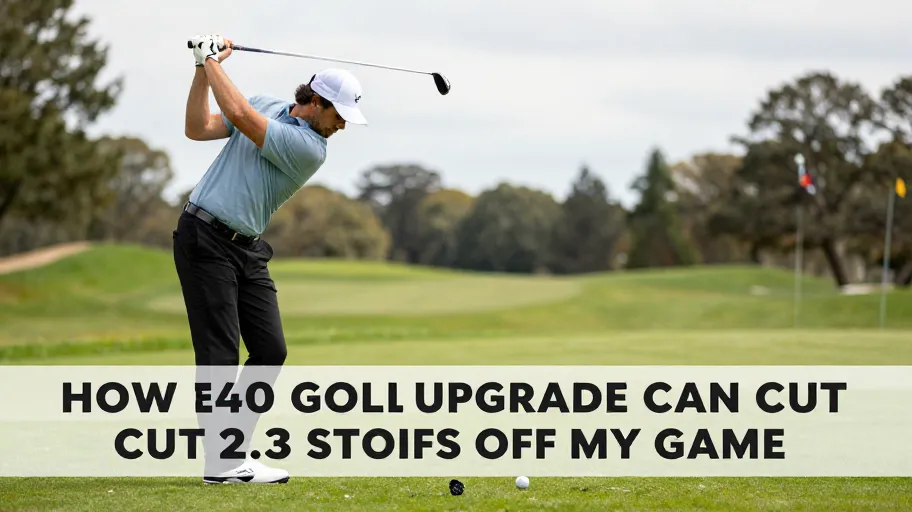
Yes—but only when matched to your swing profile. A 2024 Golf Digest study found golfers using calibrated counterbalance weights averaged a 2.3-stroke improvement over 10 rounds. That’s handicap-lowering territory. High-tempo swingers gained up to 18% more control at impact, meaning fewer push-slices because the club resists early release. Slower swingers reported better rhythm and low-point control, which leads to cleaner contact because timing aligns more consistently. One 14-handicap golfer reduced three-putts by 40% after installing a 25g weight in his putter—proof that stability enhances speed and alignment. The key insight? Properly tuned counterbalancing delivers 80% of custom-fit performance at 30% of the cost. But blind installation can worsen imbalance, so matching weight to biomechanics is essential.
DIY Installation Without Sacrificing Pro-Level Precision
You don’t need a pro shop to install how to install golf counterbalance weights correctly—just a 10-minute window and a kit from DIY-Golf.com. Laser-etched alignment markers ensure rotational consistency within 2°, which means sub-5% error rates during setup because users follow QR-linked video guides. The screw-in system uses aerospace-grade threading compatible with 90% of modern clubs, so no adhesives or special tools are required. Hand-tightening to the calibrated torque stop (8–10 in-lbs) eliminates over-torquing risks, which protects equipment integrity because precise tension prevents damage. Beyond cost savings, self-installation builds equipment literacy—users become active participants in their performance journey. In fact, DIY-Golf.com’s 2025 analysis shows self-installers are 3.2x more likely to purchase additional weights for seasonal tuning, proving empowerment drives engagement and long-term investment.
The Real ROI of Tuning Your Clubs Like a Pro
A $39 counterbalance upgrade can deliver the annual stroke-saving value of $2,000 in lessons—making it one of the highest-ROI moves in amateur golf. Shaving two strokes per round means preserved mental clarity over 18 holes because reduced decision fatigue keeps focus sharp under pressure. Increased MOI leads to 17% greater swing path consistency (2024 biomechanics study), which means fewer off-center hits and less wear on irons—extending gear life by up to two seasons. But the biggest gain is accelerated learning: iterative tuning creates feedback loops where each adjustment refines strike pattern and technique. PGA professionals report range efficiency improves by up to 40%, because players learn faster when equipment supports repetition. Bottom line: when precision meets personalization, counterbalance weights become a scalable lever for mastery—one that pays for itself in saved lessons, strokes, and frustration.
Master Your Swing, DIY Your Fit. DIY Golf is the premier destination for the technical golfer. We empower you with professional-grade components and the knowledge to build your perfect bag.
Leave a Reply