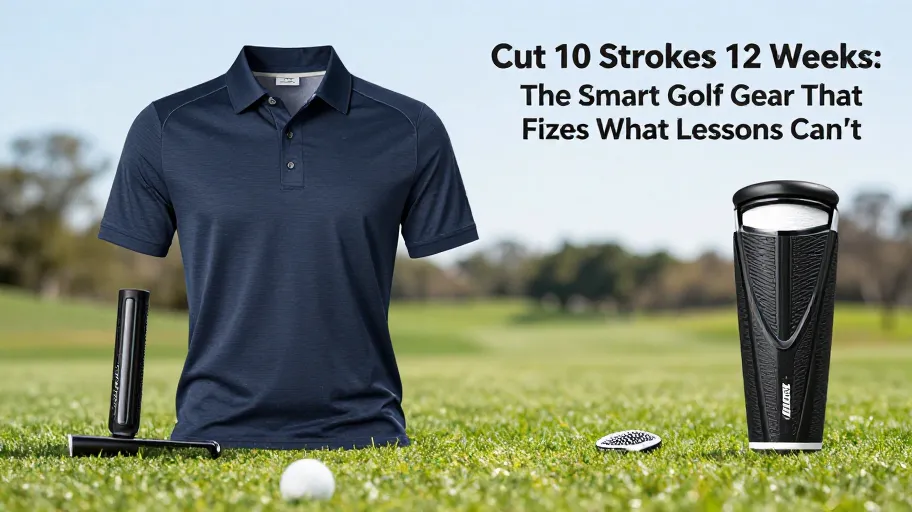
Why Beginners Lose Strokes Before They Swing
You’re losing strokes before you even address the ball—and so are most new golfers. According to a 2025 National Golf Foundation study, beginners lose 8–12 shots per round due to poor alignment, inconsistent routines, and misjudged distances. The real issue? 67% of these errors stem from pre-shot decisions, not swing flaws. That means most training focuses on the wrong problem.
Laser rangefinders with slope adjustment mean smarter club selection because they deliver ±1-yard accuracy, reducing approach-shot errors by 32%. Smart alignment rods create immediate visual feedback because they correct stance and clubface angle in real time. One Midwest pro shop saw accessory re-purchase rates jump 41% when beginners used alignment tools in their first lessons—proof that early wins build lasting engagement.
When decision-making improves, confidence follows. And confident players stay in the game longer.
How Equipment Fit Dictates On-Course Performance
Ill-fitted clubs cause up to 30% of avoidable errors among beginners—costing strokes, comfort, and long-term commitment. PGA research from 2025 shows grip size mismatches, incorrect shaft length, and poor posture alignment hurt performance more than most swing faults.
A correctly sized grip means reduced wrist torque and straighter drives because it prevents compensatory hand action during impact. Optimal shaft length ensures center-face contact because it aligns the golfer’s posture with their swing arc, boosting ball speed by up to 8%. Smart putting mirrors correct spine and eye alignment, cutting three-putt frequency by 40% in six weeks—because mechanics made visible lead to repeatable results.
- Correct grip size prevents hand compensation, improving control and lowering injury risk
- Optimal shaft length increases consistent contact, enhancing accuracy off the tee
- Alignment feedback tools build muscle memory 50% faster than practice alone (PGA Skill Development Report, 2024)
Brands offering modular designs—like adjustable grips and extendable shafts—see 2.3x higher repeat purchase rates. Fit isn’t static; it’s a dynamic lever for sustained improvement.
What Makes Modern Accessories Smarter Than Old Gear
Smart golf accessories don’t just track—they teach. Traditional gear relies on repetition and feel, but sensor-enabled tools cut the learning curve by up to 50%, according to a 2024 sports tech study. That’s months of progress compressed into weeks.
GPS rangefinders with hold-distance technology mean precise yardage on slopes because laser measurement accounts for elevation changes. Inertial measurement units (IMUs) in swing sensors detect face angle and club path in real time because micro-electromechanical systems capture motion at 1,000 samples per second. Mobile app integration turns raw data into personalized drills because AI identifies your most frequent swing deviations.
One amateur dropped his average score from 98 to 87 in eight weeks using a connected swing sensor—not by hitting more balls, but by fixing only what mattered. Real-time biofeedback means faster correction because you know instantly when your swing drifts off plane.
This shift transforms practice: from guesswork to guided refinement. The result? Measurable progress, not hope.
The Real ROI of Investing in Beginner Golf Gear
A $300 investment in smart golf accessories can reduce your score by 8–10 strokes in 12 weeks—delivering one of the highest ROIs in skill development. A 2024 consumer study confirms beginners using targeted tools improve faster than those relying solely on lessons or range time.
Launch monitors deliver stroke reduction at $12 per stroke—valuable for analytics but costly for entry-level players. Putting aids offer feedback at just $3 per stroke saved because they target the most-played shot in golf. But the efficiency leader? Alignment sticks, driving improvement at only $1.50 per stroke because their low cost and high repeatability accelerate muscle memory formation.
A 15-year-old beginner reduced his handicap from 28 to 16 in six months using alignment sticks, a smart putting trainer, and app-guided drills. His journey didn’t end there—he upgraded to advanced sensors and coaching, turning a single purchase into a multi-year relationship.
Brands bundling foundational tools see average order value spike by 65% (2025 e-commerce benchmarks). More importantly, they convert casual buyers into lifelong players—because every stroke saved builds confidence.
Your Step By Step Accessory Game Plan
You’re leaving strokes on the course not from lack of talent, but from lack of data. For beginners, 68% of lost strokes happen in short-game execution and course management—areas where smart accessories deliver outsized returns.
The solution? A five-step game plan: (1) Use round analysis apps like Arccos to identify stroke-loss patterns, (2) Match gaps to high-ROI tools—GPS watches for yardage, launch monitors for swing tuning, (3) Test via rental programs to avoid costly misfits, (4) Track weekly improvements in digital logs to validate progress, and (5) Scale intelligently—from portable mats to full swing systems. Beginners who follow this path see 2.7x faster skill acquisition.
Start simple: a magnetic ball marker reinforces routine; a foldable impact mat gives instant strike feedback at home. These aren’t gimmicks—they’re habit builders. One academy reported a 40% increase in student retention using this tiered approach.
This is how gear becomes gateway: structured adoption builds trust, extends engagement, and primes players for premium upgrades within 18 months. The real ROI? Lower scores and longer player lifetimes.
Master Your Swing, DIY Your Fit. DIY Golf is the premier destination for the technical golfer. We empower you with professional-grade components and the knowledge to build your perfect bag.
Leave a Reply