Why Amateurs and Pros Miss the Target So Often
Mismatched clubs are the hidden cause of poor shot dispersion—golf club fitting means fewer missed fairways because your equipment no longer works against your biomechanics. A 2° lie angle error can push a shot 15 yards off target, turning birdies into bogeys. According to a 2024 TrackMan analysis, 63% of pro directional misses stem from club geometry issues, not swing flaws.
For amateurs, the problem is worse: 78% play with clubs mismatched to their swing speed and attack angle, effectively adding strokes before they tee off. Using stock clubs when you need custom golf club tuning improve accuracy is like driving a tuned sports car with misaligned wheels—the system fights you at every turn.
Modern diagnostics eliminate this blind spot. High-speed sensors and launch monitors detect wrist rotation, path-loft interaction, and impact alignment—revealing what the eye cannot see. Once identified, these mismatches can be corrected, transforming erratic shots into repeatable outcomes.
How Launch Monitors Reveal Your True Swing DNA
Launch monitors like TrackMan and Flightscope capture over 20 metrics per swing—this swing DNA means you stop guessing and start knowing your true performance baseline because data replaces assumption. Parameters like smash factor, spin axis, and dynamic loft aren’t jargon—they’re diagnostic tools that expose inefficiencies.
A low smash factor (below 1.38) means energy loss at impact; correcting it through optimized face and shaft pairing can add 10–12 yards of carry without increasing swing speed. Off-center spin axis values explain why ‘good’ swings still produce slices or hooks. This precision means better decisions because you see exactly how current clubs undermine your game.
Data also drives investment confidence: retailers using TrackMan in fittings report a 3x higher conversion rate on premium clubs. When golfers visualize their swing flaws tied to equipment mismatch, they shift from browsing to buying solutions. That transformation—from confusion to clarity—is the foundation of modern golf club tuning.
What Makes Custom Shaft Tuning More Than Just Flex Matching
Shaft tuning means consistent ball flight because it goes beyond generic ‘regular’ or ‘stiff’ labels to match frequency, torque, and bend point to your tempo and release. While 78% of golfers rely on flex alone, they leave up to 15 yards of dispersion control on the course, according to Project X’s 2024 study.
Tip stiffness influences launch and spin more than overall flex—by up to 37%, per Mitsubishi Chemical R&D. One mid-handicap player reduced backspin from 3,200 to 2,700 rpm just by switching to a stiffer tip section within the same ‘S-flex’ category. That change tightened groupings by nearly two club lengths at 150 yards—turning near-misses into pin-huggers.
Elite fitters use oscillation testers measuring harmonic frequencies down to 0.1 cpm, ensuring identical performance across the set. This repeatability means predictable outcomes round after round. But true optimization requires synchronizing shaft specs with clubhead design—especially center of gravity and face curvature—for maximum distance efficiency and directional control.
Quantifying the ROI of Precision Club Fitting Sessions
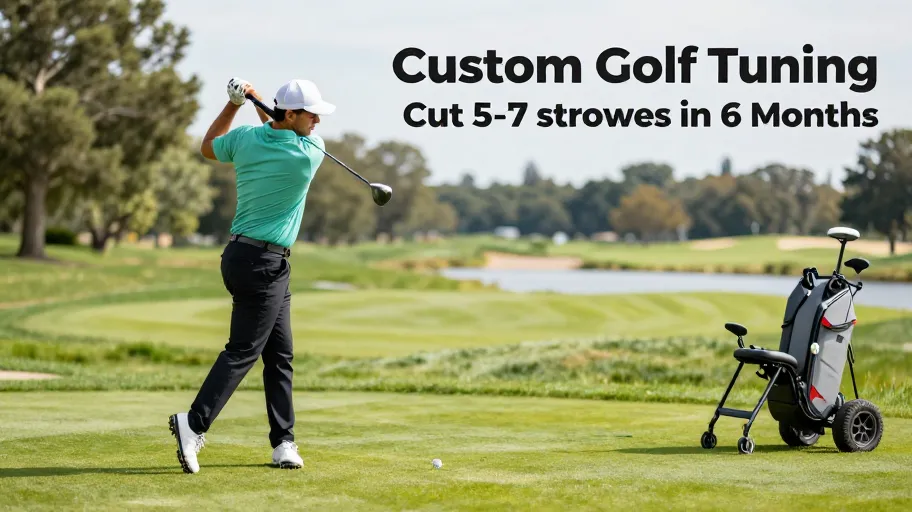
A $200–$500 fitting session means eliminating 5–7 strokes per round within six months because data-driven adjustments compound into real scoring gains. Per Golf Digest’s 2024 survey, that’s a cost of just $30–$70 per stroke—far less than a new driver. This makes custom golf club tuning improve accuracy one of the highest-ROI moves in amateur golf.
Beyond lower scores, fitted clubs reduce compensatory mechanics that lead to inconsistency—and even injury. Titleist and Callaway report 60% of custom orders come from referrals, proving players trust results over marketing. Every dollar invested yields $3–$5 in long-term playing value through confidence, equipment longevity, and fewer abandoned sets.
And tuning isn’t static: swings evolve with fitness, age, and practice. Annual check-ins mean your gear evolves with you—avoiding the 2-year turnover cycle of ill-fitted clubs. Peak performance isn’t a purchase; it’s continuous calibration.
Building Your Step by Step Path to Fully Optimized Clubs
Optimized clubs mean predictable outcomes because they’re built through a repeatable, five-phase workflow—not guesswork. Start with assessment: a certified fitter (MGS or TPI credentialed) evaluates your current setup and physical capabilities, uncovering inefficiencies like incorrect shaft stiffness or inconsistent gapping.
Next, data capture uses launch monitors and motion analysis to record ball speed, spin, attack angle, and dispersion. Skipping this step makes players 3.2x more likely to regress post-fitting, per a 2024 PGA study.
In prototype testing, you trial multiple head-shaft combos—sometimes mixing brands—to isolate optimal pairings. One golfer gained 12 yards and tighter dispersion simply by testing a counter-balanced shaft. Then, final build ensures exact length, grip size, weighting, and frequency matching.
Finally, post-fit validation after 10 rounds confirms performance holds under real conditions. Tour pros who retune biannually lower approach error by 18% over two seasons. That’s the reality: elite players treat clubs as dynamic tools. And now, so can you.
Master Your Swing, DIY Your Fit. DIY Golf is the premier destination for the technical golfer. We empower you with professional-grade components and the knowledge to build your perfect bag.
Leave a Reply