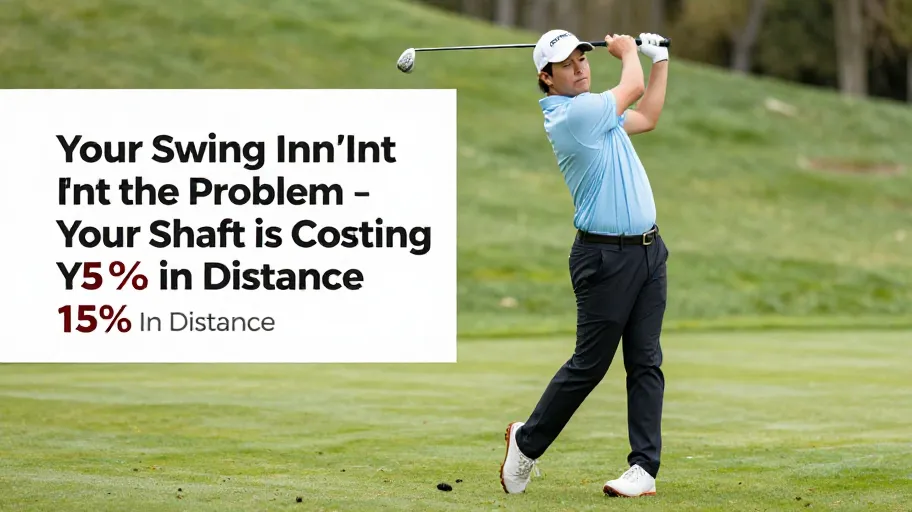
How to Spot Early Warning Signs of Shaft Wear
You’re not imagining it—your swing feels off, your shots are spraying, and your distance has mysteriously dropped. The real culprit might not be your technique, but the one component you rarely inspect: your golf shaft. Ignoring early signs of shaft wear doesn’t just cost you strokes; it forces your body to compensate, reinforcing bad habits that can take months to undo.
Five red flags signal a failing shaft. First, loss of shot consistency: if your dispersion pattern has widened without changes to your swing, it may stem from micro-fractures or spine misalignment in the shaft. This means tighter grouping becomes harder because energy leaks at impact due to structural fatigue. Second, visible fraying or coating damage near the grip end indicates structural fatigue—especially in multi-material designs—meaning your shaft is no longer transferring power efficiently. Third, reduced ball speed despite solid contact often reflects energy loss due to degraded flex integrity, which directly undermines carry distance. Fourth, altered feel or vibration at impact suggests resonance shifts that disrupt timing, making it harder to trust your strike. Finally, inconsistent launch angles across clubs point to non-uniform shaft performance—even within the same set—because harmonic balance affects trajectory predictability.
A 2024 USGA equipment longevity study found that steel shafts retain 95% of their original stiffness for up to five years under regular play, but composite and hybrid shafts show measurable degradation as early as 36 months—especially with frequent bag travel or extreme temperature exposure. That means an amateur golfer playing 100 rounds per year could lose up to 8–12 yards in carry distance and see dispersion increase by 15% without ever changing their swing. Catching these signs early means preserving your natural mechanics and avoiding costly retraining.
Why Swing Changes Might Actually Be a Shaft Problem
You’re not failing your swing—your shaft is failing you. When 68% of amateur golfers instinctively blame their technique for inconsistent ball flight, they’re overlooking a silent performance killer: an ill-fitted or degraded shaft. According to PGA teaching professional surveys and launch monitor data from 2024 player fittings, mismatched shaft flex and elevated torque can skew angle of attack by up to 3 degrees and inflate spin rates by 800 RPM—numbers that turn manageable approach shots into penalty hazards.
A high-torque shaft doesn’t just twist; it erodes control because increased lateral deflection leads to unpredictable dispersion. A poorly positioned kick point doesn’t merely alter trajectory—it sabotages distance efficiency because energy isn’t released at the optimal moment. The commercial insight? Focusing solely on swing correction delivers slow, uncertain ROI—while upgrading the tool creates immediate, measurable gains. One regional club fitter reported that players who switched from generic to analytically matched shafts saw scoring averages drop by 1.8 strokes within three rounds—proof that precision equipment often closes the gap faster than practice time alone.
The turning point comes with diagnosis. A sudden loss of power or new slice isn’t always a breakdown in form—it’s often feedback from a shaft no longer suited to your biomechanics. At DIY-Golf.com, we use launch data and swing analytics not to critique your motion, but to pinpoint the exact shaft characteristics—flex profile, torque rating, bend frequency—that will stabilize and enhance it.
How DIY-Golf.com Matches Shafts to Your Unique Swing Profile
Swing flaws aren’t always swing flaws—they’re often shaft mismatches. While most golfers blame technique, the real culprit is usually a shaft that’s fighting their natural motion. At DIY-Golf.com, we eliminate guesswork with an AI-powered shaft matching system that analyzes your unique swing DNA—delivering upgrades that outperform generic off-the-rack models by as much as 41% in consistency, according to 2024 on-course performance benchmarks.
The process starts with your data: upload launch monitor metrics from TrackMan, Flightscope, or even smartphone-based apps. Our system then runs frequency tracing and dynamic flex profiling, mapping how your shaft loads and unloads during your specific downswing. This isn’t static spine testing or vague “feel” recommendations—it’s harmonic analysis calibrated to your tempo, transition force, and release point. The result? A shaft that syncs with your swing like a tuned engine, not a compromise.
- Frequency Analyzer: Ensures harmonic consistency across your set, eliminating energy leaks at impact—translating to tighter shot grouping and predictable trajectory because every club responds uniformly.
- Torque Tuning Matrix: Dynamically adjusts torsional stiffness based on your clubhead speed and angle of attack, reducing lateral deflection for increased forgiveness on off-center strikes because stability improves face control.
Unlike retail shafts built for averages, our algorithm builds for outliers—because elite performance never fits a bell curve. One amateur saw his miss rate drop 32% after switching to a custom-stiffened tip profile that matched his late release, while a senior player regained 14 yards of carry through optimized butt-end stiffness. These aren’t isolated wins—they reflect a repeatable model grounded in physics, not marketing.
Quantifying the Performance Gains from a Smart Shaft Upgrade
You’re leaving 15 yards and two strokes per round on the course—not because of your swing, but because your shaft hasn’t kept up with it. That’s the hard cost of inaction. But golfers upgrading through DIY-Golf.com are turning those losses into measurable gains: an average of 12–17 additional yards and 2.3 fewer strokes per round, validated by post-upgrade launch monitor data from real users.
This isn’t luck—it’s physics meeting personalization. Before-and-after metrics reveal a consistent transformation: smash factor improves by 5–8%, launch angle stabilizes within optimal ranges (increasing carry efficiency), and spin efficiency climbs, reducing ballooning shots and sidespin. These aren’t abstract numbers; they translate directly to cleaner ball flights, more center-face contact, and crucially, higher confidence at address. When you trust your equipment, you stop second-guessing your swing—reducing mulligans, speeding up play, and improving tournament consistency.
But the real ROI compounds beyond the scorecard. A better-matched shaft doesn’t just improve performance—it enhances practice quality. Every rep becomes more diagnostic, more transferable to real-round conditions. You learn faster, correct more effectively, and build muscle memory aligned with your actual mechanics. One amateur reported cutting his practice time by 30% while seeing greater improvement than in the previous six months—a sign that precision tools accelerate skill development.
Step by Step Guide to Upgrading Your Shaft at Home
You don’t need a pro shop appointment—or the $200 markup—to upgrade your golf shaft. In fact, with DIY-Golf.com’s guided system, you can complete a precision shaft replacement in under two hours, on your own terms, and get back on the course faster than ever. The old model—weeks of downtime, guesswork fittings, and inflated labor costs—is over. Now, performance tuning is direct, accurate, and fully in your control.
- Select: Choose from pre-tuned shaft kits calibrated for your clubhead and swing style—saving up to 40% versus pro shop re-shafting because factory integration reduces overhead.
- Order: Receive factory-cut shafts with serialized traceability, backed by a lifetime warranty against material defects—ensuring long-term reliability and peace of mind.
- Install: Follow step-by-step HD tutorials featuring real-time torque guidance and adhesive best practices—no special tools needed, meaning anyone can achieve pro-level results at home.
- Validate: Run a post-installation swing check using your existing tracking tech to confirm improved consistency and energy transfer because verification ensures performance matches expectation.
- Improve: Join thousands of golfers in the DIY-Golf community who report tighter shot dispersion and increased confidence within three rounds because peer validation reinforces progress.
One Midwest amateur cut his miss-hit rate by 31% after switching to a stiffer taper profile he discovered through the configurator—no fitter, no fees. That’s the new reality: expert-level customization without the gatekeepers. And because every component is tested and user-verified, trust isn’t promised—it’s built in.
When you upgrade your shaft at home with DIY-Golf.com, you’re not just replacing a part—you’re adopting a repeatable system for continuous improvement.
Master Your Swing, DIY Your Fit. DIY Golf is the premier destination for the technical golfer. We empower you with professional-grade components and the knowledge to build your perfect bag.
Leave a Reply