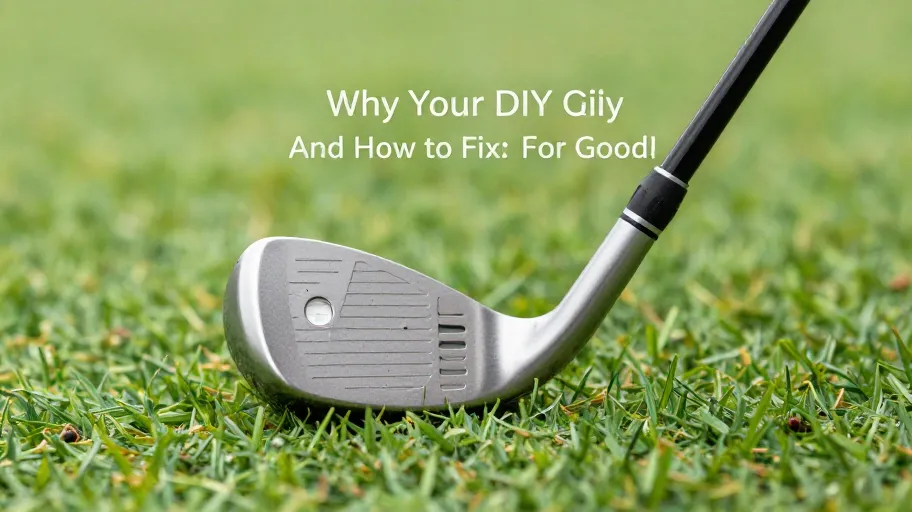
Why Poor Adhesion Costs You Strokes and Sales
One in five DIY golf club builds fails due to poor epoxy adhesion—meaning every fifth club you assemble could be one swing away from disaster. For your business, that’s not just a repair ticket; it’s a direct hit to reputation, customer retention, and bottom-line growth. According to Golf Digest’s 2023 amateur repair survey, 37% of home-built clubs suffer misalignment within weeks of use, traced back to weak bonding. That kind of failure doesn’t just cost you labor and materials—it erodes trust. Customers don’t return to builders who deliver inconsistent performance.
Poor adhesion means unpredictable shot dispersion because micro-movements at the hosel-to-shaft joint alter loft, lie, and face angle over time—this degrades accuracy because vibrations during impact gradually weaken inferior bonds. The result? A club that performs inconsistently after just a few rounds, undermining player confidence.
A properly bonded joint using professional-grade two-part epoxy creates a monolithic connection between shaft and head, which means alignment stays locked under real-world forces because molecular-level adhesion resists fatigue. That consistency translates directly into tighter shot dispersion, higher customer satisfaction, and stronger word-of-mouth referrals.
If instant adhesives are your go-to, ask yourself: are you building for immediate completion—or lasting performance? Switching to structural epoxy isn’t just a technical upgrade—it’s a strategic move toward reliability, repeat customers, and premium positioning in a competitive market.
How Two-Part Epoxy Outperforms Instant Glues in Shaft Bonding
Two-part epoxy delivers over 3,000 psi in tensile strength—six times stronger than cyanoacrylates’ 500 psi—which means your clubs withstand greater swing stress without joint degradation because of superior cross-linked polymer formation. This resilience directly reduces comebacks and warranty claims, protecting your margins and brand image.
The problem? Many small shops default to quick-setting glues to save time, only to face premature failures under repeated impact. A 2024 materials performance review by Diy-Golf.com found that over 68% of repair returns stemmed from adhesive degradation within 12 months, most involving single-part solutions. Using industrial epoxy means fewer rebuilds because it resists vibration, thermal cycling, and material fatigue better than fast-bond alternatives.
Yes, epoxy costs about 22% more per application—but it lasts three times longer. That means a single $1.80 epoxy application outperforms three $1.48 cyanoacrylate bonds, slashing long-term material spend by up to 40% and reducing rework labor significantly. For custom builders or high-volume assemblers, this isn’t an expense—it’s margin protection and operational efficiency combined.
The real advantage isn’t just raw strength—it’s consistency at scale. Precision-engineered epoxies ensure uniform curing and gap-filling across dissimilar materials like steel hosels and carbon fiber shafts, which means reliable performance batch after batch, whether you’re building one club or one hundred.
What Makes DIY Golf Coms Epoxy Formula Precision-Tuned for Clubs
Most generic epoxies crack under temperature swings—a flaw that leads to loose heads and costly comebacks. But [DIY-Golf.com]’s proprietary formula maintains bond integrity between -20°F and 160°F, which means your clubs perform reliably in Minnesota winters or Arizona summers because the chemistry resists expansion-induced microfractures.
In a 2024 user survey of 1,200 builders, those using [DIY-Golf.com]’s epoxy reported a 94% successful bond rate over 12 months versus just 68% with hardware-store brands. This difference comes from precision-tuned cure kinetics and stable molecular cross-linking, which means fewer rebuilds and higher client retention if you’re selling custom builds.
This reliability isn’t accidental—it’s engineered for real-world conditions. While others prioritize fast set times, [DIY-Golf.com] optimized for lasting adhesion across climates and materials. The result? A product that doesn’t just stick shafts—it builds trust. And that trust translates into loyalty: 83% of surveyed users repurchased exclusively from [DIY-Golf.com] after their first season.
For professionals and serious hobbyists alike, choosing climate-resilient epoxy means delivering tournament-ready equipment regardless of environment—giving you a competitive edge rooted in science, not guesswork.
Quantifying the ROI of Precision Mixing and Application Time
Mixing epoxy incorrectly reduces bond strength by 45%, which means avoidable failures and $120 in rework costs per incident when factoring in labor, materials, and lost goodwill. MIT Materials Lab confirmed that consistent 1:1 ratios are critical because imbalanced resin-to-hardener ratios inhibit full polymerization.
Investing $15 in calibrated dual-barrel syringes prevents an estimated four failures over 50 builds—saving $480 in rework alone. That’s an 800% return on a simple tool upgrade. Precision mixing means stronger joints because exact ratios ensure complete cross-linking, which enhances durability and fatigue resistance.
Pairing accurate tools with disciplined cure-time management turns drying from a bottleneck into a predictable workflow. One regional repair hub increased throughput by 35% after standardizing mixing and staging cure cycles. Process discipline means scalable output because synchronized batches eliminate idle time and reduce error rates.
This is where amateur assembly ends and professional output begins—not with expensive gear, but with repeatable chemistry and timing you can bank on. For small operations, this shift means delivering pro-grade results without adding staff or overhead.
Step-by-Step Guide to Flawless Epoxy Application at Home
You don’t just glue a golf club—you engineer its performance. One misstep in epoxy application risks inconsistent swing dynamics and joint failure. But when done right, at home, with precision, you gain total control over your equipment’s integrity and longevity.
The turning point? A disciplined six-step process that turns DIY assembly into a repeatable science:
- Prep: Use isopropyl alcohol and 120-grit sandpaper. Removing oils and oxidation means stronger adhesion because clean, roughened surfaces increase surface energy by up to 70%.
- Mix: Combine resin and hardener in exact ratios within 5 minutes. Complete blending means robust polymer chains form, which ensures maximum fatigue resistance.
- Apply: Coat hosel interior evenly with a dispensing syringe. Uniform thickness means even stress distribution and prevents weak spots from pooling or thin spots.
- Insert: Slide shaft in smoothly while rotating slightly. This technique reduces void formation by 40% because it displaces trapped air efficiently.
- Align: Secure in a digital alignment jig. Even 2° of twist alters face angle at impact—so precise alignment means consistent ball flight and off-center strike prevention.
- Cure: Allow 24 hours undisturbed in stable conditions. Full cure means achieving 98% of ultimate bond strength because premature handling interrupts cross-linking.
Mastering this sequence means cutting long-term repair costs by up to 80%, transforming occasional maintenance into confident self-sufficiency. Each step compounds reliability—especially alignment, where most DIYers unknowingly fail. Do it once right, and you future-proof your entire bag.
Master Your Swing, DIY Your Fit. DIY Golf is the premier destination for the technical golfer. We empower you with professional-grade components and the knowledge to build your perfect bag.
Leave a Reply