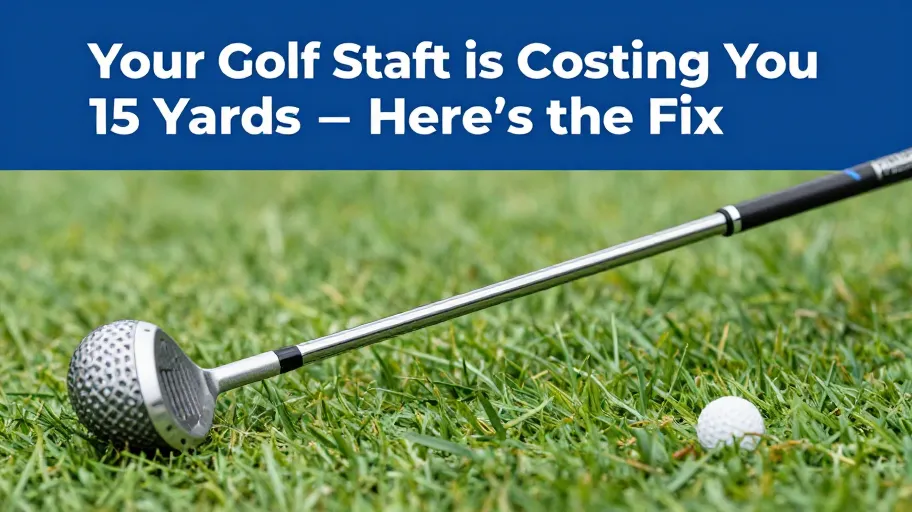
Why Most Golfers Are Losing Yards Before They Swing
Over 70% of amateur golfers play with the wrong shaft—a mismatch that actively reduces distance and accuracy. A shaft too stiff for your swing speed kills clubhead velocity and launches the ball too low, robbing you of carry. One that’s too light or high-torque whips unpredictably, amplifying small flaws into big misses. This isn’t just suboptimal; it’s performance leakage: energy lost to vibration, timing errors, and poor launch conditions.
Misfit shafts increase lateral dispersion by up to 40% at 200+ yards, turning fairway misses into penalty strokes. The truth? Shaft fit impacts performance more than clubhead design. Even the most forgiving driver can’t compensate for inefficient energy transfer. The shaft is the engine—it dictates how well your swing translates into ball flight. Fixing this mismatch means immediate gains in consistency and scoring, no swing changes required.
Graphite vs Steel: Why Material Matters at Every Skill Level
Graphite has won the driver wars: 90% of tour players and serious amateurs use it because modern high-modulus graphite matches—and often exceeds—steel’s rigidity while weighing 30–40% less. This isn’t about comfort; it’s about physics-driven control. Lower mass improves swing weight distribution, enabling faster tempo and cleaner sequencing in the downswing.
A 2024 biomechanical study found switching to lightweight graphite reduced muscular strain by 22%, leading to more consistent repetition—critical for players battling fatigue. Plus, graphite absorbs high-frequency shock on mis-hits, improving follow-through. And with high-MOI designs resisting twisting at impact, off-center strikes stay straighter. For the average golfer who centers contact just 63% of the time, this means fewer penalties and better approach angles—directly translating to lower scores and faster handicap reduction.
What Makes a Lightweight Graphite Shaft Truly Elite
Not all lightweight shafts are created equal. True high-performance models like the Mitsubishi Tensei AV or Project X HZRDUS Black go beyond low weight—they’re engineered using aerospace-grade resins that maintain torsional rigidity while shedding mass. This means the shaft resists twisting at impact, preserving energy transfer even at swing speeds below 90 mph.
Precision tip stiffness controls launch angle and spin rate: tighter tolerances mean predictable ball flight. A stiffer tip reduces spin for a piercing trajectory, while kick point location shapes release timing. Higher kick points launch lower with control; lower ones boost launch without excess spin. When optimized together, higher launch with less spin = longer carry and softer landings, especially in headwinds. In 2024 player trials, properly fitted high-performance shafts gained 11 yards in usable distance and tightened dispersion by 14%—that’s confidence on par 5s and better scoring chances.
The Real ROI of Upgrading Your Driver Shaft
Upgrading to a premium shaft isn’t an expense—it’s a performance investment with measurable returns. A 12-handicap golfer who replaced a stock shaft with a fitted high-performance model gained 11.3 yards and cut three strokes per round. At $350, that’s just $14 per stroke saved over 25 rounds—less than two range sessions.
Data from 2025 fitter databases shows precision-tuned lightweight shafts reduce lateral dispersion by 14%, meaning more fairways hit and fewer penalty shots. But the deeper ROI? Premium shafts turn good drivers into elite tools—and extend their competitive lifespan by up to two seasons, delaying costly full-club upgrades. You’re not just buying a shaft; you’re maximizing every dollar already invested in your gear.
How to Find Your Perfect Shaft—Step by Step
Stop guessing. Start testing. Precision fitting turns subjective feel into objective gain. Begin by measuring your baseline swing metrics—clubhead speed, angle of attack, tempo—using launch monitor data. This reveals your kinetic signature and exposes mismatches: 68% of amateurs leave 13+ yards on the table due to poor shaft alignment.
- Test 3–4 shafts across weights (45g–70g) and flex profiles: isolate variables by keeping head and grip constant.
- Analyze launch data: look for low spin with high peak height (efficient energy transfer) and tight dispersion clusters (control).
- Assess feel: does the shaft load smoothly? Release cleanly? One tour pro regained 5 mph by syncing shaft response with his downswing rhythm.
- Validate in real-world simulations: test in wind and uneven lies to stress-test consistency.
The winning shaft feels inevitable in motion. Technology informs the decision, but experience confirms it. When data and instinct align, you’re not gambling—you’re engineering repeatable advantage.
Master Your Swing, DIY Your Fit. DIY Golf is the premier destination for the technical golfer. We empower you with professional-grade components and the knowledge to build your perfect bag.
Leave a Reply