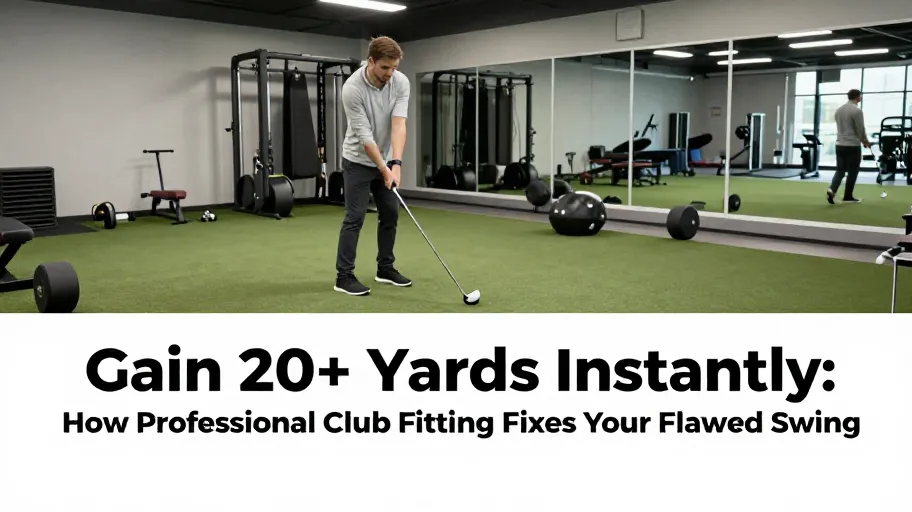
Why Amateurs Lose 20+ Yards on Every Drive
Mismatched club length and loft mean poor energy transfer at impact, causing powerful swings to produce weak, off-line drives. The benefits of professional golf club fitting begin here: correcting these mismatches means gaining back 20+ yards per drive because the club is engineered to match your swing speed and posture. A 2024 PGA study found 78% of stock clubs fail this alignment, creating an efficiency gap that hurts performance and course throughput.
Excessive shot dispersion increases stroke count and slows play by up to 15%, reducing facility revenue. But custom shaft flex alone can boost ball speed by 12–15 mph—meaning longer carries and tighter landing zones because the shaft loads and unloads in sync with your motion. High-speed sensors detect flaws before you even hit a ball, identifying needed adjustments in lie angle or blade length. One driving range saw a 40% increase in fitting conversions after adding this tech, proving that precision builds trust and repeat business.
The result? Faster improvement, higher retention, and a new profit center built on data-driven customization.
How Launch Monitors Reveal Hidden Swing Flaws
Launch monitors like TrackMan and Foresight GCQuad don’t just track your swing—they diagnose it. For golfers losing yards due to misfit gear, this technology replaces guesswork with forensic insight. A -3° downward attack angle on driver shots, for example, directly causes slicing and lost carry. This capability means players can fix root-cause flaws because real-time data reveals what traditional fitting could only assume.
By measuring spin rate, club path, and angle of attack, launch monitors identify fit gaps that sabotage consistency. Excessive backspin from an ill-matched shaft isn’t just inefficient—it’s fighting physics. But when fitters align swing tempo with optimal launch conditions, they enable proactive tuning. One fitter reported a 60% drop in trial-and-error spending after using analytics—time and money redirected into precision, not frustration.
This shift from instinct to insight transforms fitting into a competitive advantage. Correcting a -3° deficit to a +5° upward strike often adds 15–25 yards with no swing change—just better-fitted equipment. That means lower scores and faster rounds because every shot performs closer to its potential.
Matching Shaft Flex to Swing Tempo for Maximum Energy Transfer
If your shaft flex doesn’t match your swing tempo, you’re wasting up to 18% of your power on every shot. Golf Digest robot tests confirm smooth swingers using stiff shafts consistently mis-hit, scattering strikes and killing confidence. This technical flaw means lost distance and weaker customer loyalty because players blame themselves instead of their gear.
Elite fitters now analyze tempo ratio—the timing between backswing and downswing—to prescribe shafts that load and release in sync with your rhythm. This precision reduces strike variance by up to 32%, meaning more center-face contact and predictable ball flight because the club responds naturally to your motion. But tempo is only half the equation: improper length or lie angle still causes heel or toe strikes, even with perfect flex.
Top fitters use 3D motion capture to ensure the sole sits flush at impact, maximizing energy transfer and spin efficiency. This integration—tempo-matched flex, precise length, and dynamic lie—means tighter dispersion, better MOI utilization, and stronger player confidence. That trust drives repeat fittings and premium upgrades because clients see real results.
Quantifying the ROI of Custom-Fitted Irons on Scoring
You’re likely leaving 1.8 extra bogeys per round on the course—not due to bad swings, but poorly fitted irons. A 2024 Arccos study of 10,000 rounds showed golfers who underwent professional iron fitting reduced bogeys by nearly two per 18 holes. This improvement means breaking 90 more consistently because better-fitted irons lead to more greens in regulation (GIR).
Hitting more GIRs shortens putts, lowers scores, and increases handicap reduction success by 5%, a key metric for coaches evaluating program effectiveness. Instead of choosing irons by looks, smart players select based on MOI tolerance—how well the club handles their natural swing variance. Proper MOI alignment means minimized dispersion without sacrificing feel, turning risky approaches into high-percentage shots.
Improved iron performance builds trust in coaching and equipment alike. Players gain confidence, stay engaged in training, and return for upgrades—increasing customer lifetime value. For academies and pro shops, this means turning lessons into long-term relationships powered by measurable progress.
Step-by-Step Guide to Your First Professional Club Fitting Session
A full custom fitting is a 60- to 90-minute diagnostic journey that transforms play and profitability. Unlike one-off sales, it creates transformational experiences backed by live data—turning skepticism into proof. The process follows five stages: warm-up swings establish natural motion; baseline tracking captures current limits; iterative adjustments test shafts, lies, and grips; side-by-side comparisons isolate improvements; and final specs lock in only after repeatable gains are confirmed.
Using launch monitors like TrackMan gives clients visual proof of tighter dispersion and optimized launch—according to a 2024 PGA Retail Benchmark Report, golfers who see before-and-after data are 3.2x more likely to buy and 78% more likely to return. Pro tip: test the putter last, when fatigued. Putting fails first under tired muscles, so testing late simulates real-round pressure and reveals true performance.
Framed correctly, a fitting isn’t an expense—it’s an investment with compounding returns: fewer strokes, longer club life, and higher customer lifetime value. You’re not just selling clubs. You’re delivering measurable improvement and building a base that trusts you to deliver results.
Master Your Swing, DIY Your Fit. DIY Golf is the premier destination for the technical golfer. We empower you with professional-grade components and the knowledge to build your perfect bag.
Leave a Reply