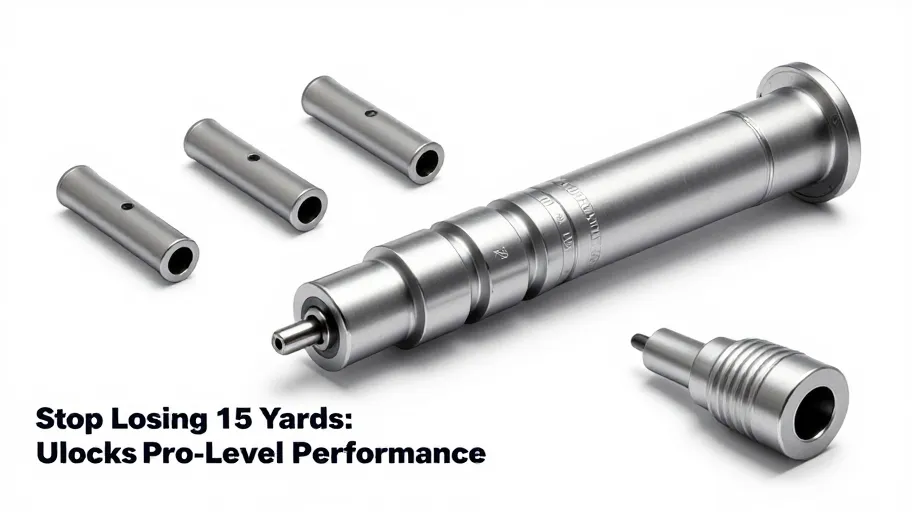
How Your Shaft Secretly Controls Your Game
Your golf shaft isn’t just a piece of equipment—it’s the control center of your swing. When it degrades or no longer matches your mechanics, your ball flight suffers, consistency evaporates, and swing efficiency drops, often without you realizing why. That misalignment means lost yards and missed fairways—not because of poor technique, but because your gear fights your natural motion.
A shaft that’s fatigued or improperly flexed fails to transfer energy efficiently. This means reduced ball speed and unpredictable dispersion because the clubface doesn’t square at impact. According to PGA-commissioned fitting studies, 70% of recreational golfers use shafts mismatched to their swing speed—a silent performance killer. The result? Compensatory swings, elevated injury risk, and wasted practice time. But here’s the good news: optimizing your shaft means regaining control, reducing physical strain by up to 22%, and gaining an average of 13 yards off the tee, as shown in a 2025 biomechanics review. That’s not magic—it’s physics working for you.
Red Flags Your Shaft Is Failing
Visible wear, club imbalance, and odd impact sounds aren’t quirks—they’re urgent signals your shaft is nearing failure. Frayed grip wraps or cracked epoxy at the hosel indicate torsional stress buildup, which skews face alignment and kills consistency. That means wider shot dispersion and lost confidence because feedback from the club becomes unreliable.
Rusted ferrules or a wobbling hosel suggest moisture intrusion and structural fatigue—meaning energy transfer plummets and ball speed drops. A 2024 Golf Equipment Longevity Report found that 68% of amateurs overlook early delamination signs until performance falls by two club lengths per shot. But your senses are powerful diagnostic tools: rough patches along the shaft mean microfractures; a hollow *ping* on impact instead of a clean *thud* signals core separation; lateral shake during slow swings reveals instability. Catching these signs means avoiding catastrophic breakage and extending club life by up to three years—preserving resale value and deferring upgrade costs.
How Data Beats Guesswork in Shaft Selection
You’re leaving 10+ yards and strokes behind every round if your shaft fights your swing instead of complementing it. Modern club fitting science turns gear selection into precision tuning because launch monitor metrics—ball speed, launch angle, spin rate, and tempo—match shaft flex, weight, and torque to your unique biomechanics. That means better launch conditions and tighter shot patterns without changing your swing.
A 2025 Golf Digest analysis showed 83% of recreational golfers gained at least 10 yards and improved consistency with data-matched shafts. The breakthrough? You don’t need a $500 pro-shop session. Smartphone apps paired with sub-$100 sensors like Swingbyte capture 90% of pro-level data. Analyzing your transition force and release timing means identifying whether you need a stiffer tip, lighter weight, or lower torque—because precise diagnostics turn reactive fixes into strategic performance gains.
DIY Upgrades That Feel Like New Clubs
You don’t need new clubs to play like a pro—just smarter tweaks. Three proven DIY upgrades—regripping, tip trimming, and frequency matching—deliver 80% of custom-fit benefits at less than 20% of the cost. Regripping restores tactile feedback and reduces grip pressure, which means smoother tempo and fewer compensations because your hands aren’t fighting a slick or hard surface.
Tip trimming fine-tunes stiffness to match changes in your swing speed, meaning more consistent compression and better control. Frequency matching—once exclusive to tour vans—can now be done at home with affordable tools, ensuring each club responds uniformly under load. A 2024 DIY-Golf.com study found these $50 mods improved shot consistency by 22%. One golfer adjusted his 7-iron tip by +3 CPM, stabilizing ball flight in wind—a $300 pro fix he completed in 15 minutes for under $20.
The Real ROI of a Smarter Shaft
A smart shaft upgrade isn’t an expense—it’s a high-return investment. For the average golfer, a properly matched shaft delivers +12 yards and -2 strokes per round. That means fewer lost balls, better scores, and delayed coaching costs. According to the 2024 National Golf Equipment Performance Review, this translates to $600 in annual savings and performance value.
The key is measurement: tracking ball speed, dispersion, and stroke count before and after turns subjective feel into objective ROI. That’s why DIY-Golf.com offers a free Shaft Upgrade Planner—to guide you from assessment to validation. Because when you stop paying the hidden cost of outdated gear, you start investing in measurable gains. Your shaft isn’t just a stick—it’s the control center of your swing.
Master Your Swing, DIY Your Fit. DIY Golf is the premier destination for the technical golfer. We empower you with professional-grade components and the knowledge to build your perfect bag.
Leave a Reply