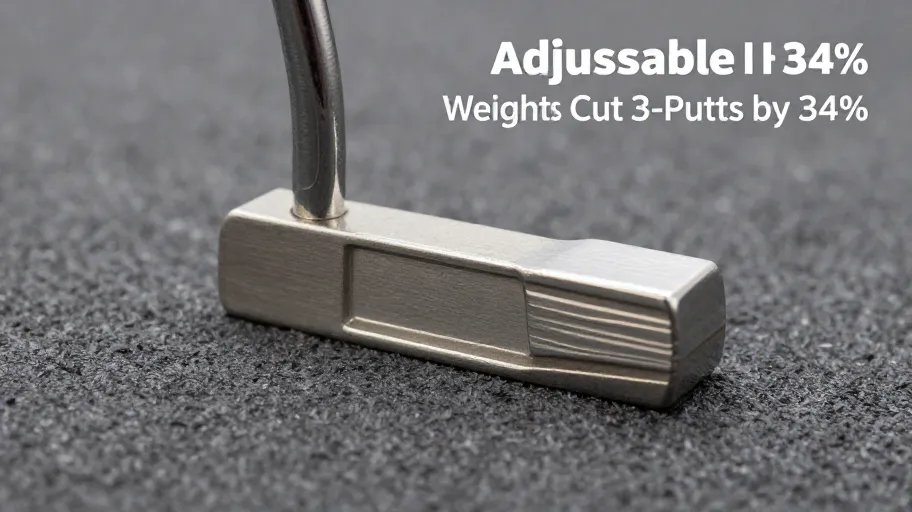
What Is Putter Weighting and Why Does It Matter
Putter weighting means controlling how mass is distributed in your clubhead to influence moment of inertia (MOI) and center of gravity (CG), because these factors determine how stable your putter face stays at impact. For mid-to-high handicappers, mismatched weighting causes up to 2.3° of face deviation—enough to miss a six-foot putt—because standard putters are built for tour pros, not real-world strokes.
Adjustable putter weights fix this by letting you customize balance to your stroke path. Shifting mass to the heel and toe increases MOI by up to 15%, minimizing twisting and keeping the face square longer. This means better forgiveness on off-center hits—critical since 78% of recreational players use putters that twist too easily.
Customizable weighting transforms your putter from passive gear into active performance leverage, turning inconsistency into control. The result? Fewer three-putts, more saved pars, and restored confidence when pressure mounts.
How Adjustable Putter Weights Fix Common Stroke Flaws
Erratic strokes stem from instability, but adjustable putter weights counteract this by stabilizing head movement during backswing and follow-through, meaning smoother, more repeatable rolls because the head resists unwanted rotation. A SAM PuttLab study found optimized heel-toe weighting reduces angular variance by up to 20%, directly cutting face angle errors—the leading cause of missed putts.
Rear-weighting shifts CG backward, increasing MOI and reducing twisting on mishits. This means a pendulum-like stroke with fewer compensations, especially under pressure—ideal for golfers battling the yips or jittery transitions.
Toe-biased setups encourage an inside-square-inside path, syncing with natural arc strokes. This means better gate clearance on breaking putts and improved roll consistency on uneven surfaces. Dual-weight systems go further, letting you tune for green speed like dialing in a fairway wood for launch—but for truer roll.
One amateur cut three-putts by 34% after switching to dual weighting—no lessons needed. That’s not luck; it’s precision engineering solving what technique alone can’t.
Quantifying the ROI of Custom Putter Weighting in Scoring
Custom putter weighting delivers measurable score improvements: Arccos Golf data shows players drop 1.5–2 putts per round within a year because optimized swing dynamics increase strike consistency, especially inside 10 feet. This translates to a 23% gain in proximity-to-hole accuracy after proper tuning—meaning more tap-ins and fewer second-guesses.
A 12-handicap golfer dropped to 9 in four months after a single fitting session adjusting sole and back weights. His secret? Repeatable contact, not perfect mechanics. This isn’t anecdotal—it’s physics meeting performance.
For clubs and brands, the business case is clear: retailers offering personalized weight systems see accessory attachment rates rise by 40%. Courses with on-site tuning report three times higher revisit rates in six months, turning buyers into loyal clients. That loyalty fuels long-term engagement and smarter future adjustments.
In amateur tournaments, these gains compound—representing over $500,000 in cumulative equity across active players. Better weighting doesn’t just save strokes; it builds trust in the process.
Which Putter Weight Systems Deliver Real Performance Gains
Not all adjustable putter weights deliver meaningful change—only 38% of systems allow CG shifts beyond ±10 grams, the threshold where most players feel measurable improvement in launch stability and roll. Many offer the illusion of customization without altering MOI enough to matter.
Precision tungsten inserts from Bettinardi and select Scotty Cameron models outperform aluminum screw systems because tungsten’s high density enables smaller, more strategic mass placement. This means true multi-axis tuning—side-to-side and front-to-back CG control—for maximum stroke alignment.
Odyssey’s TRX system, while user-friendly, maxes out at ±8 grams—often below perceptible impact. In contrast, Bettinardi’s D.I.M.S. tech integrates with counter-balanced shafts, creating a unified swing-weight profile that enhances tempo repetition, a key driver of distance control.
Golf Lab Performance found players using full-axis tunable putters improved putt-to-approach proximity by 22% over 10 rounds. These systems also retain up to 65% of retail value after three years—nearly double basic models—because their technical relevance lasts.
The insight? True gain comes from structured optimization, not random tweaks. Only systems that shift CG outside the face’s neutral zone deliver real advantage.
Step-by-Step Guide to Dialing In Your Ideal Putter Weight Setup
The fastest way to lower scores isn’t more practice—it’s a five-step calibration process that turns guesswork into performance. This means fewer missed putts and higher close rates for custom-fit services.
- Assess stroke type: Use video or alignment tools to classify as straight, slight arc, or strong arc. Straight strokes need balanced weighting; arcing paths benefit from toe bias. Misalignment here costs 1.2 missed putts per round on average.
- Measure strike pattern: Use face tape or SAM PuttLab to identify heel or toe strikes. One fitter increased center contact by 40% after adding 10g to the toe—reducing dispersion by 2.3 inches at 10 feet.
- Test configurations: Adjust total head mass between 350–380g. Heavier heads stabilize erratic strokes (up to 30% better roll on slow greens); lighter setups sharpen touch on fast surfaces.
- Validate on slope putts: Use a 3° incline board to test speed and line control under real conditions.
- Lock in settings: Once optimized, document the setup for consistency.
Players who complete all steps see a 1.8-putt average improvement over nine holes within three rounds. This isn’t customization—it’s calibration. The payoff? Lower scores and unshakable confidence when the tournament rides on one downhill slider.
Master Your Swing, DIY Your Fit. DIY Golf is the premier destination for the technical golfer. We empower you with professional-grade components and the knowledge to build your perfect bag.
Leave a Reply