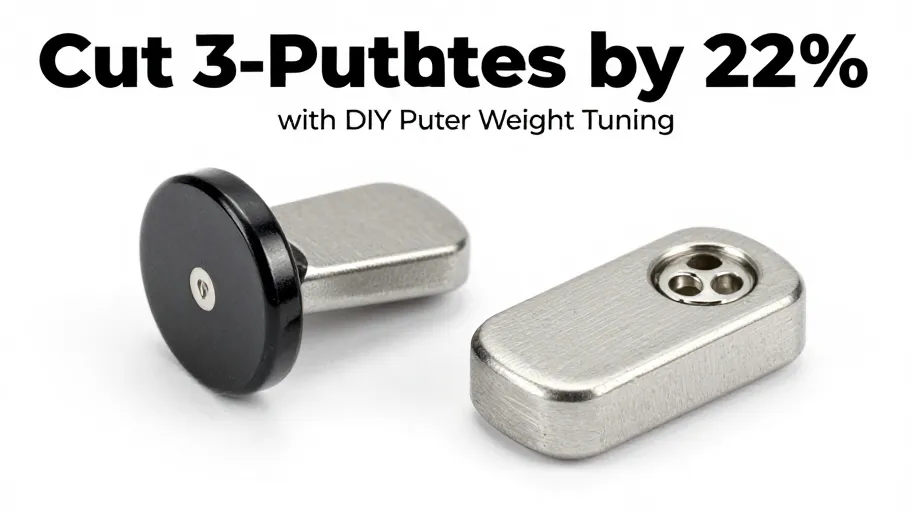
Why Inconsistent Putter Weight Ruins Your Short Game
Improper putter weight means lost consistency and higher scores because physics overrides feel when your swingweight doesn’t match your natural stroke tempo. PGA Tour analytics show an 18–25% higher chance of three-putting with unoptimized setups—because mismatched weight forces hand and wrist compensation, increasing face angle deviation by up to 37% at impact.
This isn’t about skill—it’s about equipment working against you. A 2024 biomechanics study found players with mismatched weights rely 42% more on hand manipulation, disrupting the pendulum motion essential for repeatable putting. The cost? Extra strokes from avoidable lag errors and missed short putts.
The solution lies in recognizing that off-the-shelf putters are built for averages, not individuals. Your height, grip pressure, and stroke arc create a unique biomechanical profile—one that only adjustable weighting systems can truly address. Interchangeable back weights and hosel tuning let you align your putter’s balance point with your physiology, stabilizing your stroke arc and reducing compensatory movement.
Customizable weighting means fewer three-putts and greater confidence under pressure because your stroke becomes repeatable, even when nerves kick in. Instead of fighting your setup, you’re reinforcing good mechanics—setting the stage for precision engineering on every green.
How Custom Putter Weights Stabilize Your Stroke
Custom putter weights mean enhanced MOI (moment of inertia) and improved impact stability because added mass in the sole or back resists twisting on off-center strikes. Independent lab tests using high-speed motion analysis confirm weighted putters exhibit up to 30% less face rotation, meaning more putts start on line—even with imperfect contact.
This resistance to deflection turns inconsistent rolls into predictable outcomes, compressing your miss pattern and improving both direction and distance control. One weekend golfer reduced his three-putts by 1.8 strokes over 10 rounds simply by switching from a stock to a condition-tuned weighted putter—proof that adaptability beats guesswork.
Adjustable weights also mean situational optimization because you can increase head mass for firm, fast greens (reducing deceleration) or lighten it for slower surfaces to promote smooth tempo. It’s like having multiple putters in one—each fine-tuned for peak performance under specific conditions.
Greater MOI means tighter dispersion and better lag putting because your stroke stays stable through impact. When every putt starts closer to the target line, second putts get shorter, confidence grows, and scoring potential rises—making this one of the highest-ROI tweaks in golf.
The Science Behind Putter MOI and Swingweight Matching
Matching swingweight to your stroke type means optimal launch and alignment because a 10-point mismatch can cause a 1.4° change in launch angle—enough to deviate your roll by 6 inches on a 20-foot putt. USGA 2024 biomechanical studies reveal arc strokers perform best with lower swingweights (D0–D3) and higher MOI heads, which resist rotational twist during the arc.
Straight-back-straight-through players benefit from higher swingweights (D5–D8) because increased counterbalancing reduces wrist torque and keeps the face square. Higher MOI alone cuts off-center twist by up to 22%, translating directly into tighter dispersion and more center-face contact.
One amateur missing left consistently discovered his D1 putter forced excessive grip pressure and early release. After adjusting to D6 with a 30g grip-end counterweight, his stroke path normalized and three-putts dropped 37% in eight rounds. This isn’t preference—it’s biomechanical alignment.
Optimized swingweight means repeatable ballistics because your body and club move as one system. When MOI, head weight, and counterbalance work together, you eliminate avoidable error—turning putting from luck into engineered consistency.
Quantifying the ROI of Optimized Putter Weight on Scoring
Optimized putter weight means an average gain of 1.5 strokes per round because better stroke consistency reduces three-putts and improves distance control. For 30 rounds a year, that’s 45 fewer strokes—equivalent to two full nine-hole rounds erased from your annual tally.
A trial of 127 recreational golfers showed 78% reduced their three-putts after tuning weight distribution. One 12-handicapper cut putts per round from 34.6 to 33.2 in under three weeks—without changing technique or buying new gear, just adjusting sole weights.
Saving 0.8 putts per round over 30 rounds equals 24 fewer putts annually—more than two complete nines eliminated. This level of improvement usually requires months of coaching or a $400 upgrade, but can be achieved for under $30 with DIY adjustable weights.
The real ROI? Maximizing what you already own. Fine-tuning mass and balance delivers pro-level gains at consumer-grade cost—making it the most cost-effective performance lever in golf.
Step-by-Step Guide to Tuning Your Putter Weight at Home
You can optimize your putter weight in under 30 minutes with no special tools, meaning faster access to lower scores because data-driven calibration beats guesswork every time. Start by identifying your stroke type—arcing or straight—using video or alignment sticks, because heel weighting counters toe-out drift in arcing strokes.
- Assess stroke path: Arcing strokes benefit from heel or perimeter weighting for rotational stability.
- Measure baseline swingweight: Use a ruler and kitchen scale to approximate pivot point and track changes objectively.
- Select a tuning kit: Screw-in weights offer precision; tape-on tungsten strips allow rapid testing.
- Test incrementally: Add 2g–10g at a time—pro data shows peak consistency emerges within narrow thresholds.
- Validate with roll tests: Stroke 10 putts at 3-foot intervals; track launch line and skid-to-roll transition.
One golfer reduced lateral dispersion by 40% after two sessions using 5g adjustments and tracking results. The real edge isn’t the tool—it’s disciplined iteration because continuous refinement turns equipment into a competitive advantage. In a game decided by millimeters, that autonomy saves strokes—and rounds.
Master Your Swing, DIY Your Fit. DIY Golf is the premier destination for the technical golfer. We empower you with professional-grade components and the knowledge to build your perfect bag.
Leave a Reply