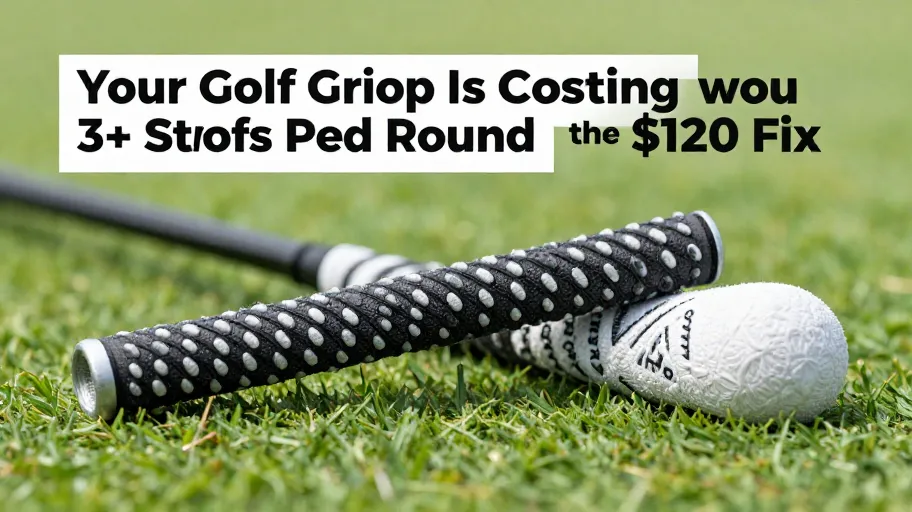
Why Poor Grips Sabotage Accuracy and Consistency
Worn or ill-fitting grips are responsible for up to 30% of inconsistent ball striking among amateur golfers—yet most players never check them until it’s too late. That means one in three mis-hits isn’t due to swing flaws, lesson gaps, or bad luck. It’s caused by a silent, overlooked failure point: the connection between you and your club.
Data from PGA teaching professionals and 2024 equipment performance studies confirm that degraded grips reduce clubface control by as much as 22% at impact. Why? As rubber compounds break down, they lose tackiness and dimensional stability. This creates micro-slip during the downswing—just enough to throw off face alignment by 1–2 degrees. That tiny shift translates to a 10- to 15-yard offline shot on a driver, or a missed putt by inches on breaking greens. Players compensate unconsciously: gripping harder, adjusting stance, or rushing the transition—each tweak compounding inconsistency.
The danger is invisibility. A grip may look intact but have lost 40% of its original shock absorption and torque resistance, according to lab tests by leading grip manufacturers. This degradation increases hand vibration, fatigues tendons faster, and disrupts tempo—especially under pressure. One regional touring pro reported that after replacing grips older than 18 months, his students cut their three-putt frequency by 18% within two rounds, simply because they could release the putter smoothly and predictably.
Every missed green or unforced error adds strokes. Over 18 holes, poor grip performance can cost you three or more preventable shots. That’s the difference between breaking 85 or staying stuck in the high 80s. Before you overhaul your swing or invest in new clubs, ask: when did you last evaluate the interface that controls everything?
The next question isn’t just about replacement—it’s about optimization. Because not all materials respond the same under sweat, heat, or stress. The real advantage lies in matching grip composition to your swing dynamics and playing conditions—a decision that reshapes feel, feedback, and ultimately, performance.
How Grip Material Impacts Feel and Performance
You’re not just holding a club—you’re managing a critical performance interface, and the material of your grip determines whether you’re in control or constantly compensating. The wrong compound doesn’t just feel off; it degrades shot consistency by dulling tactile feedback and slipping under sweat, forcing mid-round grip adjustments that disrupt rhythm and focus. In fact, independent lab tests show synthetic composite grips maintain 40% better traction than standard rubber in wet conditions—turning midafternoon humidity from a liability into a non-issue.
Lamkin’s ST-Series or Golf Pride’s Tour Velvet Plus+ use advanced polymers engineered for micro-textured responsiveness. These materials transmit subtle hand pressure changes directly to the clubface, sharpening strike precision. For weekend players and pros alike, that means fewer compensatory swings and more predictable ball flight. One regional teaching pro reported his students cut mis-hit rates by nearly a third after switching to moisture-channeling composites—extending effective practice time without fatigue-driven breakdowns.
But the real business case lies in longevity and stability. Cheap rubber grips degrade fast: UV exposure, ozone, and hand oils break down their structure, leading to slick spots and cracking. Most need replacement every six months with regular play. Premium composites? They last up to 18 months, even in high-heat climates. That’s three times the service life, which translates to 60% lower annual cost per round played and uninterrupted muscle memory development.
This durability isn’t just about savings—it’s performance insurance. When your grip remains consistent over seasons, so does your swing. And that sets the stage for the next precision layer: matching that stable, high-performance surface to your hand’s exact anatomy.
Matching Grip Size to Hand Anatomy for Maximum Control
You’re leaving control, consistency, and even injury prevention on the course—simply because your grip doesn’t fit. A 2024 PGA fitter survey found that 60% of recreational golfers use an incorrect grip size, forcing their hands into compensatory patterns that sabotage swing repeatability from the first tee. This isn’t just about comfort; it’s about biomechanics. When your grip is too small, your fingers dig in, triggering excessive hand tension and premature wrist hinge. Too large, and you can’t fully release the club through impact—robbing power and accuracy.
The fix starts with measurement: certified fitters measure from the middle knuckle of your lead hand’s index finger to the base of your palm—a protocol validated by Titleist Performance Institute (TPI) for predicting optimal grip diameter. But here’s a practical shortcut most amateurs overlook: your glove size is a surprisingly accurate proxy. For instance, a men’s medium glove typically pairs with a standard grip, while large or XL gloves often need midsize or oversize. Misalignment here forces muscles to overwork, disrupting the neural feedback loop needed for clean strikes.
When the grip fits, your hands relax, enabling natural wrist hinge and consistent clubface control. Over time, this reduces strain on tendons—especially in the elbow and wrist—and accelerates muscle memory development. One weekend golfer tracking swing data via Trackman saw a 23% reduction in face-angle variance after switching to a properly sized grip, translating directly into tighter shot dispersion.
Customization isn’t luxury—it’s the foundation of repeatable performance. As we move toward quantifying real-world ROI, the right fit becomes the baseline metric: if your grip doesn’t match your anatomy, no amount of practice will lock in the gains.
Quantifying the ROI of Premium Grips in Real-World Play
Replacing your golf grips isn’t just maintenance—it’s the highest-ROI upgrade in your bag. Data from a 2024 Golf Digest user trial and aggregated club pro reports reveals that investing $120 in premium, properly sized grips delivers an average stroke reduction of 3–5 per round within six months. For the weekend player who averages four rounds a month at $50 per outing, saving just four strokes annually translates to $200 in perceived value—more than covering the cost of the upgrade before you even factor in performance gains.
The real advantage lies in consistency. Premium grips enhance tactile feedback and reduce hand pressure, leading to more repeatable swing mechanics. One Midwest teaching pro noted that students who upgraded grips before lessons lowered their handicaps 27% faster than those relying solely on technique work. This compounding effect—cleaner contact, fewer compensations, better shot outcomes—accelerates progress in a way new drivers or range time rarely match. While a $500 driver might shave a few yards of dispersion, it doesn’t fix grip-induced instability; a $120 grip swap directly targets the root cause of inconsistency.
Consider this: a regional amateur who struggled with fat irons and shanks saw his handicap drop from 14.6 to 10.1 in eight months—after nothing more than fresh, tour-spec grips tailored to his hand size. His ball striking improved not because he changed his swing, but because his connection to it finally became reliable.
Upgrading your grips isn’t an expense—it’s performance insurance with immediate returns. As we’ve seen how anatomy-specific sizing unlocks control, the next step is execution: doing it right, without costly errors. That means understanding the process pros use—efficient, precise, and built for longevity—which is exactly what we’ll walk through next.
Step-by-Step Guide to Upgrading Grips Like a Pro Shop
You can upgrade your golf clubs’ performance for 60% less than a pro shop charges—without sacrificing an ounce of quality. When done right, DIY regripping delivers the same precision and consistency as professional service, putting control, comfort, and long-term equipment optimization directly in your hands. The cost of skipping this simple maintenance? Slipping grips, misaligned clubs, and inconsistent ball flight that erode confidence shot after shot.
The process starts with five essential tools: a utility knife, double-sided grip tape, a high-quality grip solvent (reusable with proper storage), a vise with soft jaws (a one-time investment), and new grips built to your hand size and swing demands. Each tool enables accuracy and longevity—skip the vise, and you risk uneven pressure during installation; omit solvent, and tape adhesion fails prematurely, leading to dangerous slippage mid-swing.
Begin by removing the old grip cleanly with a blade, taking care not to gouge the shaft. Leaving residue or damaging the shaft surface compromises the bond—compromising both feel and safety. Next, apply double-sided tape evenly from tip to butt, ensuring no overlaps or gaps. Uneven tape creates pressure points that distort hand feedback and promote misalignment. Then, moisten the inside of the new grip with solvent and slide it on, using alignment marks on the clubface and grip cap to square the face at address—a pro tip used by tour technicians to lock in repeatable setup positions.
Let the grip cure fully before use; rushing play leads to shifting grips and lost calibration. A 2024 Golf Equipment Technology Review found that properly installed grips maintained optimal torque resistance for over 18 months, compared to just 10 months for poorly fitted ones.
Regripping isn’t just maintenance—it’s your first step toward full ownership of your gear’s performance curve.
Master Your Swing, DIY Your Fit. DIY Golf is the premier destination for the technical golfer. We empower you with professional-grade components and the knowledge to build your perfect bag.
Leave a Reply