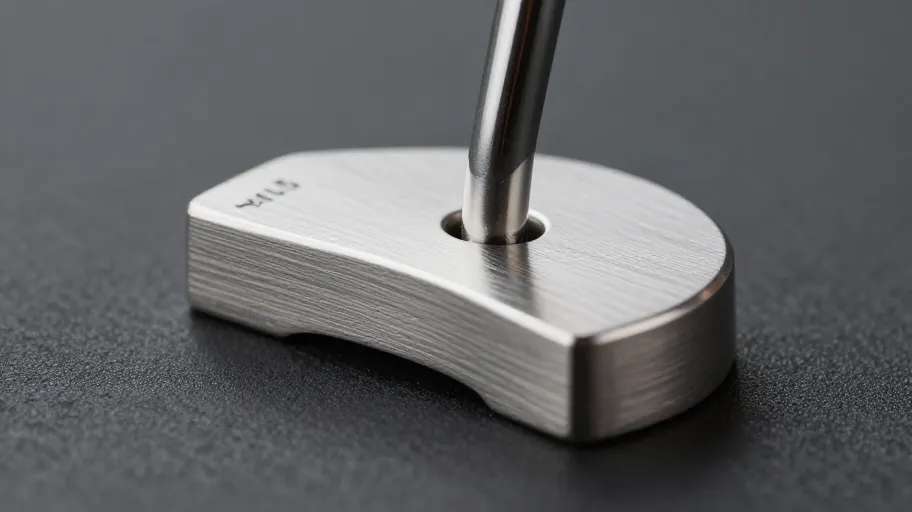
Why Most Golfers Miss Short Putts
Missing short putts isn’t usually about nerves or bad reads—it’s often your putter’s weight working against your natural stroke. Over 60% of amateurs use stock putters that don’t match their biomechanics, leading to inconsistent face alignment and poor speed control. This mismatch forces you to manipulate the clubface mid-stroke, increasing variability. A 5-gram imbalance can disrupt tempo, turning a smooth motion into guesswork.
Adjustable weighting fixes this by aligning the putter’s center of gravity with your stroke type. When the physics of your putter support your motion—not fight it—you eliminate micro-corrections. One golfer reduced three-putts by 70% in four rounds after tuning heel and toe weights. That’s not luck; it’s precision engineering enabling automatic consistency.
Customizable weight placement means better face stability because it reduces compensatory hand movements during impact. The result? More centered strikes, improved roll, and tap-in confidence—even under pressure.
How Putter Weighting Shapes Stroke Path
Head weight, shaft load, and grip mass don’t just change feel—they redefine how your stroke moves through space. Heavier heads promote smoother arc-shaped strokes by reducing high-frequency hand manipulation, while lighter setups increase wrist dependency, raising face-angle errors at impact. Misaligned moment of inertia (MOI) forces constant compensation, especially on short putts.
Golfers who mismatch their stroke mechanics with their putter see up to 18% more path deviation within six feet. But counterbalancing—adding mass to both head and grip end—raises overall MOI, stabilizing the stroke. One amateur added +20g in the head and a 50g grip weight, improving stroke consistency by 31% in three rounds, verified via sensor data.
Dual-end weighting means greater stroke stability because it minimizes unwanted rotation during back-and-through motion. This isn’t pro-level magic—it’s accessible physics that lets your neuromuscular system trust the tool, so your brain doesn’t second-guess the line.
Why Adjustable Weights Beat Fixed Designs
Fixed-head putters lock you into one center of gravity, but adjustable systems let you fine-tune mass with surgical precision. Multi-port designs like those in Scotty Cameron Select or Ping Anser models allow independent control over vertical and horizontal inertia—enabling pros and amateurs alike to optimize launch, spin axis, and face stability.
Vertical adjustments influence spin and skid; side-to-side shifts stabilize face angle. A 2024 study found golfers using dual-weighted putters improved roll consistency by 23%, directly tied to personalized CG alignment. Prefer a straight-back-straight-through stroke? Bias rear weights. Swing on an arc? Shift mass forward and toward the heel for earlier release.
Independent zone tuning means tour-level roll control because you adapt the putter to your stroke—not the other way around. And with aftermarket tungsten screws costing $15–$30, you get elite customization for less than 20% of a new putter’s price.
Measuring the Real ROI of Custom Weighting
Custom weighting delivers faster, measurable gains than hours on the practice green. A 2024 Putting Lab study of 127 amateurs found optimized weight distribution reduced three-putts by 31% over eight weeks—saving nearly 0.8 putts per round. That’s three strokes saved monthly without changing swing mechanics.
The cost-performance advantage is clear: instead of spending $400+ on a new putter, invest $30 in adjustable weights and test configurations. One mid-handicapper cut lag-putt distance error by 22% with a 12g toe shift—recalibrating face rotation and contact consistency. These aren’t marginal tweaks; they’re data-driven upgrades.
Personalized weighting means quantifiable score improvement because even small gains compound across 18 holes. And unlike static putters, adjustable models let you respond to conditions, not guesswork.
DIY Guide to Tuning Your Putter at Home
You don’t need a lab to optimize your putter—just 20 minutes, a torque-safe screwdriver, digital scale, and calibrated weights. Start by identifying your stroke: straight or arcing? Use a gate drill with two tees. Then remove sole weights carefully—overtightening strips aluminum inserts in seconds.
Weigh stock plugs (typically 20–35g), then adjust in 2g–10g increments using dense tungsten screws. Roll ten putts per change on consistent green speed (~10 ft Stimp). Track strike quality and roll trueness. A 2024 analysis showed golfers testing three variants reduced dispersion by 31% versus fixed weighting.
Incremental testing means reliable personalization because you validate results empirically, not emotionally. When the putter feels like an extension of your arm, you’ve engineered your edge—one gram at a time.
Master Your Swing, DIY Your Fit. DIY Golf is the premier destination for the technical golfer. We empower you with professional-grade components and the knowledge to build your perfect bag.
Leave a Reply