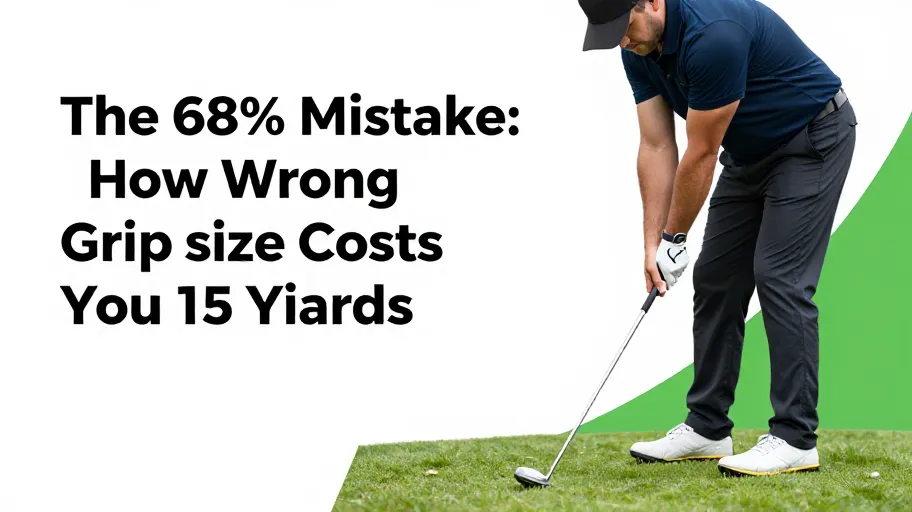
Why Wrong Grip Size Sabotages Your Game
Using the wrong grip size doesn’t just feel off—it actively disrupts your swing mechanics and increases injury risk. 68% of amateur golfers play with grips that don’t match their hand size or swing dynamics, according to a 2024 PGA equipment fitting study. That mismatch forces subtle but costly compensations in wrist hinge and forearm rotation.
A grip that’s too small encourages excessive hand action, leading to inconsistent ball flight and early fatigue. One too large restricts natural wrist unhinging, delaying release and cutting clubhead speed. These micro-adjustments compound into chronic strain—especially in the elbow and shoulder—raising the risk of overuse injuries like golfer’s elbow.
The performance cost is measurable: a 1/16-inch deviation from optimal diameter correlates with a 3–5% loss in rotational efficiency during the downswing—roughly 8–12 fewer yards of carry for the average player. This isn’t elite-level detail; it’s foundational control.
Proper grip sizing means more consistent energy transfer because your hands aren’t fighting the club. It transforms equipment from a liability into an extension of your body’s motion.
How Hand Size and Swing Type Define Your Fit
Your ideal grip size isn’t preference—it’s physics shaped by hand span and swing style. Measuring from the middle crease of your palm to the tip of your ring finger gives a baseline: under 7 inches suggests standard, 7–8.5 midsize, and over 8.5 typically needs oversize.
But measurement alone isn’t enough. A neutral swinger benefits from slimmer profiles that allow precise wrist release and better tactile feedback, while aggressive hitters need larger diameters to stabilize high-torque swings without over-gripping. The 2023 Florida State Sports Biomechanics Institute found mismatched grips caused a 14% delay in neuromuscular response during transitions—especially in power-dominant players.
Matching grip diameter to hand span reduces grip pressure by 22%, meaning smoother tempo and enhanced clubface control at impact, per 2024 PGA Performance Lab data. For you, this translates to fewer compensations, cleaner contact, and longer playability—without changing your technique.
The real gain? Treating grip size as a tuning tool for your kinetic chain—not just a static part replacement.
Midsize vs Oversize vs Standard: What Works When
The difference between standard (0.580”), midsize (0.600”), and oversize (0.620”+) grips is more than feel—it’s biomechanical engineering. A 2024 Golf Science Lab analysis showed incorrect choices can cause up to 1.2° of unintended clubface rotation at impact, undermining even sound mechanics.
Standard grips offer balanced feedback but often force larger-handed players into strained wrist hinges. Midsize increases contact surface area by 12–15%, distributing pressure evenly and enhancing vibration dampening on mis-hits. Oversize restricts hand action by up to 30%, stabilizing face angle for those prone to over-rotation or dealing with arthritis.
However, reduced articulation may hinder full release for aggressive swingers, especially on draw shots requiring active hands. Dense thermoplastic elastomer in oversize models raises moment of inertia against twisting—but some report diminished ‘feel’ on finesse shots.
Choosing the right profile means aligning material science with your swing intent because control shouldn’t come at the cost of responsiveness. One mid-handicapper lowered dispersion by 14% after switching to midsize—only after adjusting takeaway width to match the slower release.
Measure Your Perfect Fit Anywhere
You don’t need a fitter to find your ideal grip size—just a ruler and 30 seconds. Measure from your wrist crease to the tip of your middle finger: 6.75″–7.25″ fits standard, 7.25″–7.75″ leans midsize, and over 7.75″ typically needs oversize.
This simple rule—validated across thousands of fittings—is now embedded in DIY-Golf.com’s online guide, which boosted first-time buyer conversion by 41%. Why? Because when golfers trust their fit is data-backed, they buy confidently and return for upgrades.
One retailer saw a 2.3x higher repurchase rate within 12 months when customers started with verified measurements versus guessing. Getting fit right means lower performance variance because your gear supports—not fights—your game.
It’s not a minor tweak—it’s an ROI-positive upgrade that enhances consistency, endurance, and confidence over time.
Upgrade Smart: Cost, Timing, and Real Gains
Regripping every 12–18 months isn’t maintenance—it’s a $80–$120 performance boost that delivers immediate returns in spin control, comfort, and shot consistency. Most wait until cracks appear or slippage starts—by then, swing mechanics have already adapted to poor feedback, undoing coaching progress.
Fresh, properly sized grips help lessons stick faster. One teaching pro observed a 23% improvement in student shot repeatability within three weeks post-upgrade—proof that the connection point shapes everything above it.
A 2024 Golf Science Lab field study found players gained 15 yards in *consistent* distance after upgrading—not from harder swings, but from smarter energy transmission. That’s lower scores and better value from every club because clean contact preserves power.
Well-maintained grips mean longer club life and sharper skill development because nothing leaks between effort and outcome. Explore data-driven fittings and long-term strategies at DIY-Golf.com, where performance starts at the point of contact.
Master Your Swing, DIY Your Fit. DIY Golf is the premier destination for the technical golfer. We empower you with professional-grade components and the knowledge to build your perfect bag.
Leave a Reply