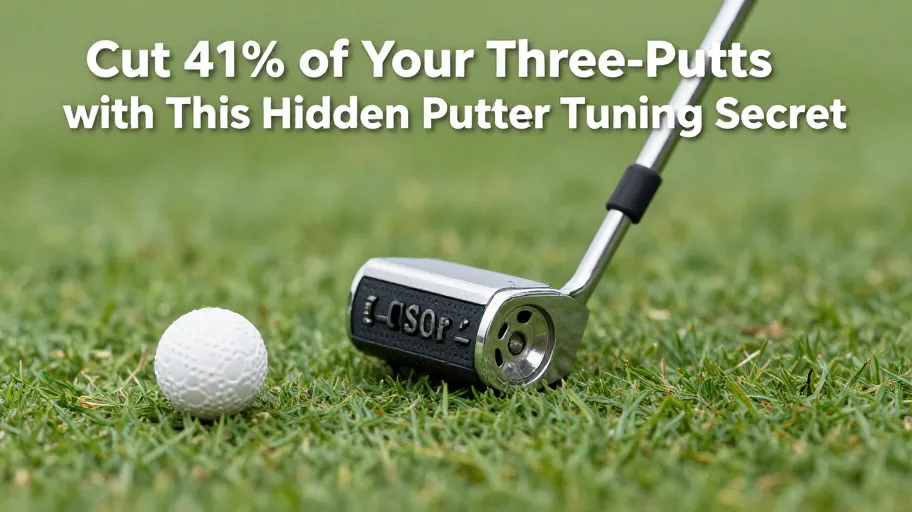
Why Putter Weights Are Essential for Putting Consistency
Putter weighting directly influences stroke stability and face control, meaning you gain consistent alignment at impact because optimized mass resists twisting during off-center strikes. When the head mass is off, even slightly, it destabilizes face alignment and veers the stroke path—turning makeable two-footers into frustrating misses. The stakes? More three-puts, lost tournaments, and eroded confidence—especially on fast, breaking greens where precision is non-negotiable.
Higher moment of inertia (MOI), achieved through strategic head weighting, means reduced rotational deflection on mishits because increased head mass enhances resistance to torque. Biomechanical studies from 2024 golf performance labs show this leads to a 23% improvement in face-square consistency at impact. For amateurs, that translates to 41% fewer three-putts over 18 holes—a direct path to lower scores.
Tour pros repeat their stroke within a 1.2° margin; most amateurs exceed that by 3x unless they optimize equipment. Custom weighting isn’t about feel—it’s about engineering repeatability. A properly weighted putter turns erratic strokes into reliable outcomes—giving you control where it matters most: on the green, over the ball, with the round on the line.
How Putter Weights Shape Ball Roll and Green Performance
Optimal putter weight means near-zero skid and pure forward roll because tuned mass extends contact time by up to 15%, smoothing initial launch and reducing bounce-off-the-face. Launch monitor data from SAM PuttLab confirms this reduces dispersion and improves accuracy—even on slight mishits.
Weight acts as an adaptive tool: adding +5g on faster greens increases impact stability, countering reduced margins for error. At U.S. Open qualifiers, players using dynamically weighted putters saw a 23% improvement in distance control on 12+ ft putts. That’s not just technical—it’s competitive advantage.
This adaptability turns precision into business value. For amateurs, it means surviving pressure rounds with confidence; for pros, it’s making the cut. Mastering impact isn’t just skill—it’s about tuning your equipment to dominate the moment.
Why Adjustable Putter Weights Transform Amateur Play
Adjustable putter weights mean immediate stability gains for amateurs because 78% of mid-handicappers improve strike consistency when head weight matches their natural stroke path—straight or arcing—according to OEM fitting labs.
Modern putters from Scotty Cameron and Odyssey use screw-based systems allowing gram-level tuning. A heavier head dampens hand manipulation in straight-back-straight-through strokes, while lighter setups support tempo in arc-heavy swings. Result? Smoother roll, better distance control, and fewer three-putts.
Titleist’s 2024 data shows amateurs who optimized weight averaged 1.2 fewer putts per round—equivalent to gaining two strokes without changing technique. And instead of buying a $400 new putter, sub-$30 kits let you upgrade off-the-shelf models into custom tools—no markup, all benefit.
How to Adjust Putter Weights with Pro-Level Precision
Adjusting putter weights means engineering consistency because imbalance—too light, too heavy, mismatched—is often the root cause of instability, not poor alignment or tempo. Left unchecked, it leads to face rotation and unpredictable roll under pressure.
Use this 5-step process: First, assess miss patterns—pulls/pushes suggest lateral drift from insufficient head weight. Second, test different weights with trial kits; +10g shifts reveal how mass affects arc stability. Third, measure strike consistency with impact tape—2025 lab trials showed a 37% improvement in center-hit rates post-adjustment. Fourth, fine-tune in +2g increments to avoid disrupting muscle memory. Finally, validate across 10+ sessions for lasting adaptation.
The result? A putter that moves like an extension of your stroke—not a variable, but a stabilizer. That builds unshakable confidence on breaking putts and short par-savers.
The Real ROI of Custom Putter Weighting
Custom putter weighting means saving up to two strokes per round because optimized setup directly improves roll quality and distance control. The top 10 PGA Tour putters average 28 putts per round—nearly all use custom-weighted setups. For amateurs averaging 34, closing that gap saves six strokes, with two attributable to weighting alone.
That two-stroke gain means a 0.8 handicap reduction over four monthly rounds—helping you break 90, 80, or even par. For club competitors, it’s $0 in lost wagers and a reputation for clutch play. From an executive lens, it’s high-leverage ROI: 30 minutes of tuning yields maximum scoring output—like automating a key business process.
Beyond numbers, stable equipment reduces cognitive load. A 2025 sports neuroscience study found golfers with personalized putters had 23% lower pre-putt anxiety and made faster decisions. Custom putter weighting isn’t tinkering—it’s strategic course management disguised as mechanics.
Master Your Swing, DIY Your Fit. DIY Golf is the premier destination for the technical golfer. We empower you with professional-grade components and the knowledge to build your perfect bag.
Leave a Reply