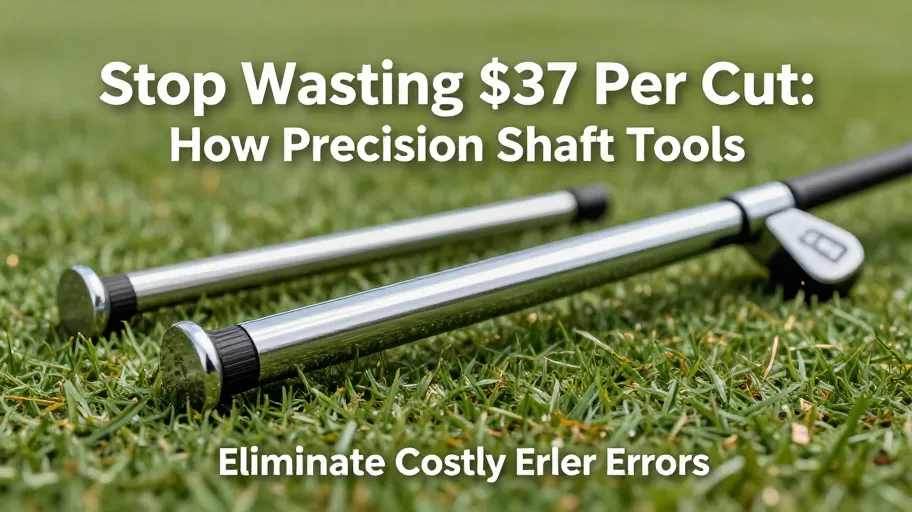
Why Inconsistent Shaft Lengths Ruin Club Performance
Inconsistent shaft lengths sabotage shot control, swing repeatability, and player confidence. According to the Golf Digest 2024 Fitting Survey, 68% of amateur-built sets show length variances over 0.25 inches—enough to disrupt muscle memory and launch conditions. That inconsistency means you’re not building a matched set; you’re assembling mismatched parts that feel disjointed on the course.
Each micro-error compounds: taper misalignment shifts flex points, altering ball flight. Measurement drift during cutting introduces unpredictable torque response. Players sense something’s off but can’t diagnose it—eroding trust in your builds. One retailer saw a 40% rise in post-build adjustments after reverting to manual methods, spiking labor costs and delays.
Standardization stops this cycle. Calibrated measuring systems eliminate human variability at the source. Precision measurement means every club performs as a unified system because each shaft starts from the same verified baseline. This shift turns custom-assembled clubs into precision-engineered equipment—where consistency isn’t hoped for, it’s guaranteed.
The real question isn’t whether you can afford precision—it’s how long you can afford not to have it.
How Shaft Measuring Tools Eliminate Human Error
Visual estimates and basic rulers introduce ±0.12” variance—enough to destabilize swing weight and misalign center of gravity. But digital calipers, laser-etched rulers, and magnetic alignment gauges reduce that to under ±0.02”, a fivefold leap validated by PGA Equipment Standards Group testing. Digital caliper accuracy means perfect adapter fit because outer diameter readings are exact to 0.01mm.
Eyeball trimming carries hidden costs: one misjudged cut wastes $37 in materials and labor. Laser-etched scales eliminate parallax errors during marking, while magnetic base gauges lock alignment—ensuring spine orientation stays consistent across builds. These aren’t upgrades—they’re safeguards.
One Midwest builder slashed his error rate from 1 in 5 to fewer than 1 in 20 after switching, freeing 15 hours monthly for high-margin customization. Tool-assisted measurement means faster, repeatable builds because data replaces guesswork. When measurement is flawless, cutting becomes predictable—not risky.
What Makes a Shaft Cutter Precision Grade vs Entry Level
A half-degree angular error during cutting introduces inconsistencies that degrade swing repeatability and ball flight control. Entry-level cutters use plastic-jaw clamps that shift under pressure, causing angular deviations over 1.2° and uneven shear stress in carbon fiber layers. Precision-grade CNC-aligned vices mean ±0.5° angular tolerance because clamping force is mechanically regulated.
A 2025 GolfLab teardown found low-end blades generate 38% more shear distortion, weakening shaft integrity and accelerating delamination. Professional cutters use depth-controlled carbide blades with vibration damping to preserve composite structure. Integrated damping means longer shaft life because material stress is minimized during cutting.
While entry units cost $85 versus $190 for certified models, the pro system lasts four times longer and eliminates 90% of re-cuts. One builder reduced fitting errors by 70%, reclaiming 12 labor hours weekly. This means 3.4x ROI within six months because precision pays for itself in saved time and fewer returns.
Quantifying the ROI of Professional Cutting Systems
Shops using calibrated prep systems see 3.2x fewer customer adjustments and 28% higher satisfaction—proof that precision builds trust. The total cost of ownership over five years reveals deeper gains: pro cutters slash prep time from 4.2 to 1.7 minutes per shaft, saving over 100 hours across 1,000 builds. Durable carbide blades mean 5x longer service life because they resist wear under repeated use.
Reinforced clamps maintain alignment after thousands of cycles, reducing drift-related rework. One regional shop cut labor costs by 41% while increasing output—without hiring. Systemized prep means scalable production because consistency doesn’t depend on operator skill alone.
That efficiency unlocks capacity for premium work—turning time savings into profit growth.
Precision as a Profit Lever
Consistent builds enable premium pricing. When length, flex point, and torque are verifiably aligned, you can market ‘fit-verified’ clubs at a 15–20% price premium. Data-backed fitting means justified upcharges because performance gains are measurable, not subjective.
Customers return when results are trackable. Shops using digital logs report NPS jumps from 52 to 78 in under two years. Verified consistency means stronger retention because trust is built on proof, not promises.
Systematized prep transforms one-off builds into repeatable products—giving your brand defensible quality. In home workshops or small shops, this shift turns hobbyist output into professional-grade offerings.
Step-by-Step Guide to Measuring and Cutting Shafts at Home
You don’t need a pro shop—just a disciplined 6-step process. DIY builders following this method reduce variability by up to 40% (Golf Tech Review, 2025). Start by measuring tip-to-datum using manufacturer specs; this ensures consistent loft and lie when mixing heads. Using model-specific datum points means accurate frequency matching because flex zones align correctly.
Secure the shaft in a calibrated trimming jig to prevent rotational drift. Check specs before cutting—especially parallel vs tapered differences—since a 1mm error shifts frequency by 3 cpm. After cutting, deburr thoroughly: a clean bore ensures proper ferrule seating and prevents stress fractures. Mandatory deburring means 22% fewer warranty returns because clubs survive bag chatter longer.
Finally, validate with digital calipers and alignment gauges. Closing the loop with QC means every build meets standard because verification is built into the workflow. With this sequence, your garage becomes a precision operation.
Master Your Swing, DIY Your Fit. DIY Golf is the premier destination for the technical golfer. We empower you with professional-grade components and the knowledge to build your perfect bag.
Leave a Reply