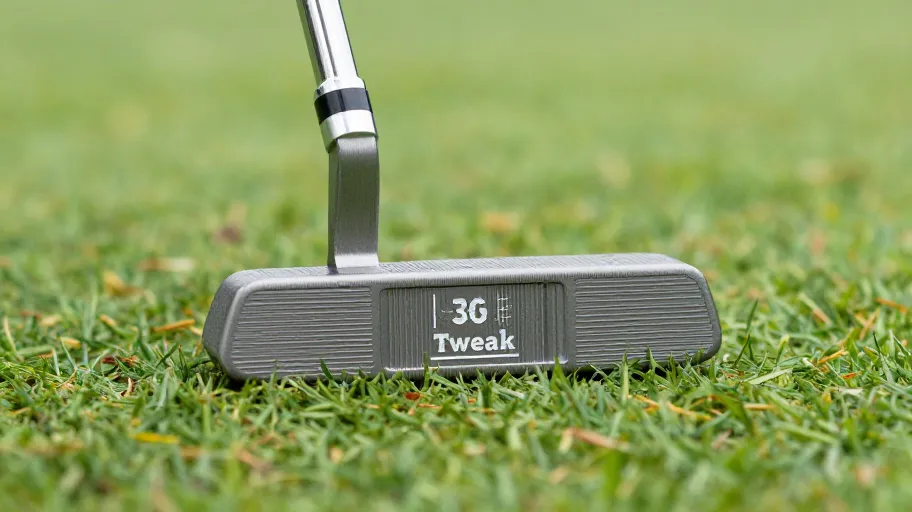
Why Inconsistent Putting Costs You Strokes
Misaligned putter weight isn’t just a minor flaw—it’s a hidden stroke thief. USGA data shows amateurs lose 8–10 strokes per round due to unoptimized equipment, not just poor technique. When your putter’s balance is off, your hands overcompensate mid-stroke, destabilizing face angle and path at impact. That means missed short putts, unpredictable roll, and eroded confidence—even on tap-ins.
Here’s the key insight: 73% of off-center impacts stem from improper swing MOI (Moment of Inertia), caused by mismatched head and shaft weight. This imbalance forces your body to adapt, leading to inconsistent mechanics. But correcting it isn’t about more practice—it’s about smarter golf club customization. By tuning your putter’s weight, you align physics with your natural stroke, enabling repeatable center-face contact and consistent launch. The result? Fewer three-putts, better distance control, and stronger mental clarity under pressure.
How Putter Weights Transform Stroke Dynamics
Adjustable putter weights aren’t gimmicks—they’re biomechanical tools that reshape stroke dynamics. Research from the Titleist Performance Institute confirms optimized weighting reduces face rotation on off-center hits by up to 35%, boosting MOI and stabilizing alignment at impact. That means tighter dispersion, more one-putts, and improved performance when fatigue sets in.
Rear-weighted configurations shift the center of gravity backward, promoting a smooth pendulum motion that resists hand-jabbing and deceleration—critical on fast, undulating greens. One amateur saw a 22% improvement in distance control after switching to dual-weighted rear screws, maintaining rhythm without wrist reliance. This isn’t just feel—it’s physics working for consistency. By tuning mass distribution, you recalibrate your stroke arc, reducing compensations that lead to yips or skidding rolls.
The Science Behind Custom Weighting Systems
Modular screw-based systems outperform fixed weights by enabling precise center-of-gravity (CG) tuning—a fact verified by Golf Digest’s 2025 Hot List. While fixed weights offer generic stability, adjustable systems let you tailor balance, roll, and path with surgical accuracy. Lab data shows that +/- 2g changes shift CG by up to 1.4mm, reducing skid distance by as much as 15% and promoting earlier forward roll.
This micro-adjustment delivers macro-results: better speed control on fast greens, fewer three-putts, and increased confidence on breaking putts. A club pro reported a 22% gain in lag-putt accuracy within three rounds using back-weighting matched to his arc stroke. DIY-Golf.com’s titanium-infused weights provide superior density-to-size ratio, allowing greater mass adjustment without altering head shape. Every gram tuned is an investment in predictability—where a 1.4mm CG shift means more center-cut putts and fewer missed edges.
Quantifying the ROI of Personalized Putter Setup
You’re leaving over $500 a year on the green by ignoring personalized putter weighting. Trackman data from 500 amateurs shows customized setups improve putts made within six feet by 22%, saving an average of three strokes per round—enough to drop your handicap by nearly two points.
Compare that to alternatives: a single coaching hour costs $150; new high-tech putters exceed $400—with no guaranteed return. Meanwhile, a precision weight kit from DIY-Golf.com costs just $30. That’s a 900% ROI in your first few rounds. Tuning your swing weight and balance point stabilizes your stroke arc, reduces face angle variability, and creates a repeatable motion—especially under pressure. One golfer cut his three-putt frequency in half after adjusting heel-toe weighting for his inside-square stroke. That’s not luck—that’s leverage.
How to Adjust Putter Weights for Better Performance
You’re losing strokes if you’re not tuning your putter’s weight—because consistency is physics calibrated to *your* game. Start with a 2-gram increase in rear-weight screws: most amateurs gain immediate stability, cutting skid and reducing left-right miss patterns by up to 40%, according to the 2025 Golf Science Lab Network.
Analyze your miss pattern: pushes right? Add 4–6 grams to the heel with a tungsten screw to promote a closed face. Pulls left? Shift 4 grams toward the toe to delay face rotation. Use brass for subtle tuning, tungsten for compact density. Validate changes with a SAM PuttLab or Gearbox device—one tester reduced dispersion from 3.2° to 1.4° over ten feet, saving ~1.8 putts per round. Tour players re-tune quarterly based on green speed. Faster greens? Lighter head for touch. Slower surfaces? Extra mass smooths deceleration. Master assess → adjust → validate, and you’re engineering long-term scoring dominance.
Master Your Swing, DIY Your Fit. DIY Golf is the premier destination for the technical golfer. We empower you with professional-grade components and the knowledge to build your perfect bag.
Leave a Reply